Category Archives: preparations

Posts about getting prepared for cycle-touring

Our Bikes: Surly LHTs

surly LHT

Our bikes currently live inside, but soon they will be outdoors 24/7!

This post is solely about our bicycles and their components. Read on to find out some gritty details.

Long Haul Truckers are a touring standard.

LHTs are a touring standard.

Frame: We chose to get Surly Long Haul Trucker (LHT) frames. Daisy has a 46 cm, and I have a 60 cm. Needless to say, we don’t fit very well if we try to ride each others’ bikes! LHTs are known in the touring community as very reliable. We wanted to go a little above and beyond the basic model to upgrade some components. Daisy likes to have things, as she says, “bomb-proof.” This will be useful so we don’t have to worry about maintenance mishaps in remote areas. The combination of various upgrades meant it would actually be easier to just custom-build the bikes starting from the LHT frame. Our local bike shop, Freeze Thaw Cycles was very happy to oblige.

Wheels: We wanted sealed bearings, a dynamo hub, and extra sturdy wheels. Justin (from Freeze Thaw) made a custom build – with 36 spokes per wheel. We chose 26″ wheels because that is the standard size for bikes in Central and South America, which will allow us to get new parts as needed. Sealed bearing hubs allow for less maintenance.

Front wheel with Schmidt dynamo to light the LEDs

Front wheel with Schmidt dynamo to light the LEDs

Tires: We are big fans of Schwalbe Marathon tires. This line of tires lasts a loooong time, and they don’t flat easily. In the summer of 2012 we rode about 2500 miles without flats – border-to-border from Mexico to Canada on ACA’s Sierra Cascades route. Also, once we get out of the US and Canada, we expect all sorts of flat-inducing road hazards. I hear cactus needles are bad in Mexico…

Lights: We each got a Schmidt dynamo hub for electricity generation and LED front and rear lights. The rear Seculight plus light is on all the time to increase visibility (for safety). The front Planet Bike light has 3 settings: off, on, and blink. The LHT frame has a nicely positioned eyelet on the front fork so you can mount the front light easily. We’re excited about the lights because you never know when may be caught in the dark. In fact, they sure came in handy when we were cycle-touring the outer banks in late November!

tiny chainringGears: We like it low for those steep hills while fully loaded for touring. Our smallest-largest chainring combo is 22-34, giving a ratio of 0.65. That means three pedal rotations are only 2 wheel rotations. Add that to the fact that the 26″ wheels are smaller than 700C wheels. What you have is a gear that is so low there is no question that walking is faster!

Racks: We went with something very sturdy – Tubus front and rear racks. The outer diameter of tubes on these racks is about 3/8″, and the front rack has a tube that is over 1/2″. That seems pretty sturdy to me. Plus, since they are made of steel, we can get a weld job south of the border, if for some reason they do break. (Note: Aluminum racks are not so easy to weld.)

Bags: Ortleib is the touring standard for waterproof cycling bags. We each have 2 front, 2 rear, a rack pack, and a handlebar bag. When you’ll be on the road for a long time, you end up carrying a lot of stuff. We also wanted space to store 2 or three bear canisters worth of extra food, cooking supplies, and other smellables for when we’ll be several days between towns in remote bear country in Alaska and Canada. We bought our bags from thetouringstore.com, which was relatively inexpensive, and chatting with Wayne to place your order is a riot. Of course we’ll have some bungee cords to strap on other items, as necessary.

Fully loaded bike, with a tent instead of a read rack pack.

Jason’s fully loaded bike, with a tent instead of a rear rack pack.
Honeymoon Recap (Outer Banks Tour)

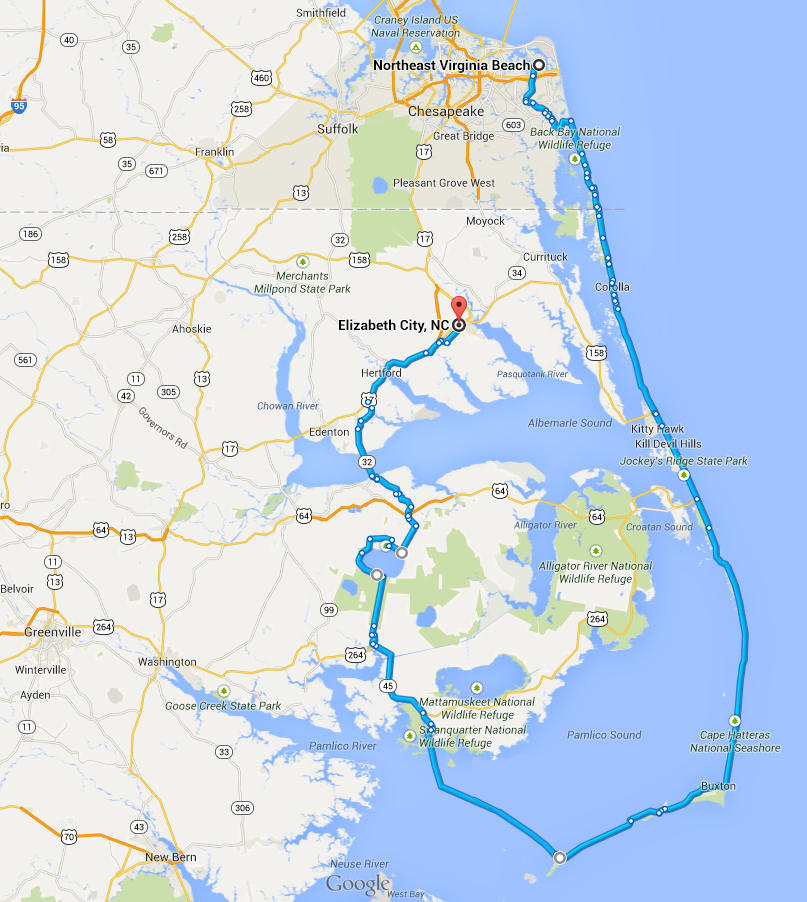
Loop through the Outer Banks of NC; 6 days of riding; 285 mi (460 km)

6-day Bicycle route through the Outer Banks of NC

Bicycle route through the Outer Banks of NC

The trip was a resounding success! We had a great time, our bikes worked well, and we had enough warm gear to keep us going. We saw some awesome sights, including lighthouses and the Wright Brothers National Memorial. And we had quite a few adventures, like getting picked up by the Currituck Sheriff on the beach highway, the Sisyphean sand plows, and the (almost) never-ending muddy wildlife refuge road.

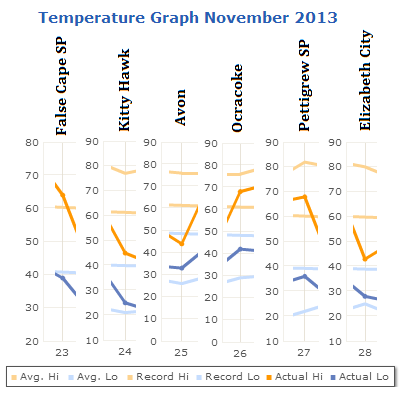
We knew we needed to head south from PA if we were going to have a pleasant bicycle tour in late November, but we were a little surprised by how cold the weather actually was in the outer banks!


Daily temperatures on our trip - colder than average!

Daily temperatures on our trip – colder than average!

On half of the days, the daily high was actually close to or below the average low. Brrr. But this ended up being useful, in the fact that we could test our cold-weather gear. We wanted to do this anyway, since we are planning to start in Alaska in May, and depending on the year it is chilly. We learned that we have enough warm things for our cores, but could definitely use a few items…


#1: Thin wool gloves – Our hands were warm inside the bar mitts, but wool gloves would have been better for wet conditions

#2: Neoprene booties – Our rain covers for our shoes did not hold up, and once our socks got wet our feet got cold. Good booties could remedy this problem by keeping out the cold and wind.

#3: Warm waterproof hiking boots – Our SPD-style riding shoes are actually summer shoes with a lot of mesh for breatheability and contain vents in the bottoms. These vents were great at letting in water! So, for those days that are both quite cold and really wet having some hiking boots would be great to keep our feet both dry and warm. Also, it would give us an extra pair of shoes when one is wet, and for hiking in general.

#4: Flat pedal attachments – We’ll need some pedal attachments to allow use of “normal” shoes if we wear our hiking boots when riding.

In other lessons learned… we definitely will be more careful with our use of Google Maps! There are a lot of roads on map services (and in GPSs) that are not very driveable – or rideable). This makes more of a difference when the road turns muddy, and the winter days are short. Speaking of which, this was our first winter-season tour, and we were caught off guard by how early it got dark! If we weren’t set up to camp by 4:30 or so we were in for a cold dinner — at around 5 PM it got dark.

The final lesson was that we need to get used to our new bicycles and the riding postures. I (Jason) started having knee pain part way through the trip, and it got so bad I couldn’t finish the ride back to Virginia Beach on the last day. We think it was brought on by a change in riding posture – our new bikes are set up to focus on the hamstring muscle group and pulling, as opposed to the quads and pushing – in combination with a lot of hard mashing into the wind. My knee is doing much better now, though, and this is good, since I commute via bicycle to work every day.

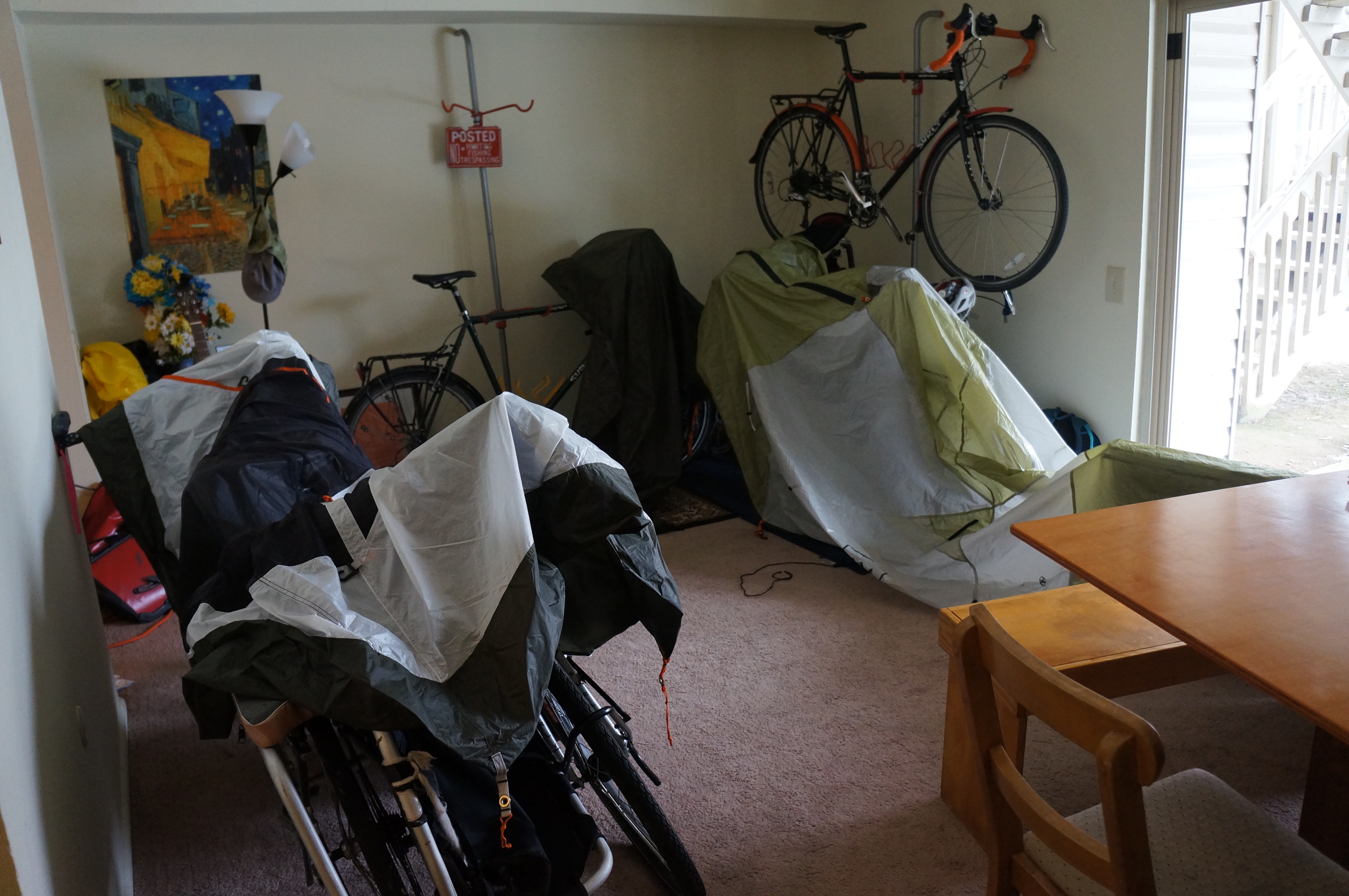
Drying the tent and rain fly.

Drying the tent and rain fly after returning home.

Honeymoon – Day 6

Pettigrew State Park, NC to Elizabeth City, NC: 58 miles

Route for day 6

Route for day 6

We woke up to a very cold morning. Hot water for oatmeal and coffee/cocoa lured us out of the ice-crusted tent. While Daisy got the tent packed up, it was my turn to hit the hand dryer over and over to dry out my shoes. When we were both sufficiently dry and decently warm, we stuck a hand warmer by the toes of each foot and got on the road.

No rain today! We had some headwinds, but it was much much more calm than the previous day. Also, our route was great – back roads the whole time, except when we had to cross the bridge over the Albemarle Sound. After the bridge we found a picnic table to eat lunch at. It was nice to sit in the sun.

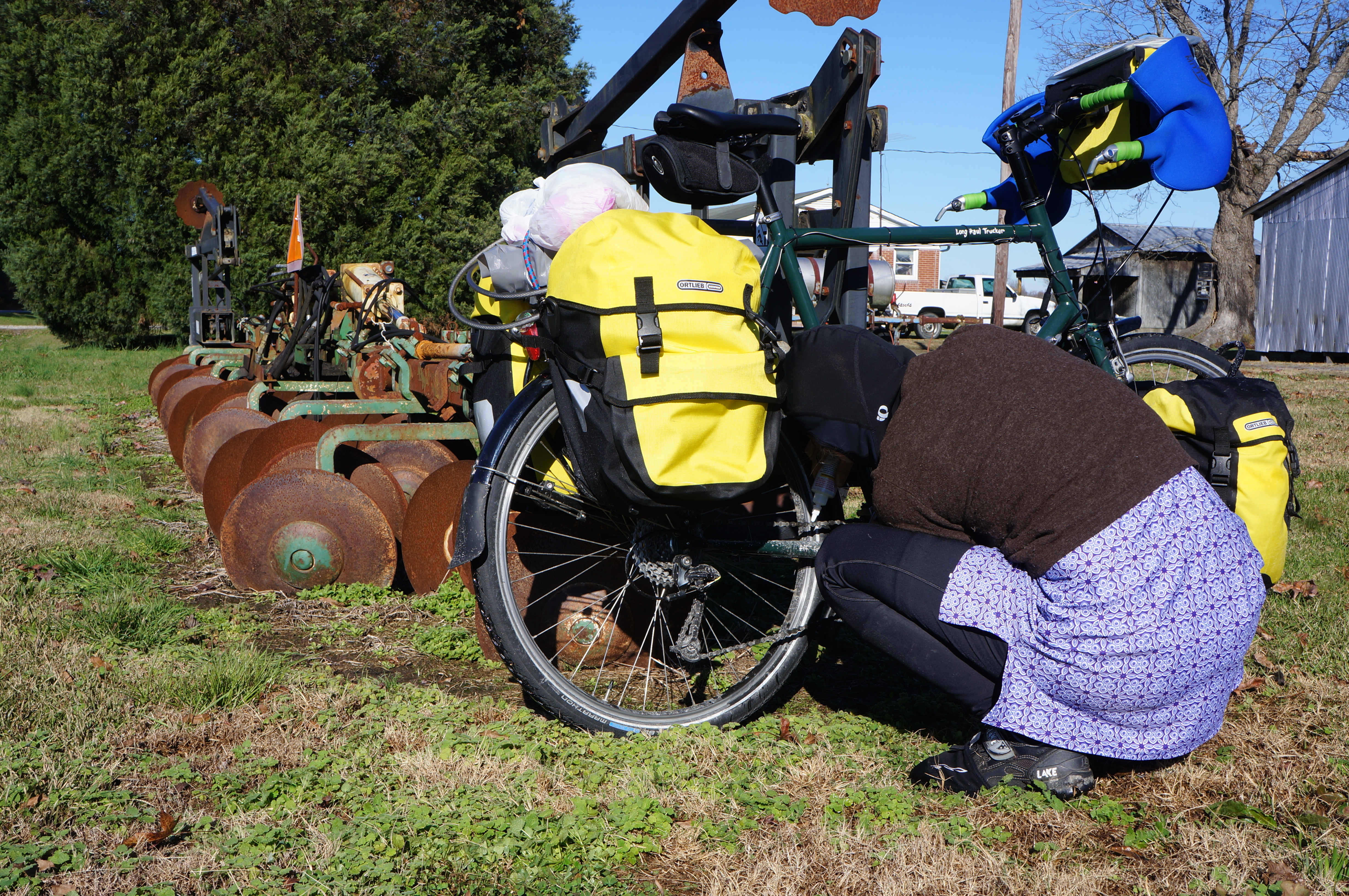
To make it a little easier on ourselves, we decided to check our tire pressure and top it off. They weren’t too low, but we did put in an extra 20 psi or so. This was definitely noticeable with the fully loaded bikes. Since we didn’t install kickstands yet, we needed to find something to lean the bikes against — luckily this yard had some farm equipment.

Convenient spot to lean the bike for maintenance

Convenient spot to lean the bike for maintenance

However, the ground was still quite wet. A lot of the land was still swampy, although as we moved north we saw less standing water.

Trees in the swamp water

Trees in the swamp water

Peanuts!

Peanuts!

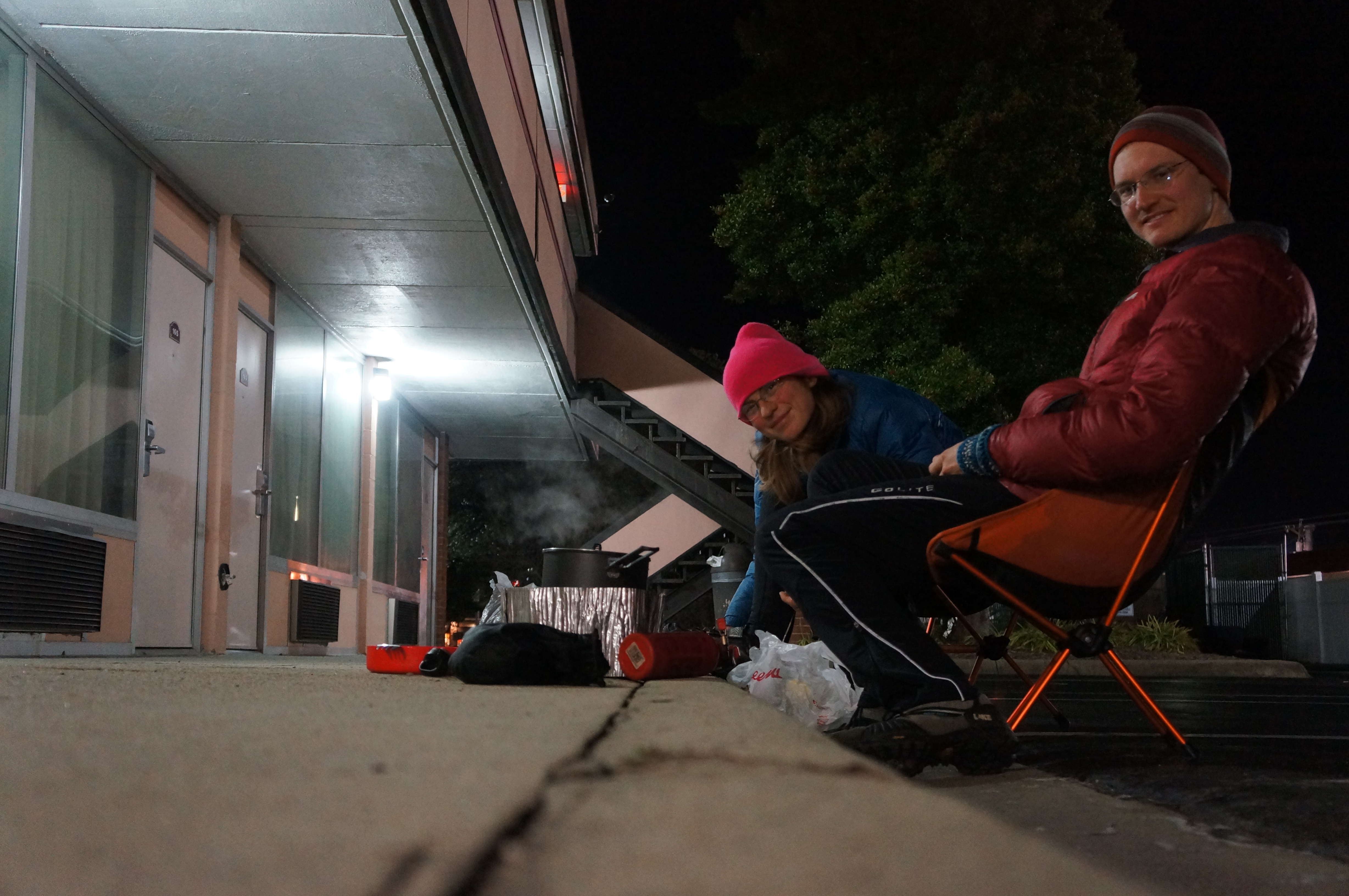
We found our preferred hotel as we rolled into the outskirts of Elizabeth City. The employee that checked us in looked like a high schooler that was getting paid to be on Facebook. The room was sufficient, and we cooked a delicious meal of rice, veggies, and sausage in the parking lot. While the meal was cooking we finally broke out our camp chairs, after carrying them all week. We shelled and ate some peanuts as an appetizer.

Cooking in the parking lot

Cooking in the motel parking lot

Honeymoon – Day 5

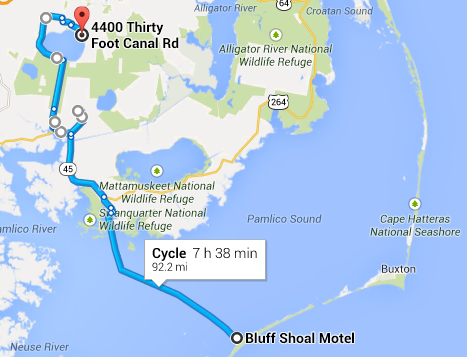
Ocracoke, NC to Pettigrew State Park, NC; 62 miles

Route for day 5

Route for day 5

What a day!  It was supposed to be a nice, easy 36 miles to the state park.  We failed to notice, however, that a few of the roads that Google sent us on were unnamed.  The adventure started even earlier though, around 2 am.

The storm that blew in over the Outer Banks the night before caused the power in our motel to go off around 2 am.  Sometime later we got cold from the resulting lack of heat, and had to resort to using our sleeping bags to stay warm!  In the morning we had to be at the ferry before 7am, and so had to get prepared while it was still dark out. Without the lights we had to pack up using our headlamps in the motel!

The ferry had generator power, so it was still on schedule.  The woman selling tickets told us there were 7 inches of standing water in her lawn.  Yikes.  It took 2.5 hours to ferry back to the North Carolina mainland, and the rain continued.  It would continue all day.

We rode for about 2 hours into a strong headwind and rain.  Our directions sent us down a road with a sign: ‘road ends 1 mile’.  Uh oh.  Foolish us, we pushed into the wind anyway, hoping the sign was wrong.  It wasn’t – we reached the end of the road and found only a farmhouse and a large building with tractors.  We stepped in for directions and met Reed and Randy, two cotton farmers.  They invited us in out of the rain and peppered us with questions about life on bikes.  Reed even helped us plan a route to the state park we were aiming for, and gave us a new map.  Best of all, they gave us a big bag full of raw North Carolina peanuts.  I’m not sure how Jason fit the bag into his pannier, but he did.

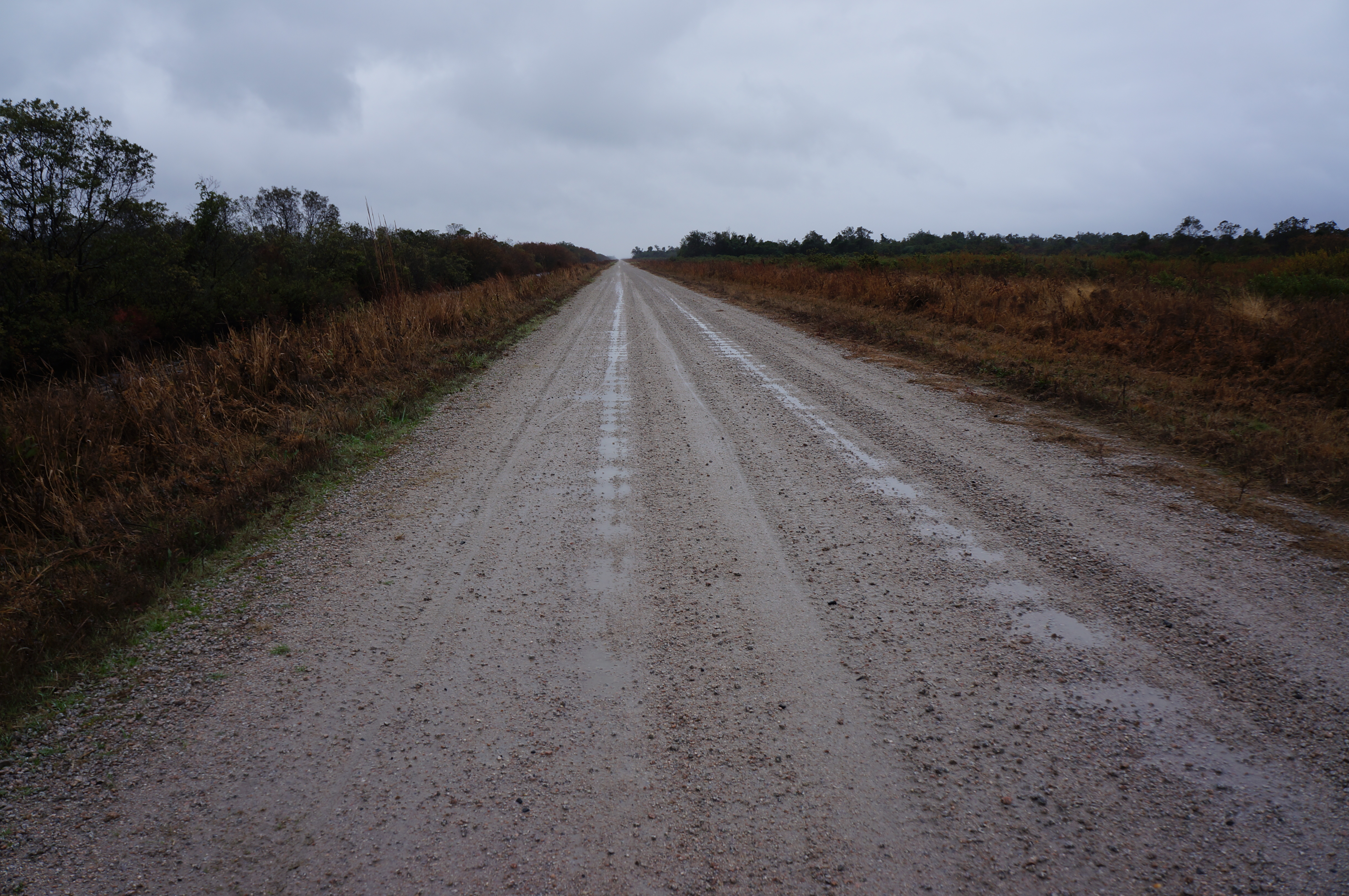
As we left the rain started again, and we still had a long way to ride.  10 of the remaining miles were on a dirt/sand/gravel road through a wildlife refuge.  On another day it would have been beautiful, but on that day it seemed to go on forever, and we were exhausted when we finally reached the edge of the lake we were aiming for.

10 slow, difficult miles into the wind on this muddy road nearly finished us.

10 slow, difficult miles into the wind on this muddy road nearly finished us.

At the end of the mud road we met a gravel road, and luckily a park ranger who provided us with yet another map to find the campground.  We didn’t know it at the time, but there were still 20 miles left to ride.  We were already exhausted, but the promise of a picnic table, restroom, and spot for the tent kept us pushing as the temperature dropped.

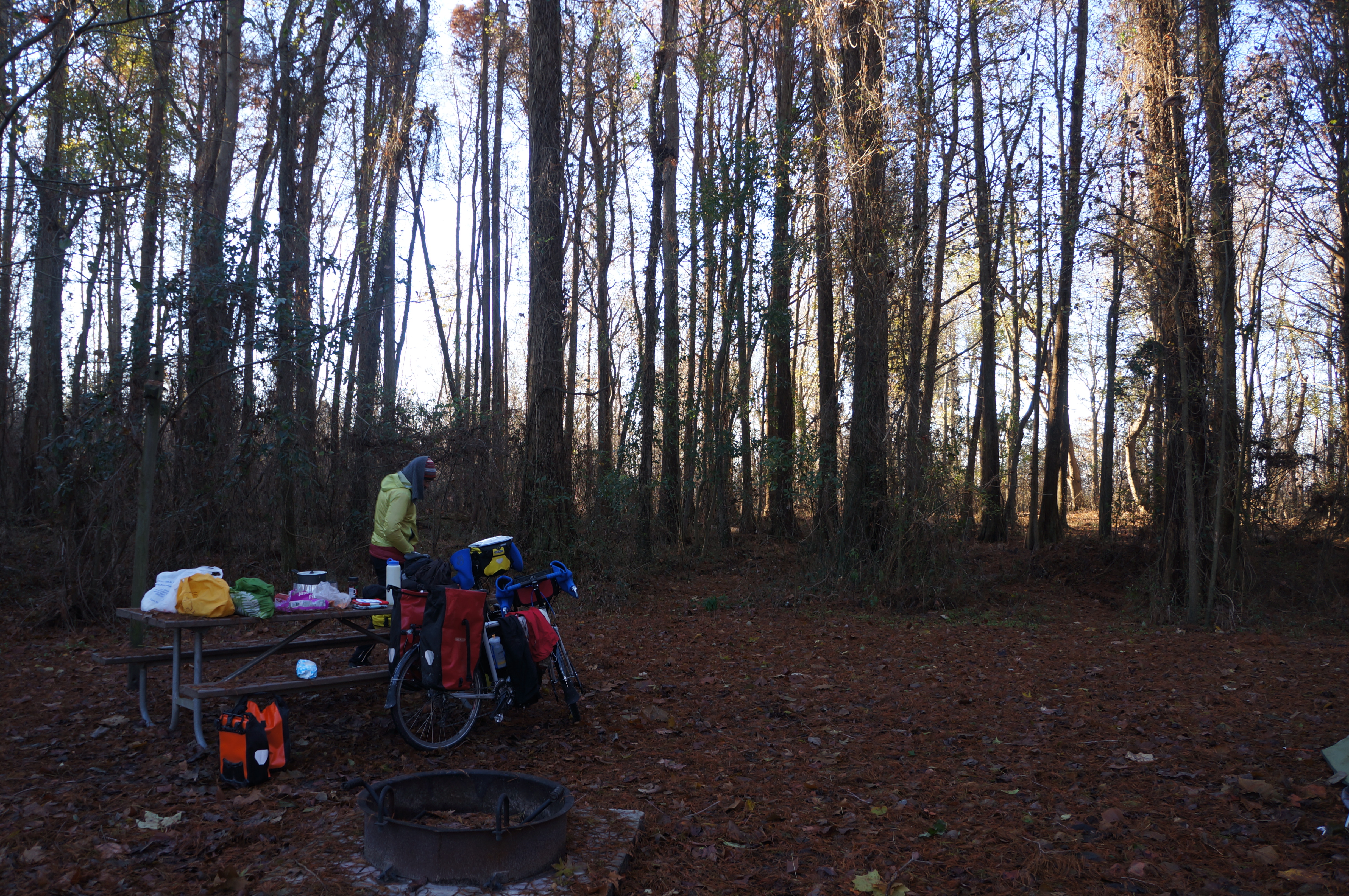
We arrived at the park at dusk – just in time.  The ranger was very nice and helped us find a sheltered campsite.  I spent nearly half an hour in the restroom hitting the hand drier over and over to warm up and dry my shoes out.

Our campsite at Pettigrew State Park.

Our campsite at Pettigrew State Park.

We were so tired that we didn’t even have energy to read after climbing in the tent.  Honestly, we were asleep at 7:30.