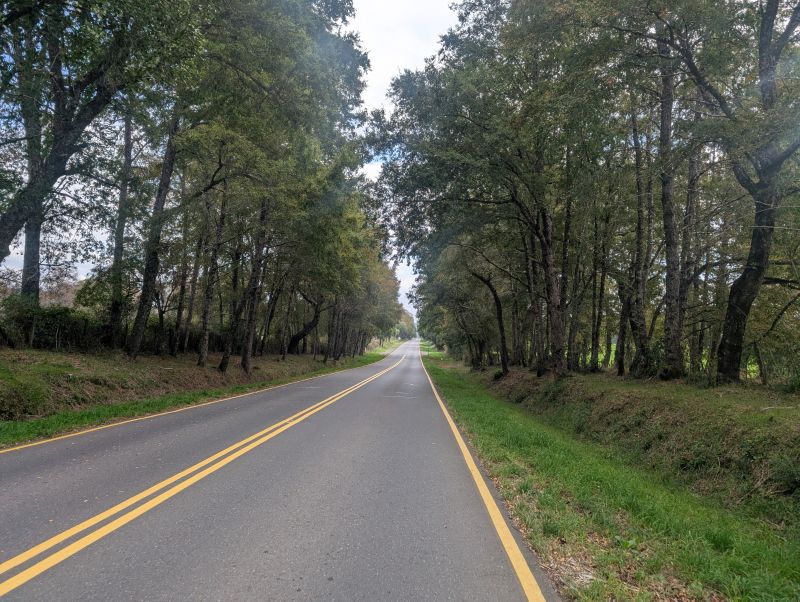
Category Archives: camping

Posts about where we stayed the night.

Illapel to Ovalle: From chinchillas to vineyards

After finishing the route of the tunnels we continued on interior roads, heading north as always. We really enjoyed this section. There was a lot of climbing, a lot of cacti, and beautiful places to stay.

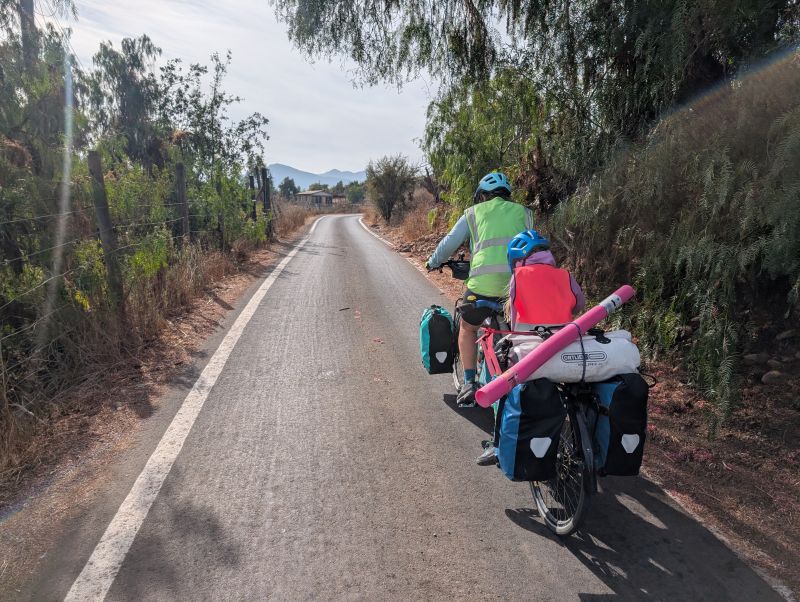
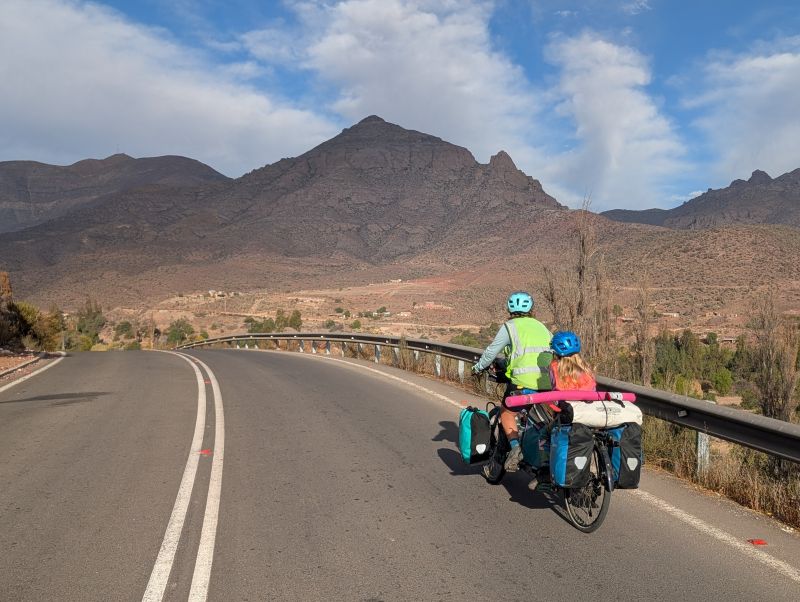
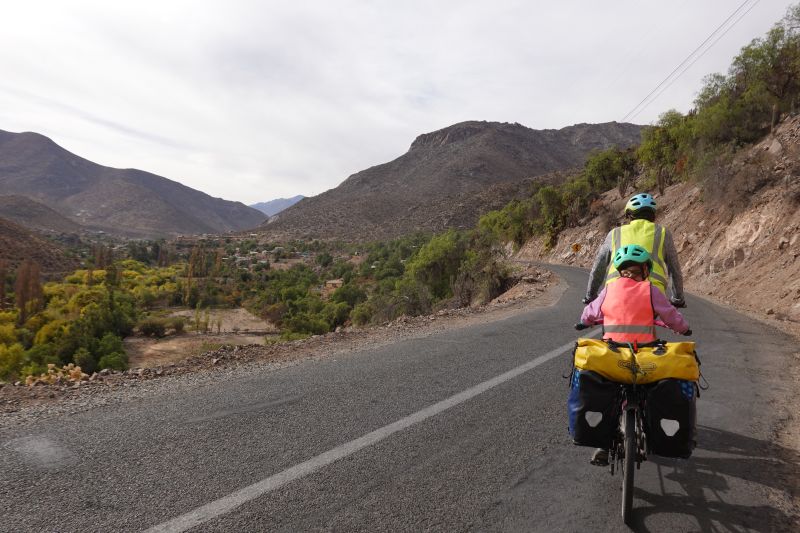
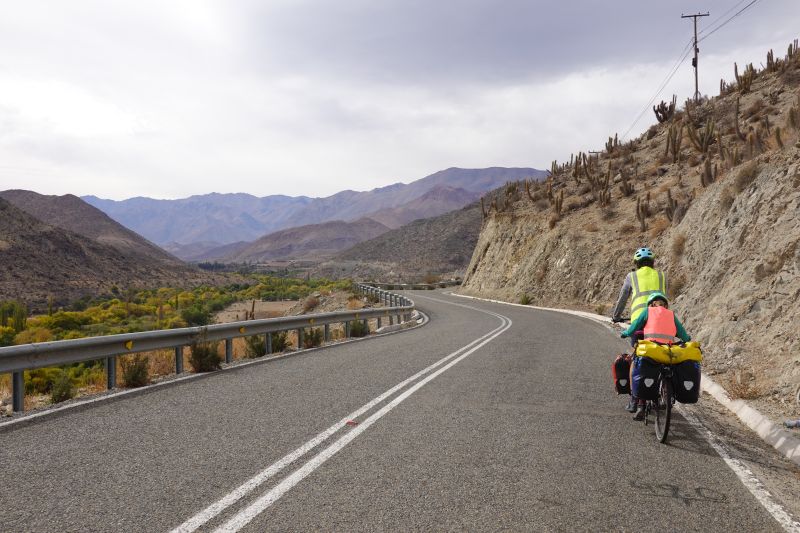
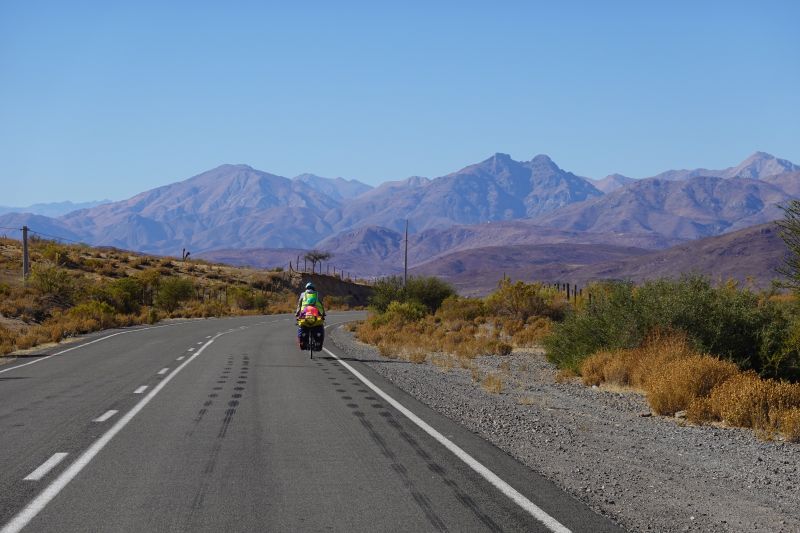
Riding north out of Illapel
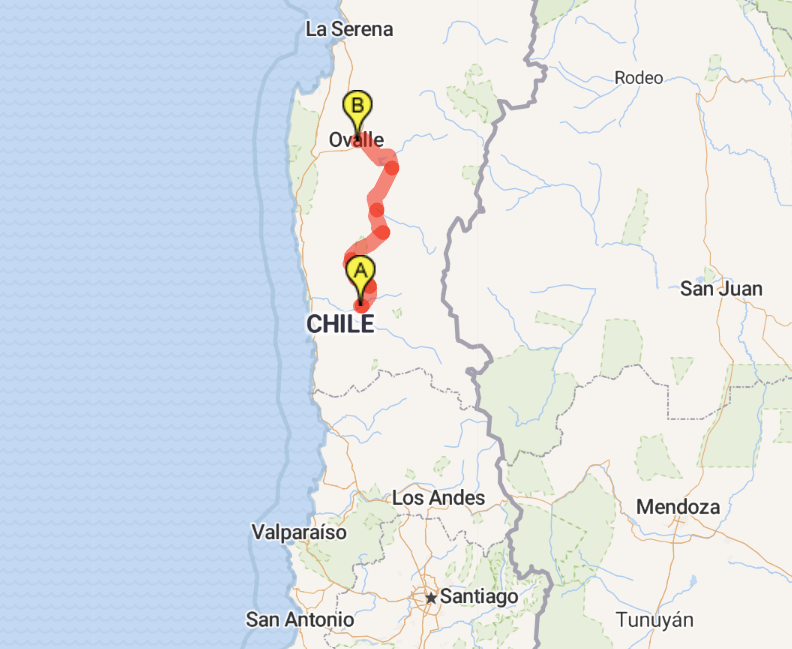
Our route from Illapel to Ovalle

Day 146: Illapel to Reserva Nacional Las Chinchillas (18 km / 11 mi)

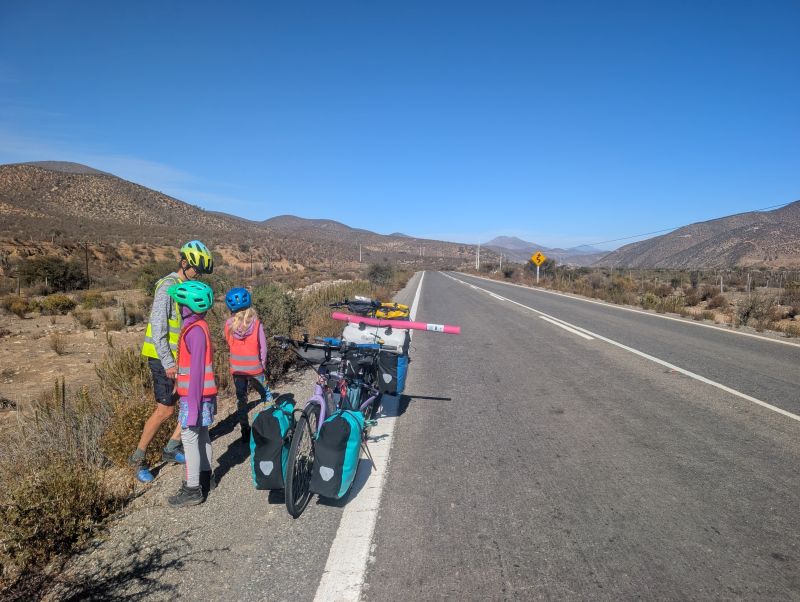
This was a short day, since we planned to stay inside the National Chinchilla Reserve. We lazed our way through the morning at the friendly Sherpa Hostel, then easily got out of town. The road wound through several small settlements along the hillside. Just when we were finally seeing the last of the settlements we realized that we had forgotten to refill our cooking fuel!

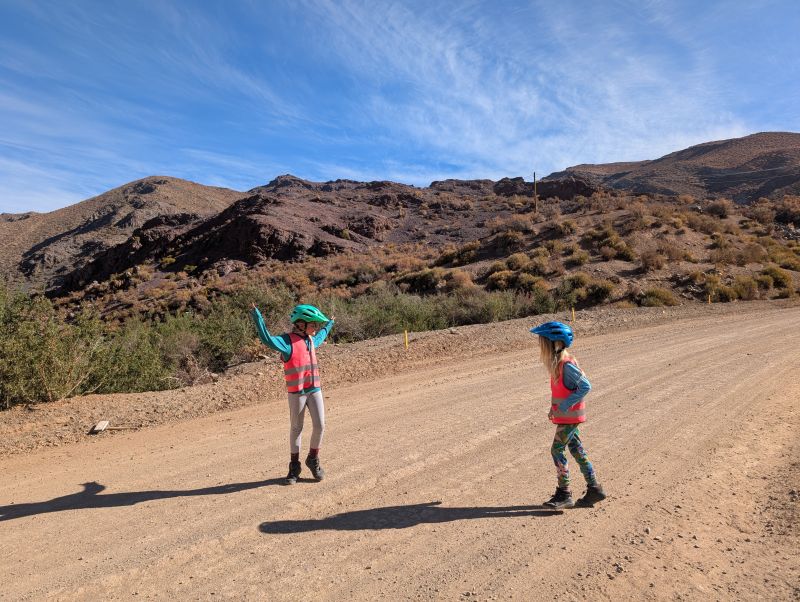
We use gasoline for our stove, and we expected to need it for the next couple nights. After a quick check of the maps we decided to send Jason back 4 km each way to the gas station while the girls and I sat in the shade and waited. It worked out! Apparently Jason had a much more adventurous half hour than we did. He got yelled at by some drunk guys, had a good chat with the guy working at the gas station about his sister who lives in Miami, and then got invited to get coffee by a passing cyclist! He had to turn down the invite though, since we were waiting. We passed the time drawing pictures in the dirt with a stick.

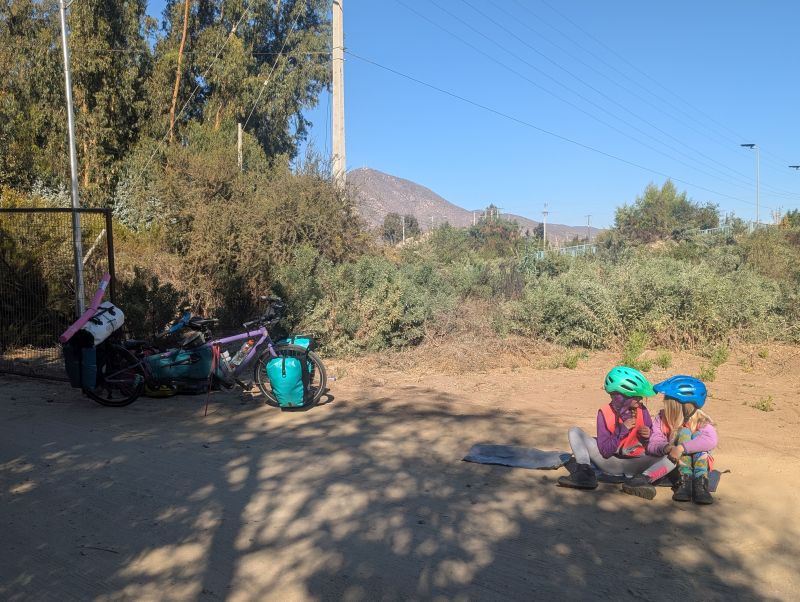
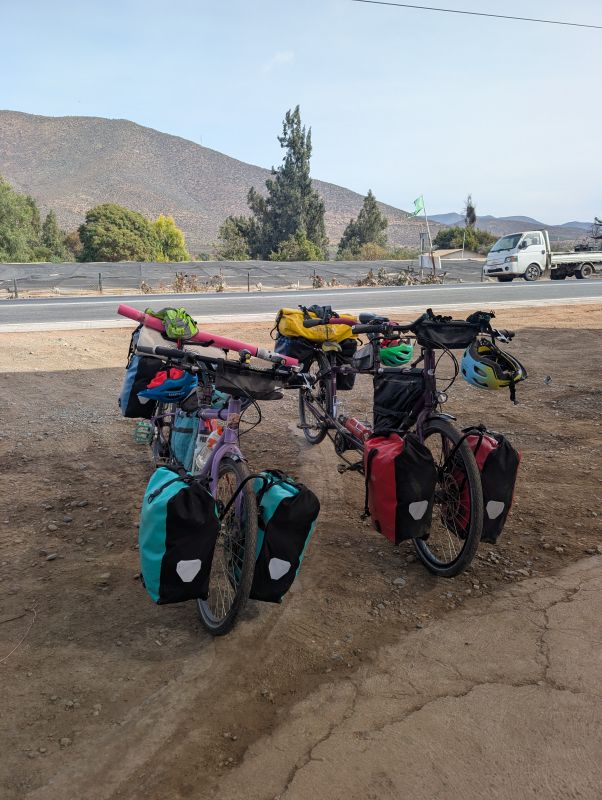
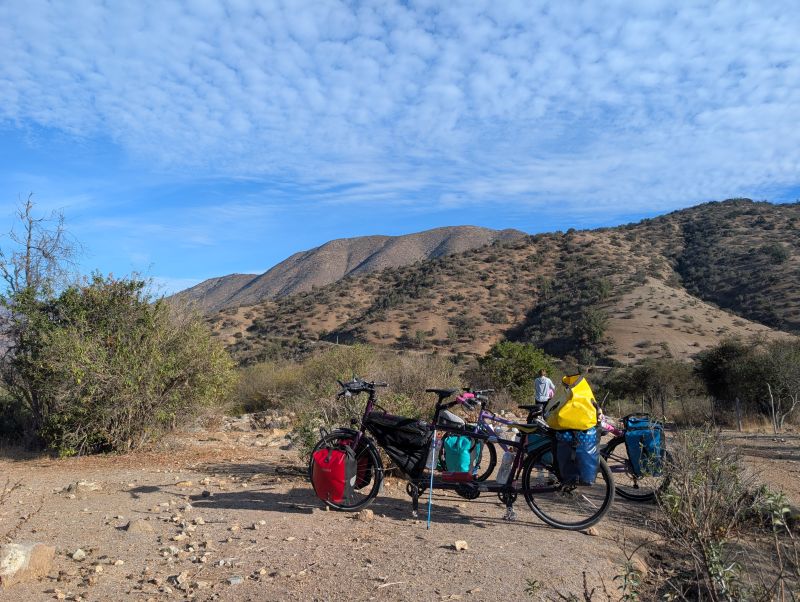
Rest spot, waiting for Jason to go back to get fuel

Back on the road we spent the rest of the day climbing gently up an increasingly dry valley. Jason and I remembered the valley from eleven years ago. Back then we took a slightly different route, skipped the Chinchilla reserve and tackling a long, challenging dirt climb. Today we kept left at the fork to stay on pavement!

Desert pit stop

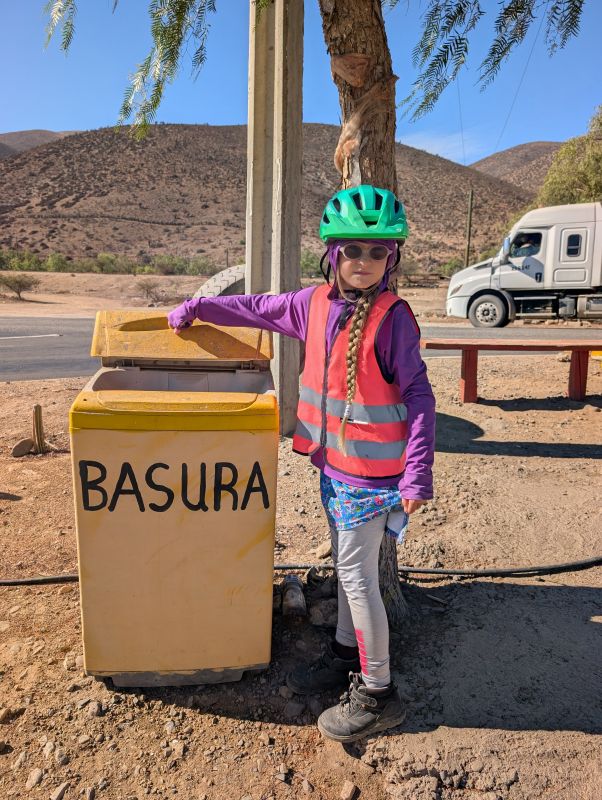
We stopped at a little convenience store to buy some avocadoes and were very amused to find several garbage cans fashioned out of old wash machines.

Just up the road we reached the Reserve. As we turned in, the park ranger came down to greet us. He was so friendly! We had called and emailed ahead of time to ask for space in the ‘cabin’ that we had read might be available. We had no idea what to expect. It turns out it was a lovely two-room cabin with a full kitchen, bathroom, and dining area. It was lovely, and right next to the visitor center. After we dropped off our gear we were given a tour where we learned about chinchillas and the reserve.

Chinchillas are extremely adorable desert rodents that were once highly prized for their extremely soft fur. They were hunted nearly to extinction in the 1910’s, when over 20 million were killed and turned into jackets and comforters. Today they live in a much smaller area than they used to and in dramatically smaller numbers. About 14,000 live in the reserve. 6 (that wouldn’t survive in the wild for some reason or other) live in the reserve’s ‘nocturama’, dark display area, and we were able to see them. We spent the afternoon taking a little hike to learn about the desert plants and then relaxing in the cabin.

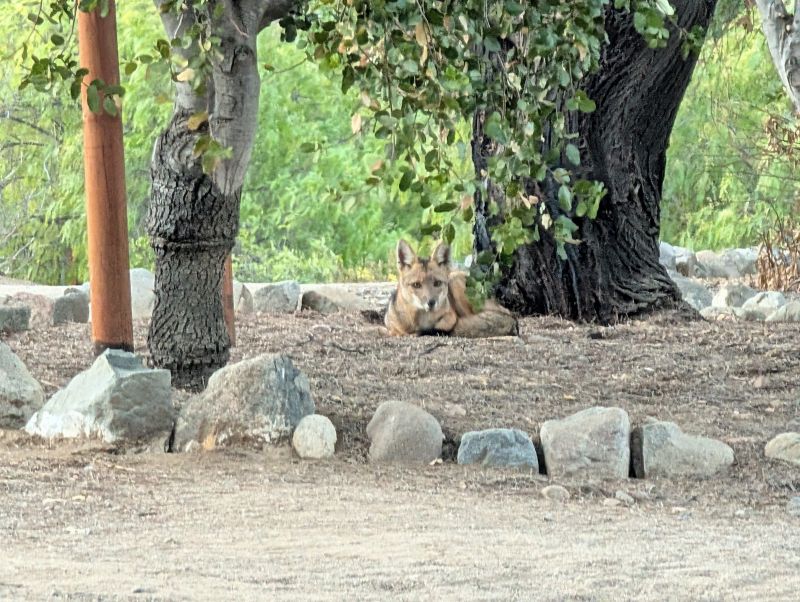
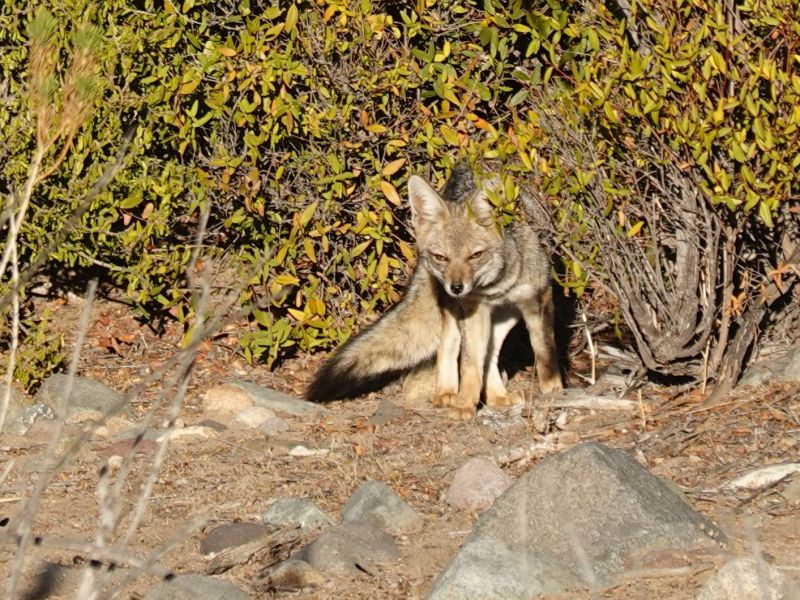
When 5pm rolled around so did the resident foxes. We watched them jump and play, then laze about as sunset neared. The rangers left to go home. It was just us all night in the Chincilla Reserve! What a special experience.

Evening fox time
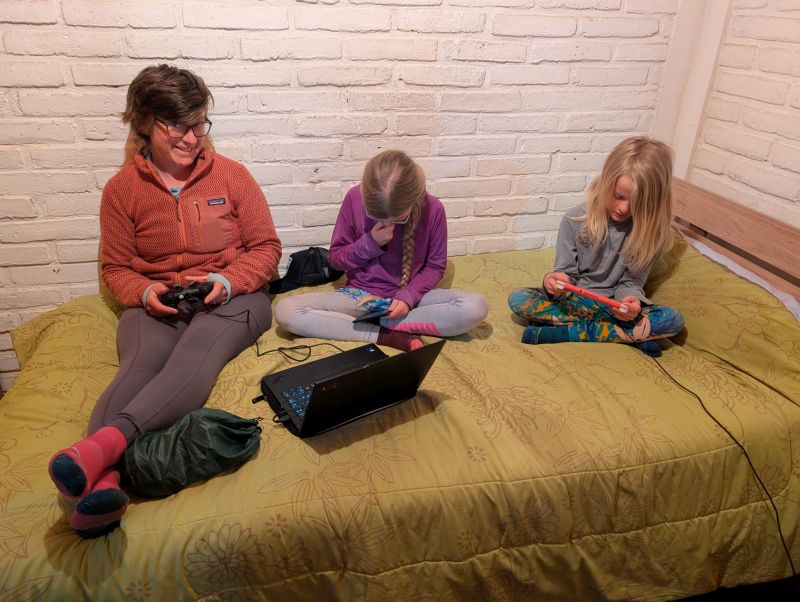
And then some video games and reading

Day 147: Chinchilla Reserve to Wild Camp near Los Pozos (36 km / 22 mi)

I swore I heard music in the night at the Chinchilla reserve, even though that was impossible. Maybe it was a ghost? In any case, the day dawned warm and sunny. The rangers were happy to see us, and chatted more as we got ready for the day. I got the feeling they don’t get many visitors, so they were thrilled when we showed up excited to learn about everything. Here are a few things we learned about:

  • The native people in the area never developed metalwork, likely because of some slow-growing trees with extremely strong wood.
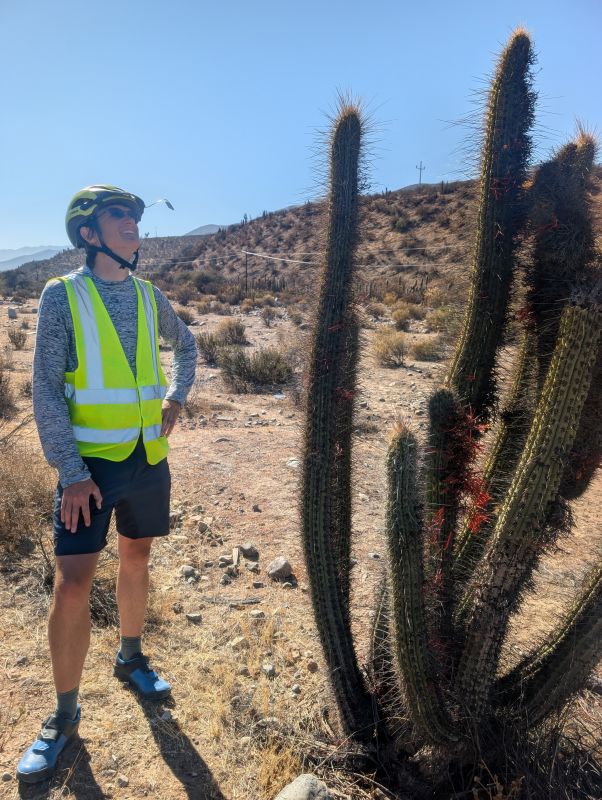
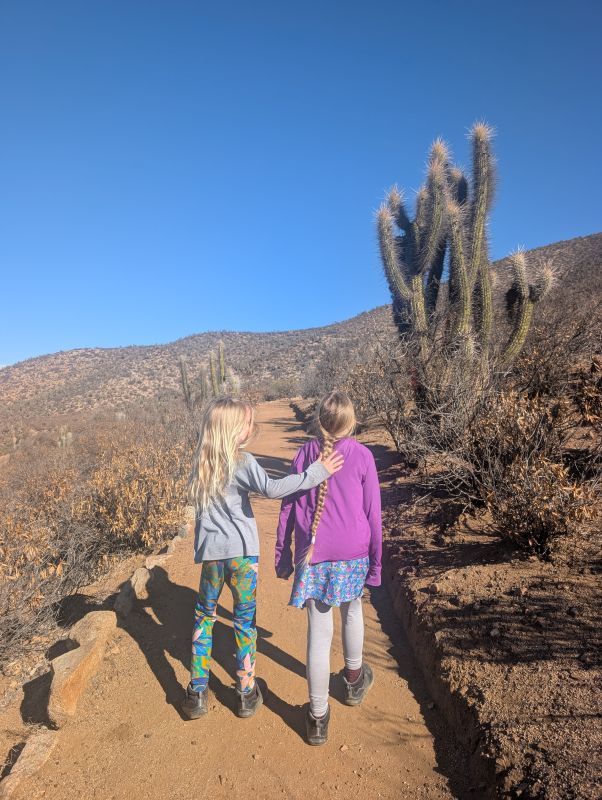
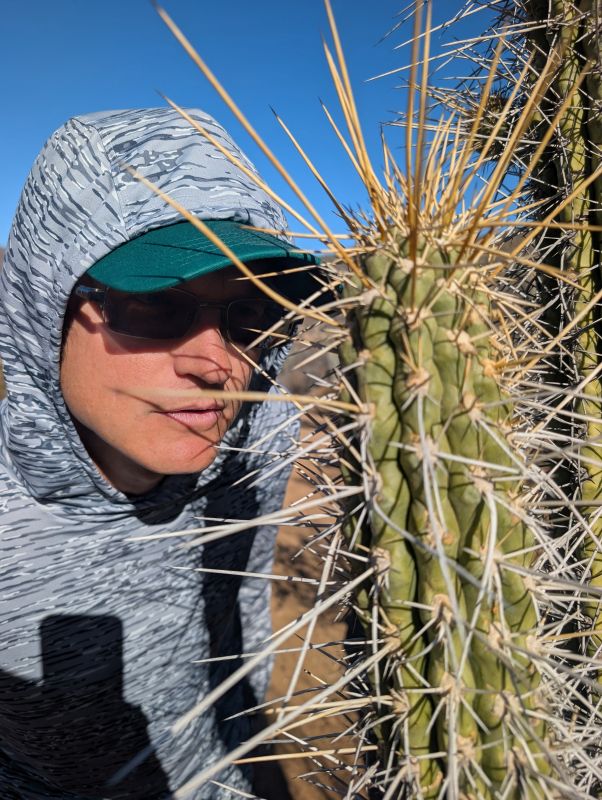
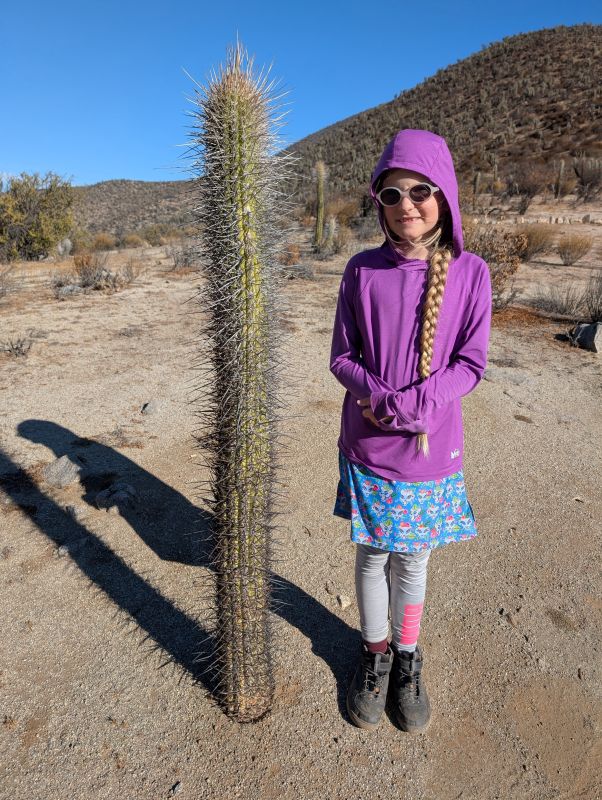
  • A cactus that is Jason’s height here is about 80-90 years old
  • The prickly pear cacti we saw the day before were planted by a US traveler named Emmy that stayed at the Chinchilla reserve for a month and hitch-hiked back and forth to town.
  • The red flowers we see on cacti are in fact a parasitic plant. They use the cacti for supplies and birds as a means to spread.

The climb started immediately as we left the chinchilla reserve. It was a sneaky climb – it started off gradual and lovely and slowly got steeper and steeper until the very top. I didn’t eat properly and ‘bonked’ near the top. Quite simply, I just ran out of energy. We sat on the side of the road and ate protein bars and drank water.

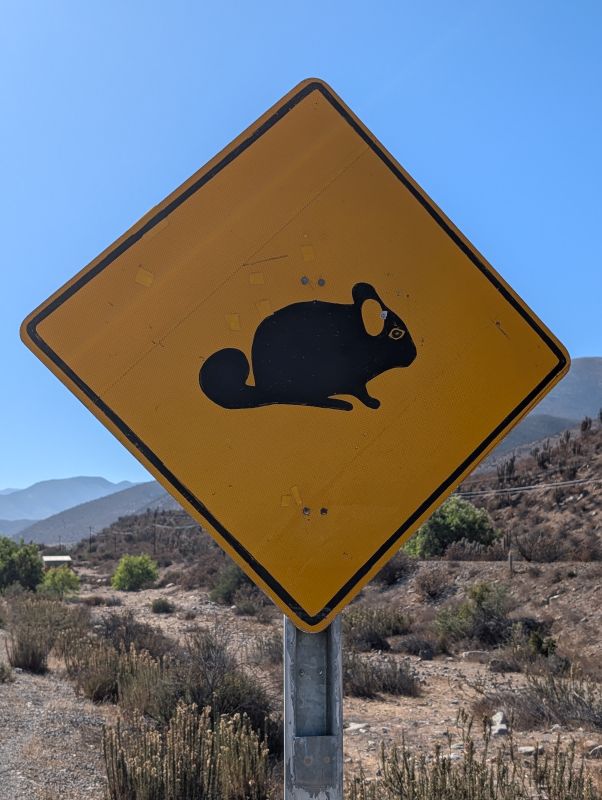
Through the park there were signs to not been your horns, because the chinchillas are nocturnal
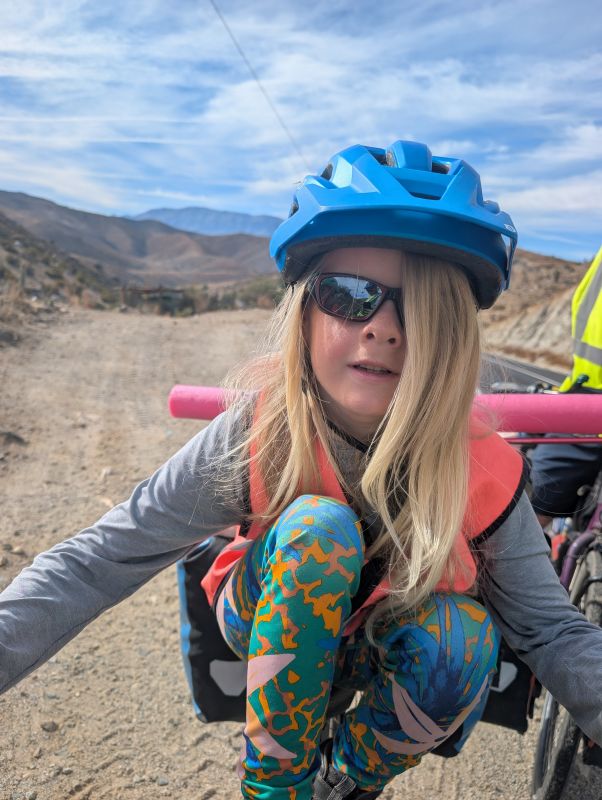
Luckily this isn’t how she normally rides
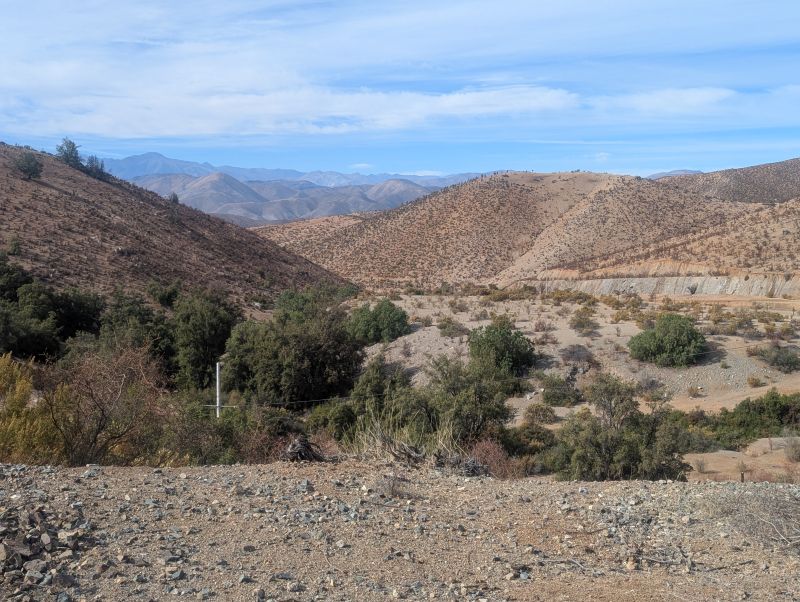
Chile is a land of hills and mountains

Finally the climb ended. It went straight from ‘steep and brutal uphill’ to ‘steep and brutal downhill’. At the very top a transport truck had broken down. We were amused that even diesel engines struggled on the climb. His buddy, in another transport truck, had just arrived to help. He waved us past as if we were at the finish line of a NASCAR race. We laughed and zoomed down the hill.

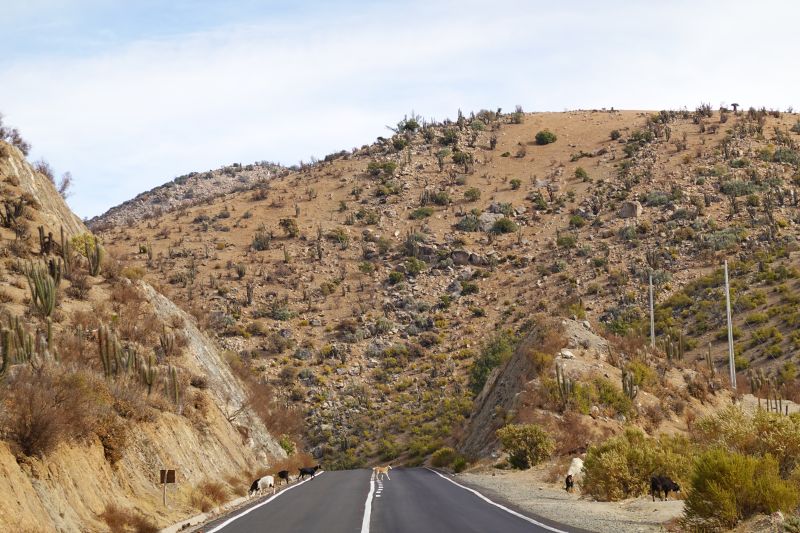
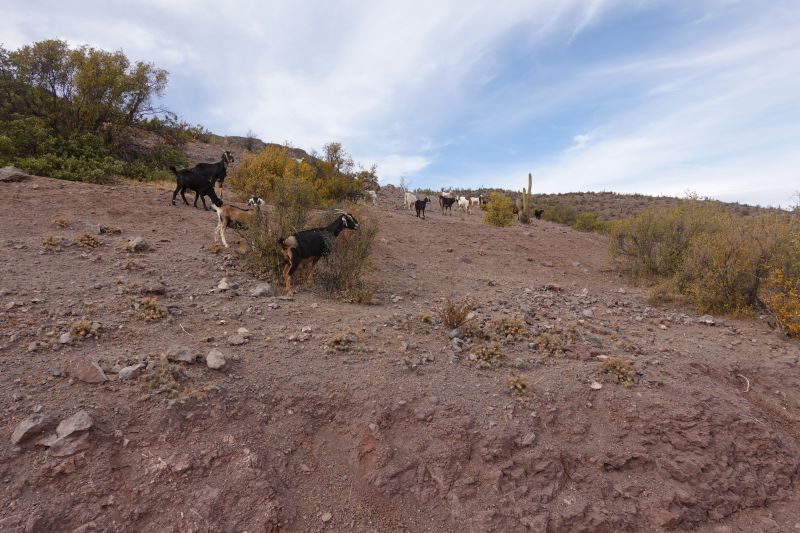
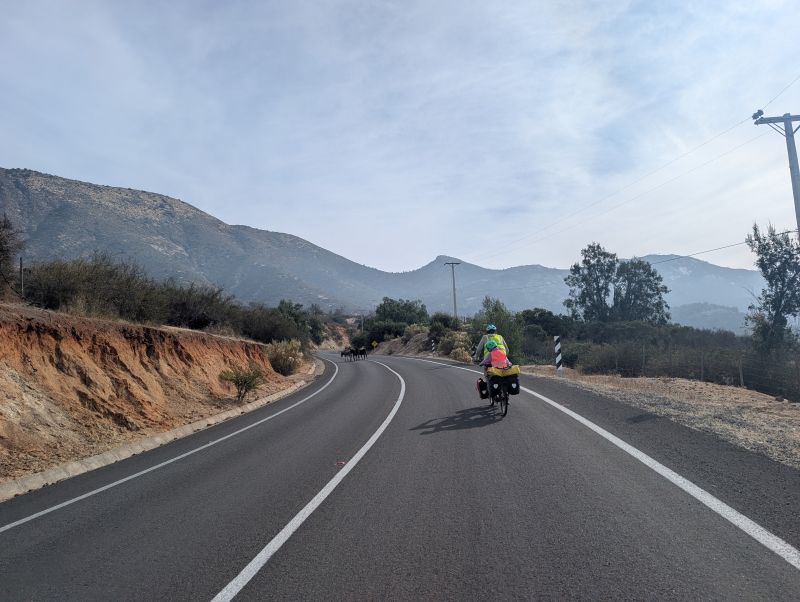
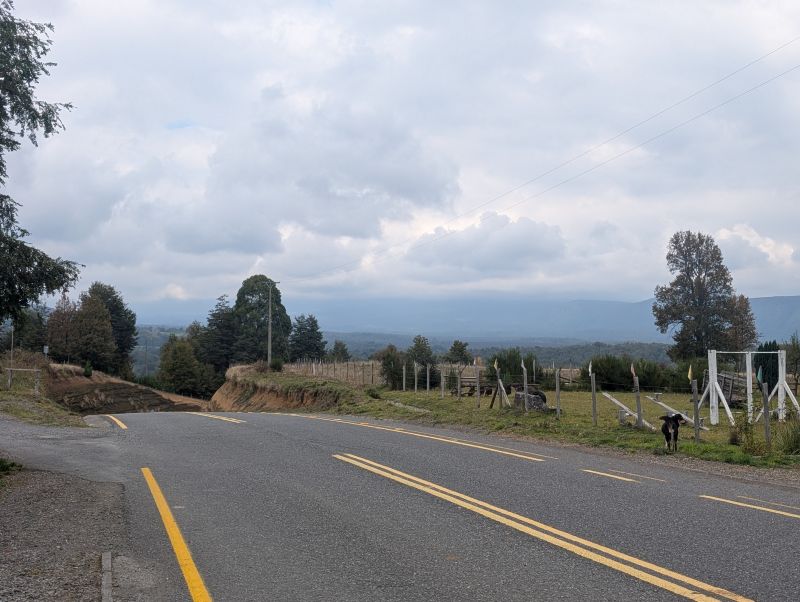
Goat crossing

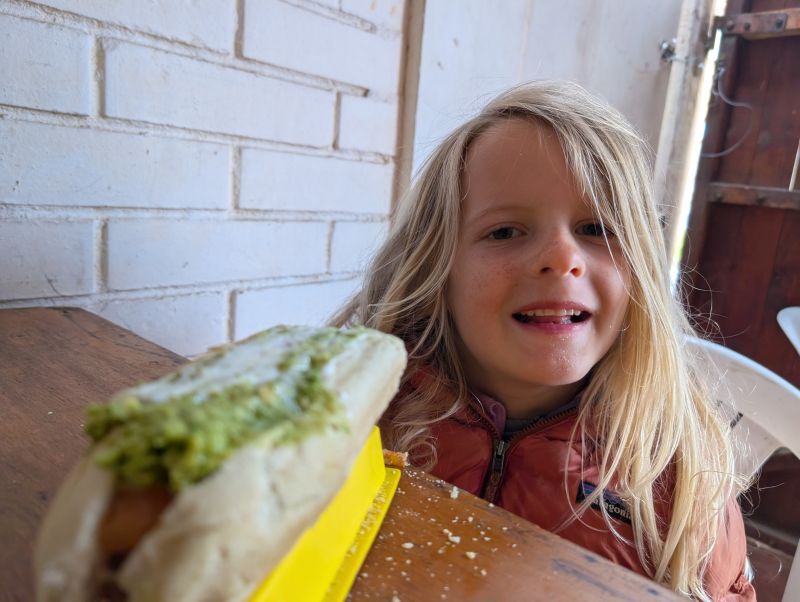
As we descended we noticed houses scattered along much of the valley. The land did not seem hospitable, yet there they were finding a way. We passed a minimarket about halfway down, but were going too fast to try and stop. At the bottom we found another, that was also serving completos. That was our stop!

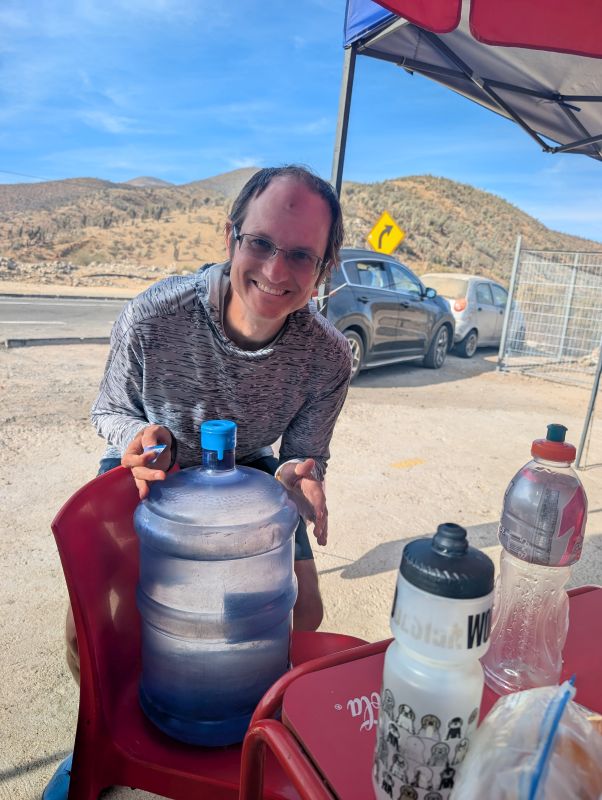
We were starving and ordered a completo each. A couple of kids were hanging out in front of the market, playing wildly in a small push car. After we ate we asked after accommodation nearby and the grown-ups in charge said we should just go to the next town, since the next pass was ‘gentle’. Yeah right! They meant well, but we were in no shape to do another pass. Instead we bought dinner supplies and a giant jug of water, refilled our various water containers, then headed out to find a camp in the desert.

Jason’s water “bottle”
A flapping her wings as we fly along in the afternoon

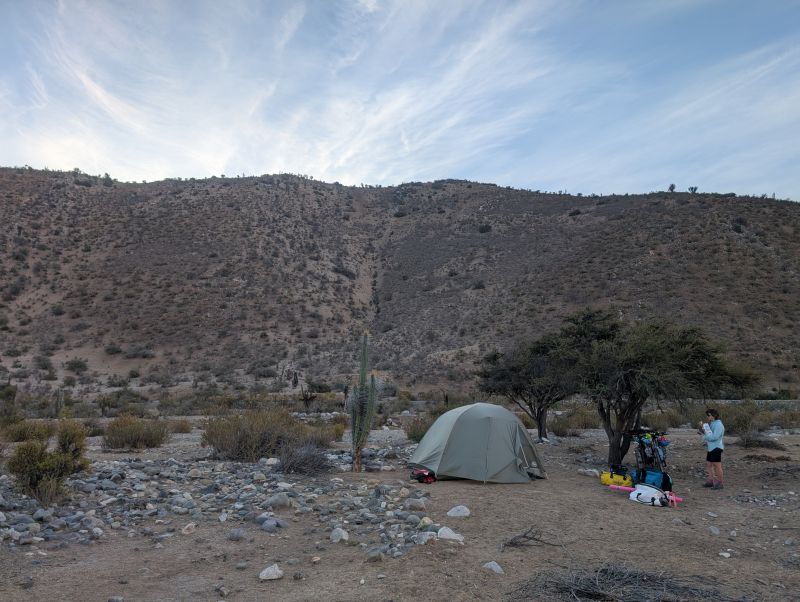
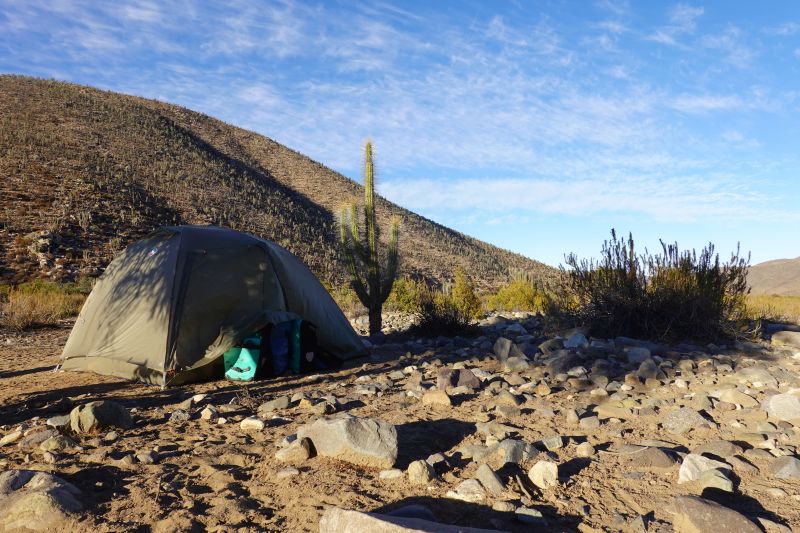
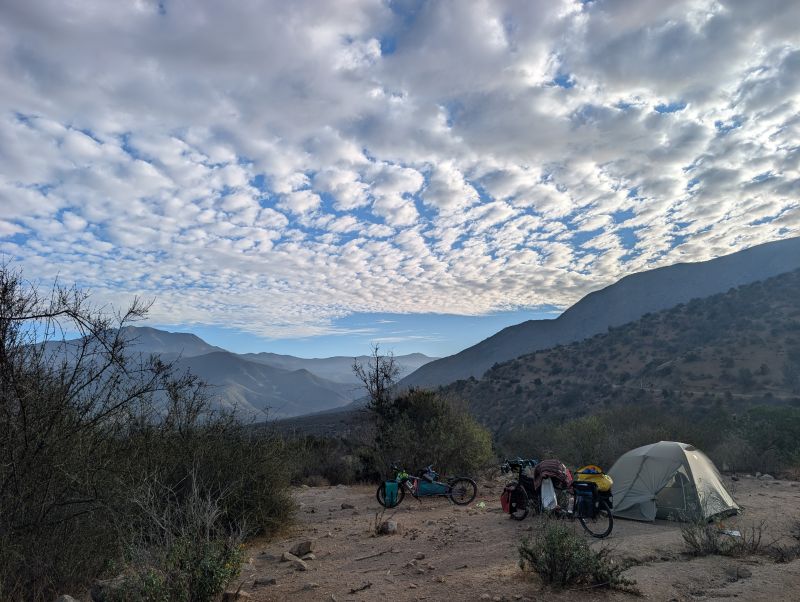
The road up the next valley was lovely and mostly flat (at first). It passed some few houses then we were alone in the desert next to a dry wash. We waited until there was no more fence next to the road then we walked out to find a spot for our tent. Jason and the girls found us a lovely flat spot next to a cactus and by two trees. We set up camp and deeply enjoyed the desert calm.

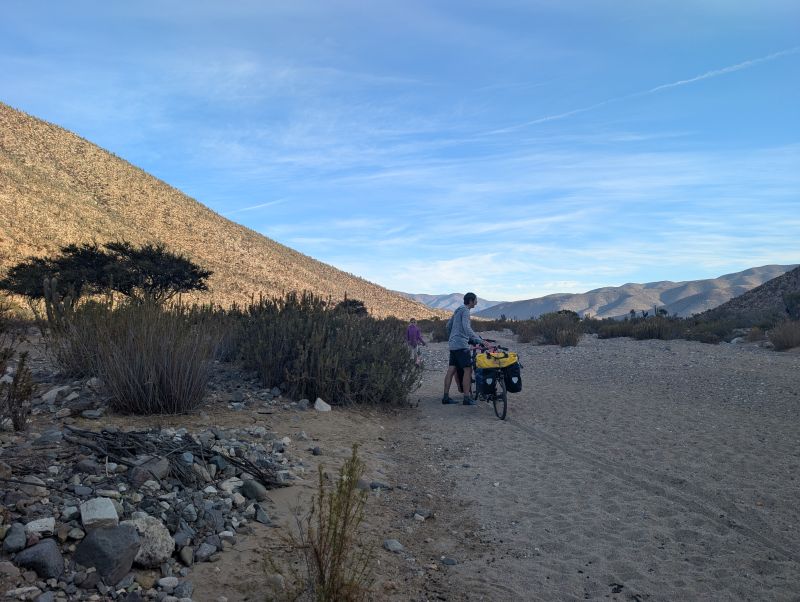
Heading to the wild camp
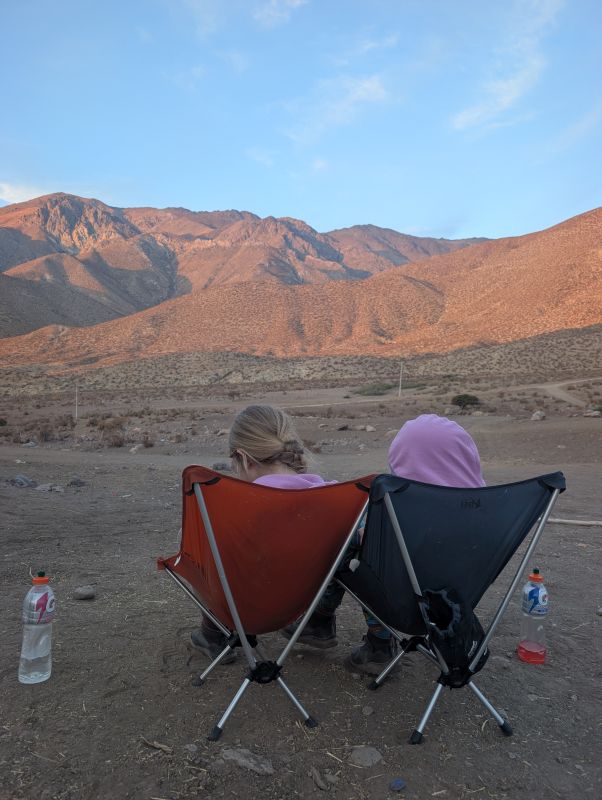
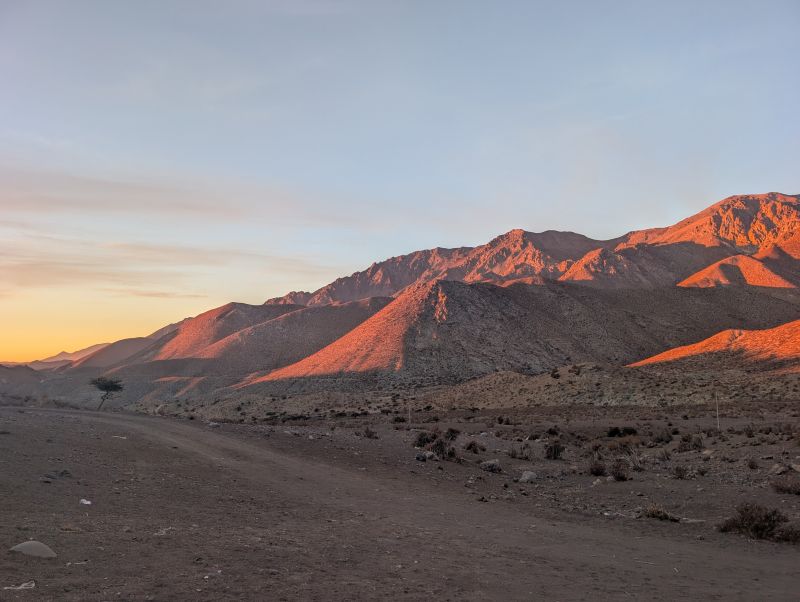
A lovely desert campsite
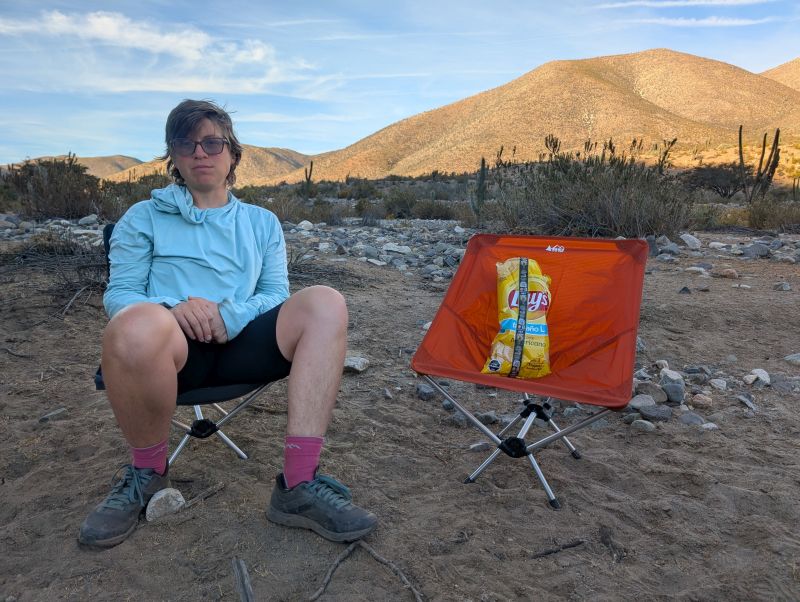
Daisy with her favorite companion after a long day of riding (a bag of potato chips, of course!)

A big herd of goats wandered by and we ate a filling dinner of hot dogs and pasta. It was quiet and peaceful. We were happy to be camping again after the months of hotels and hostels in central Chile.

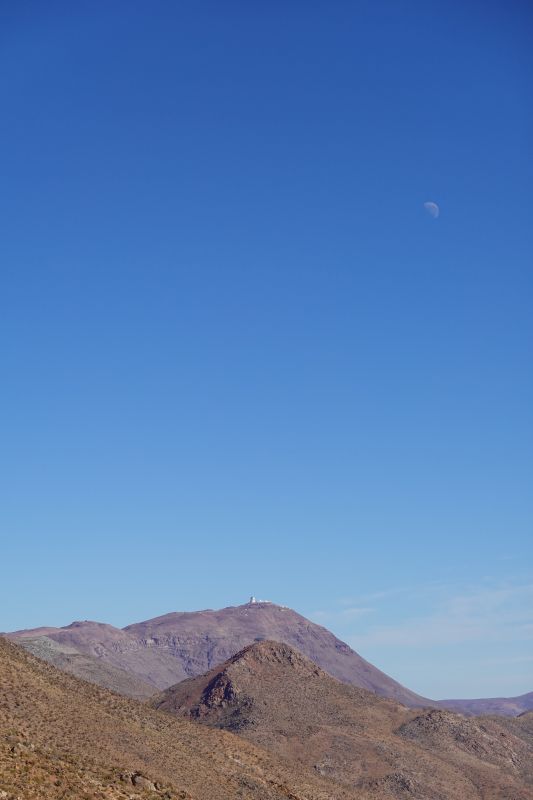
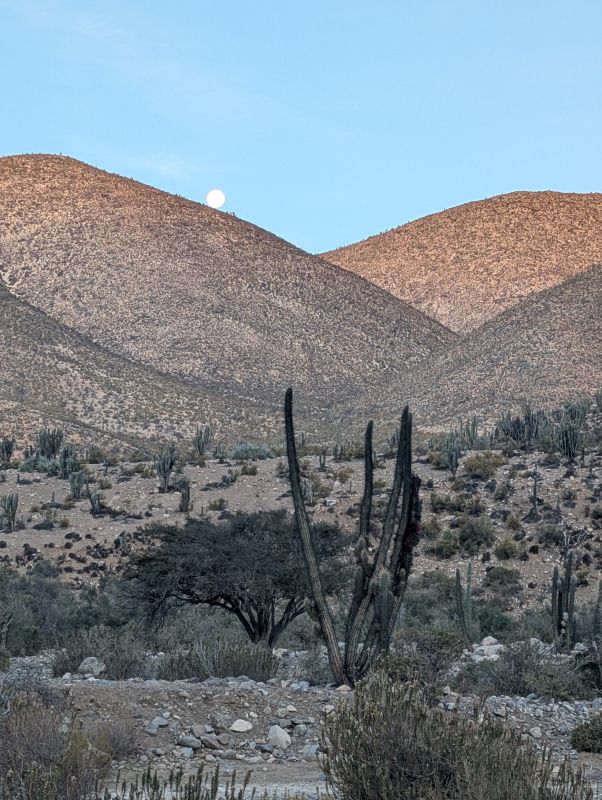
Moonrise in the desert

Day 148: Wild Camp to Combarbalá (30 km / 19 mi)

As expected, it was a perfectly peaceful night. We slept soundly and awoke with the sun (which isn’t early, since it’s winter here). A curious fox came by to see what we were doing. Packing up wasn’t fast, even though we wanted to be on the road before the heat. In the end it was nearly 11 when we finally drug our bikes back to road. After a long inspection of all the wheels (no cactus spines allowed!) we climbed back on the bikes.

Morning fox sighting!
Yeah, it was a good campsite
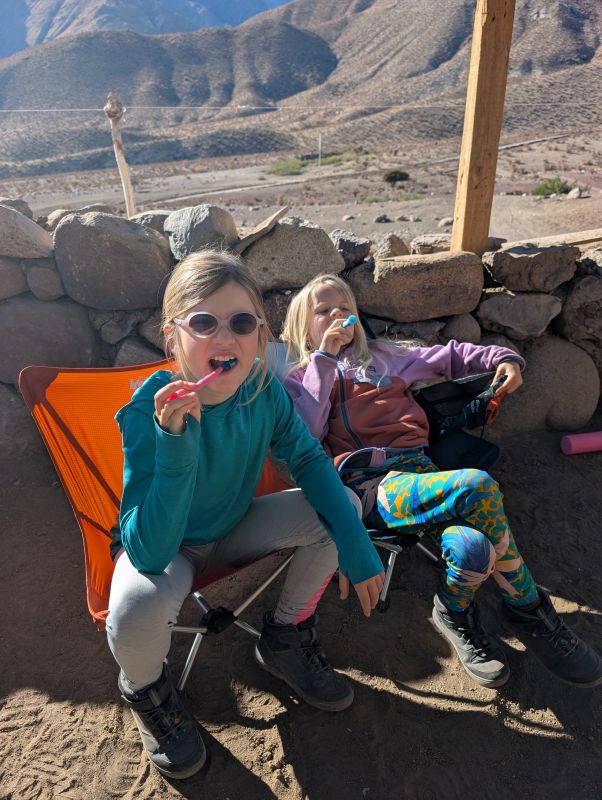
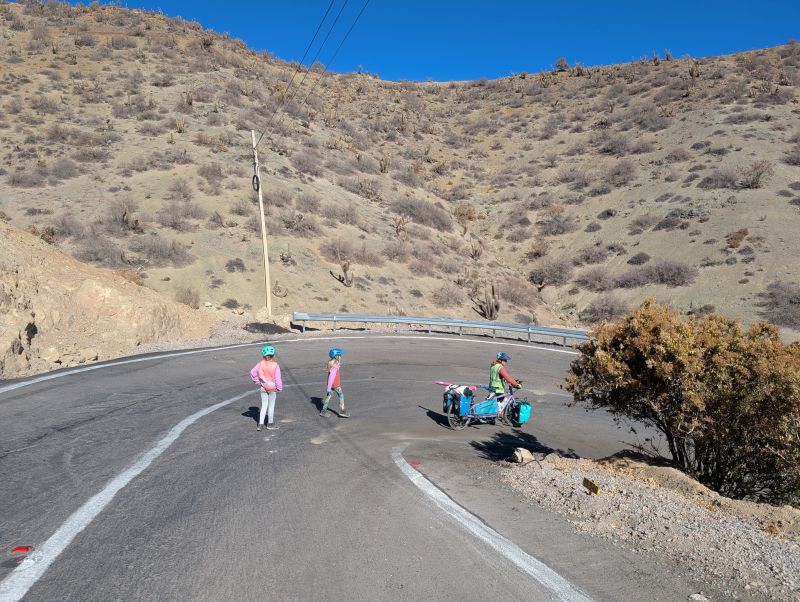
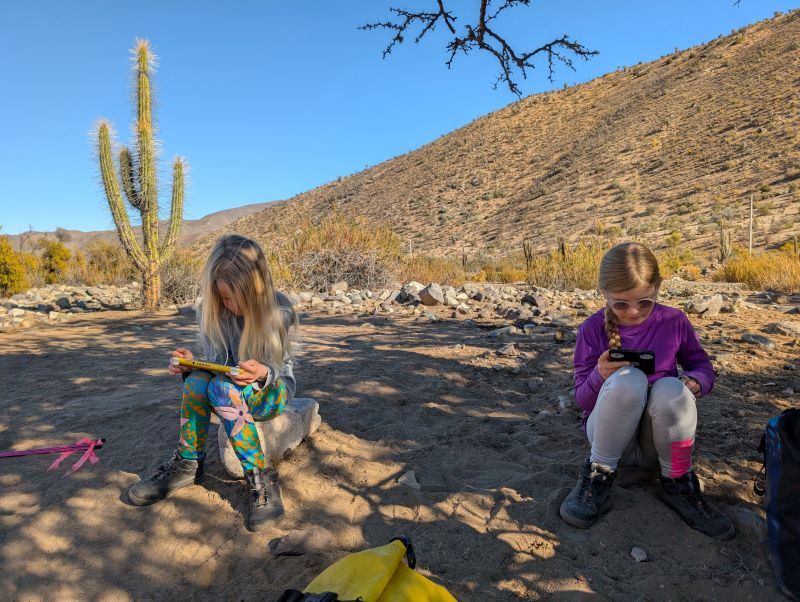
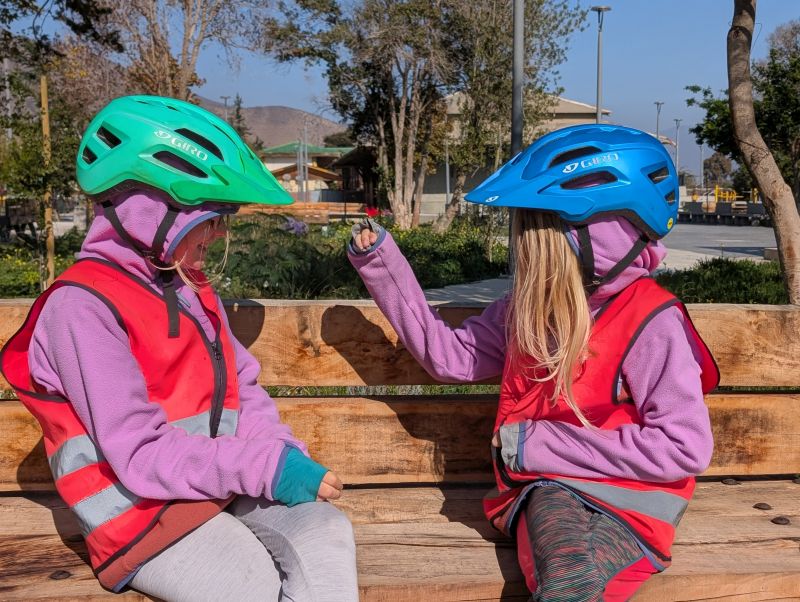
Girls chillin’ while adults pack up

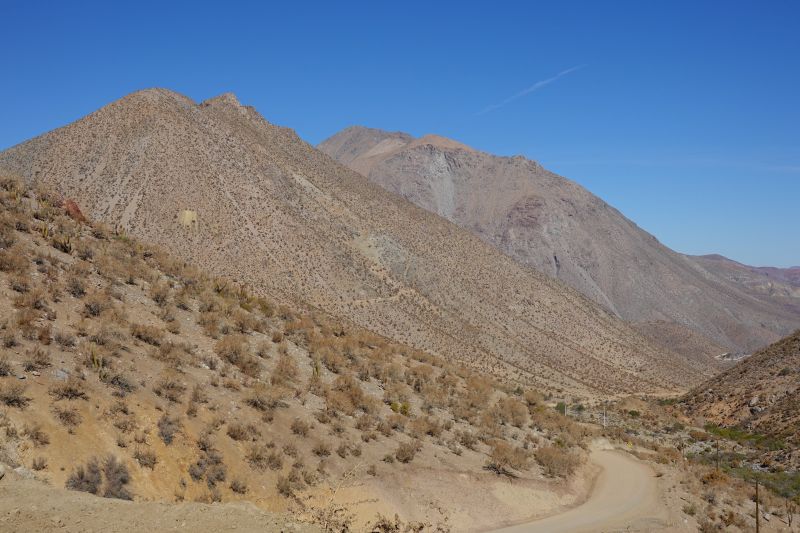
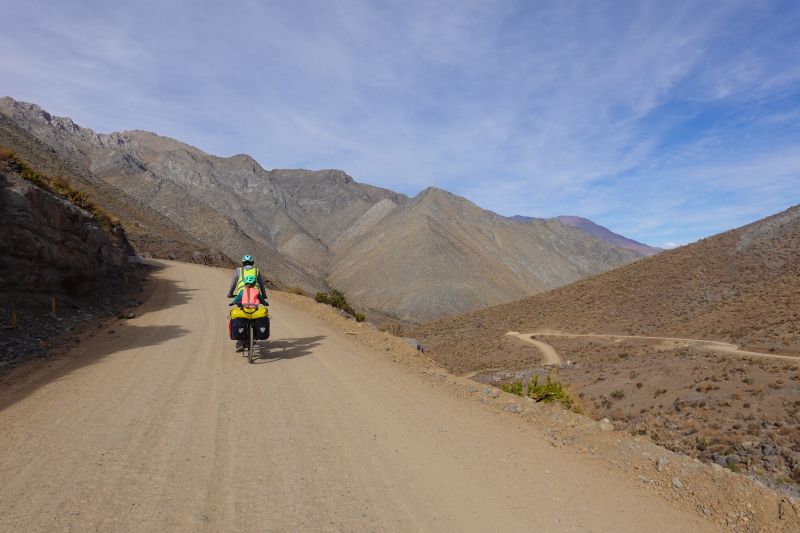
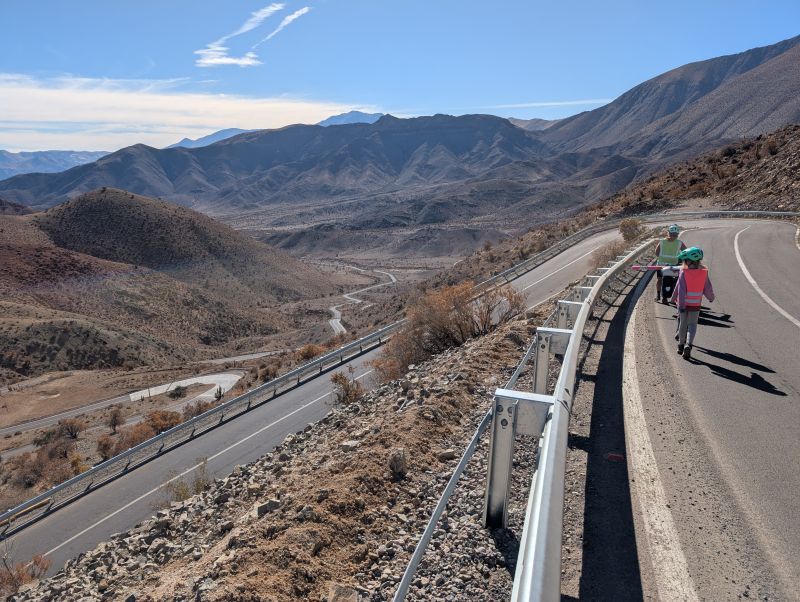
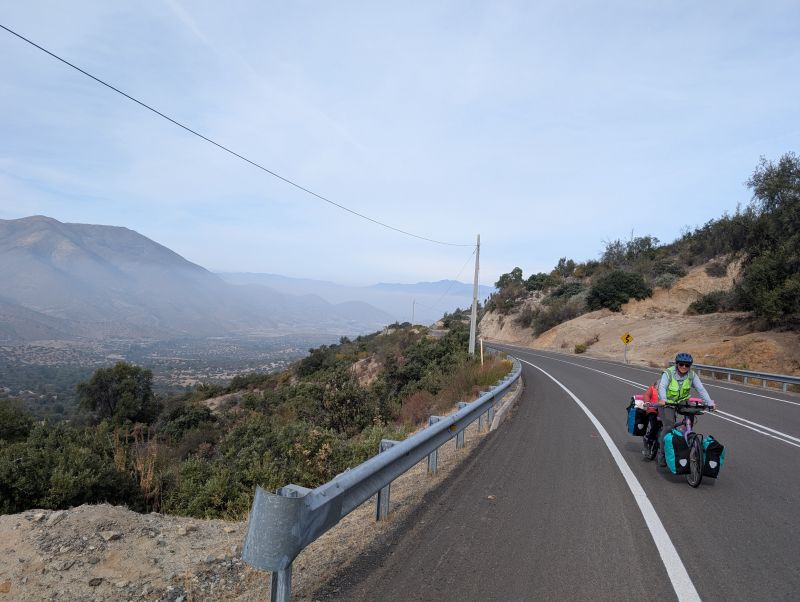
The valley was gentle for the first part of the day, and it was incredibly fun to see the many goatherds next to the road. Before long though, the grade kicked up again and we were climbing. It was hot. We had to stop every kilometer or so to rest and drink water, and when we found a shady spot from a road cut-out we stopped for a leisurely lunch. The scenery was interesting at least – we mostly were switch-backing up the same valley and weaving around rocky outcroppings. Plants were more numerous in the steeper valley bottoms where shade was more plentiful.

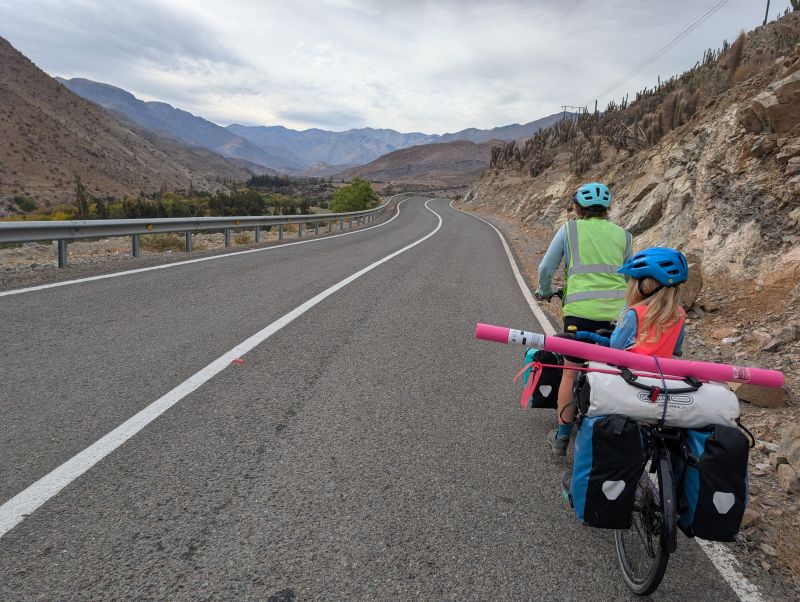
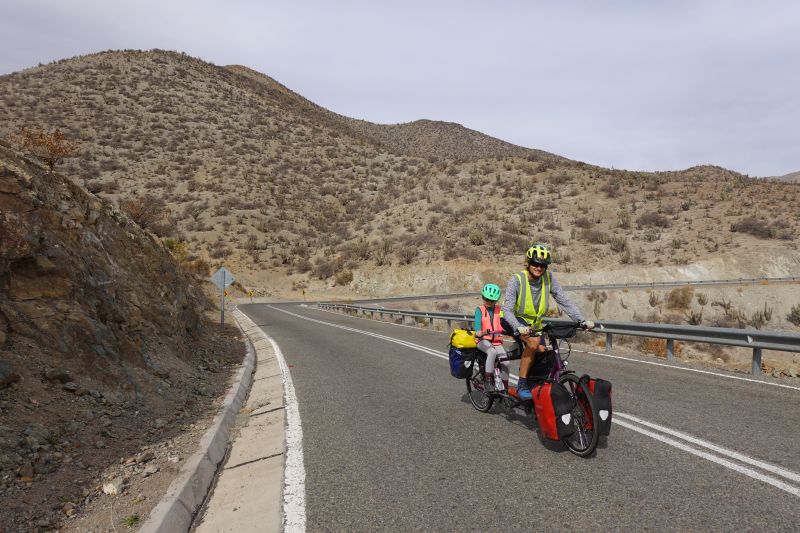
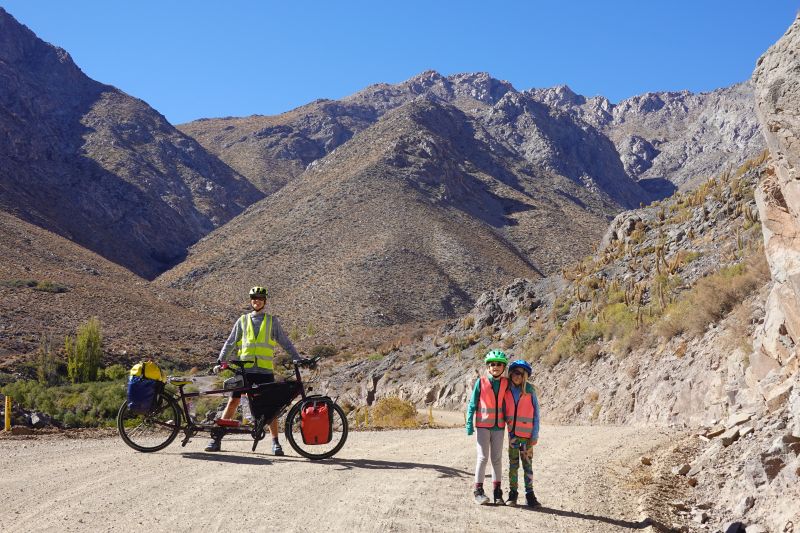
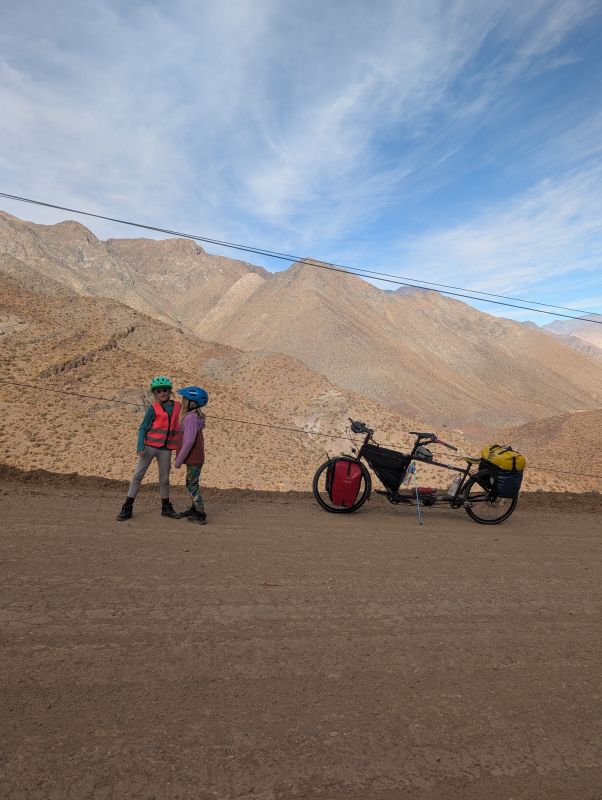
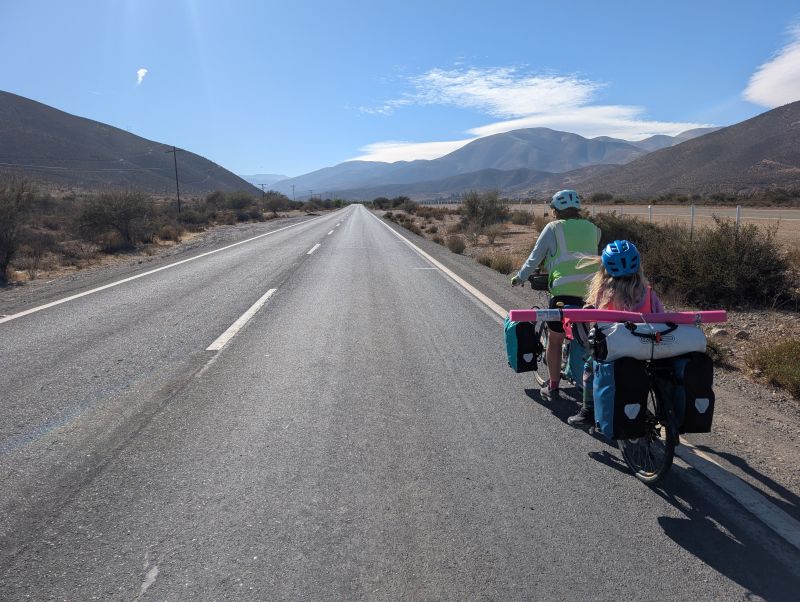
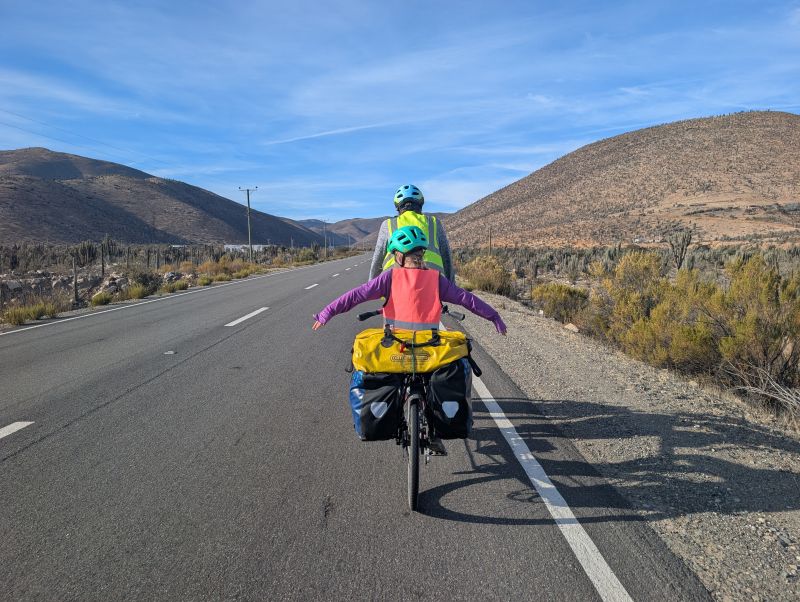
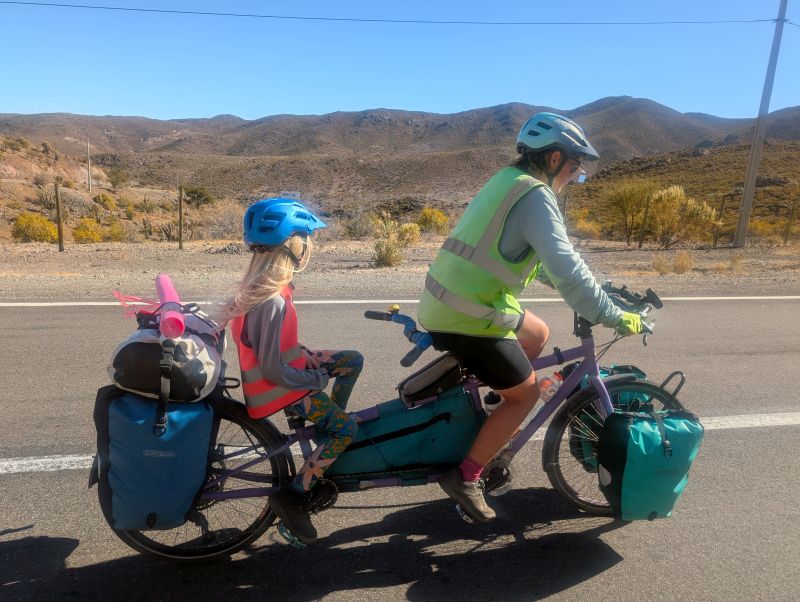
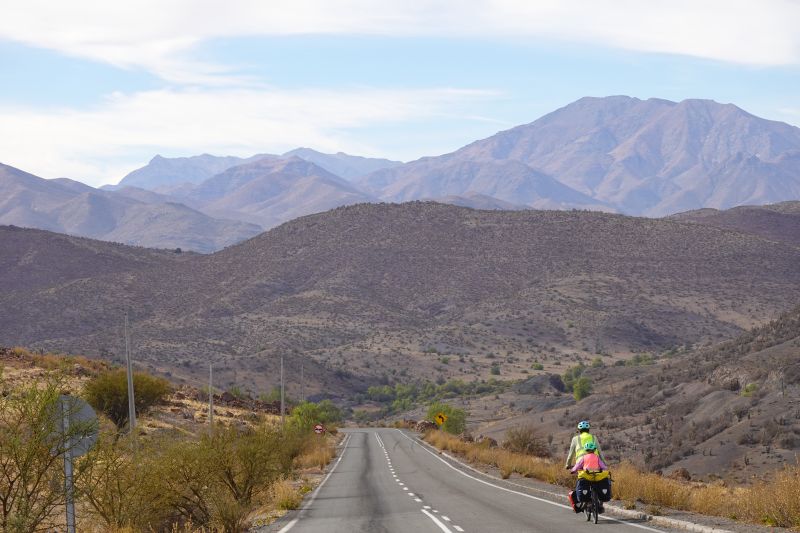
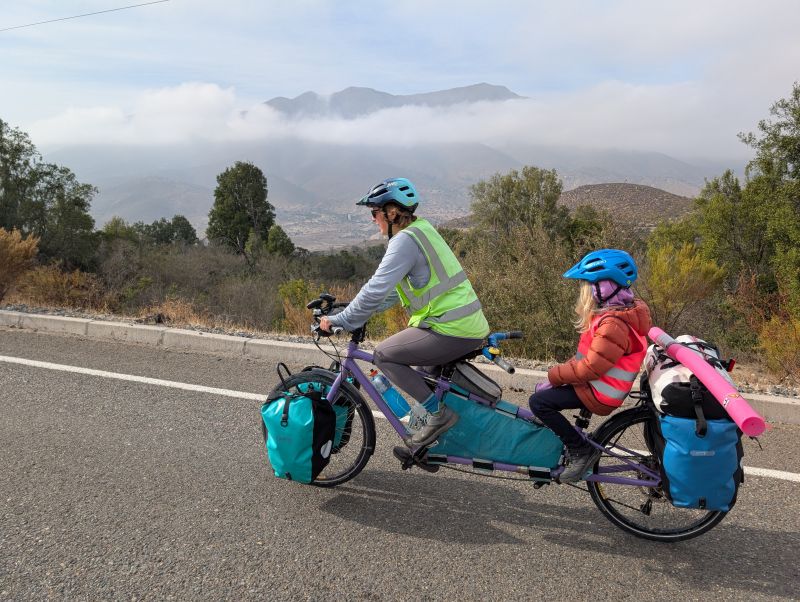
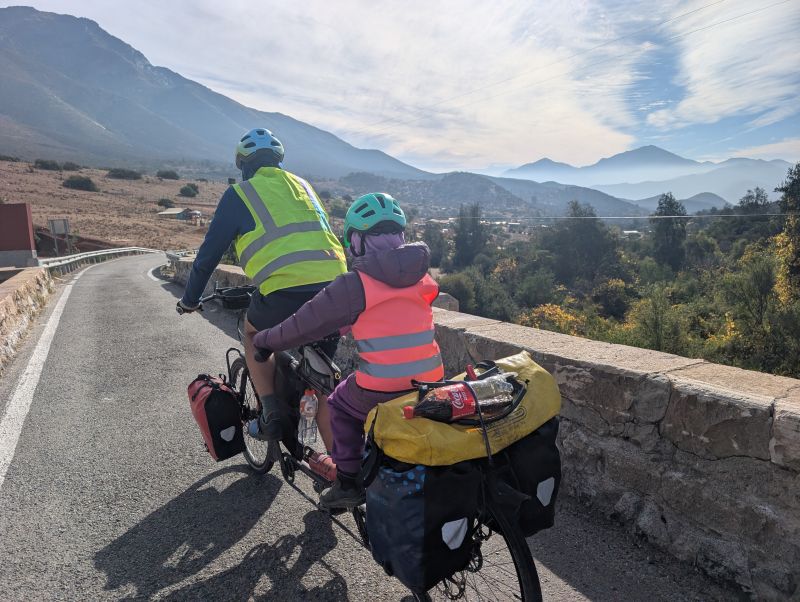
Daisy and H riding the desert highway
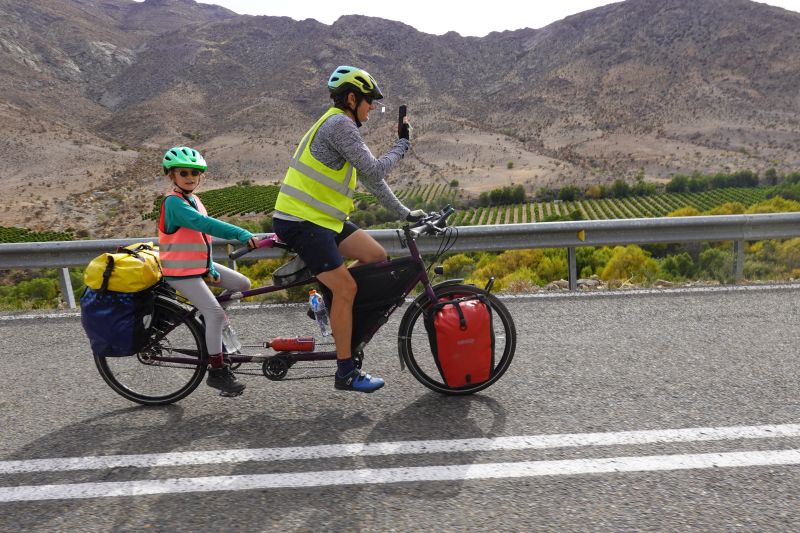
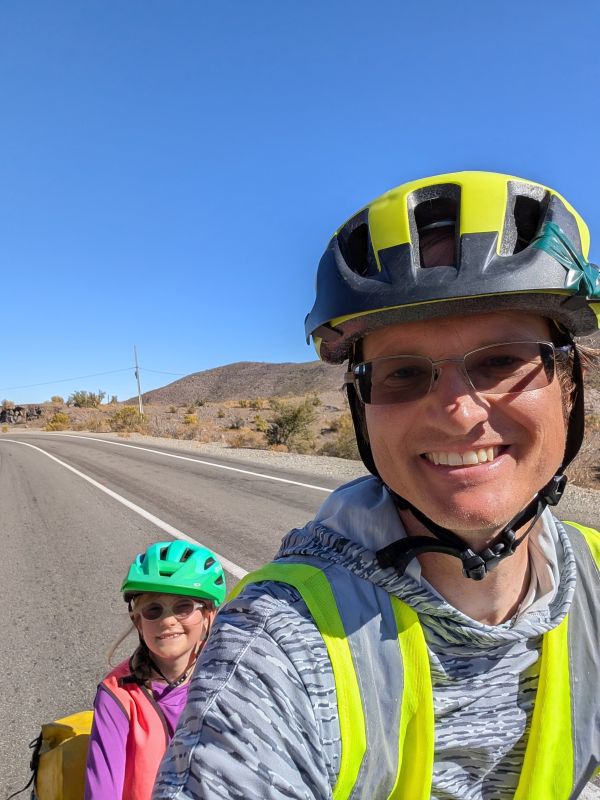
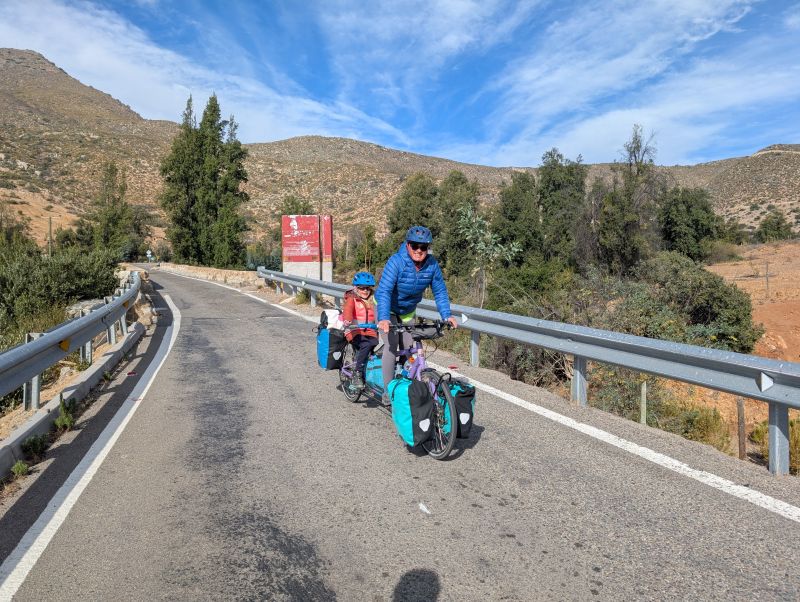
Jason and A, too!

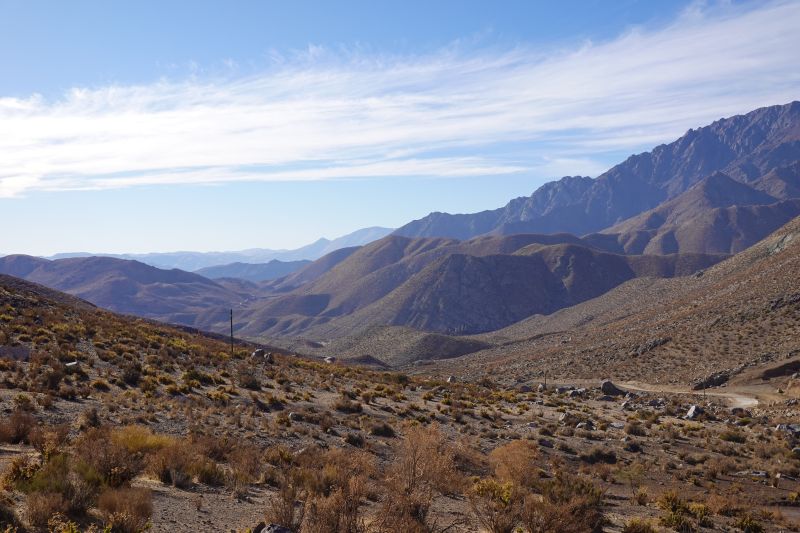
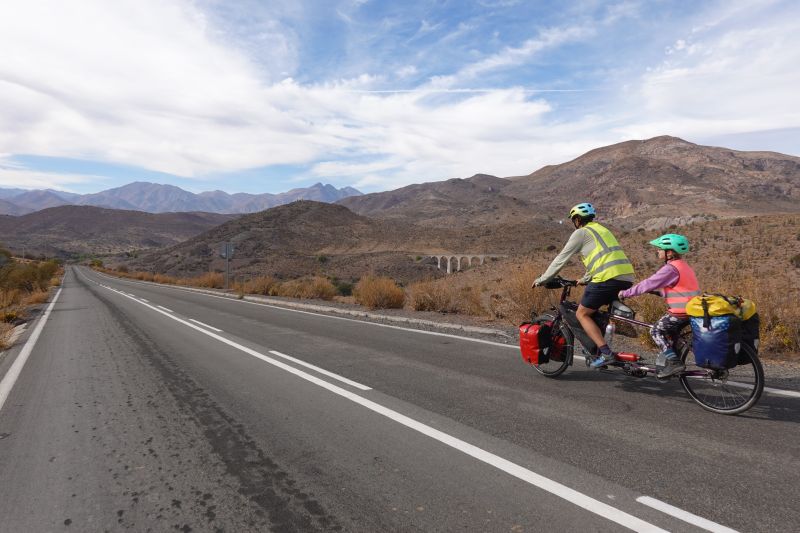
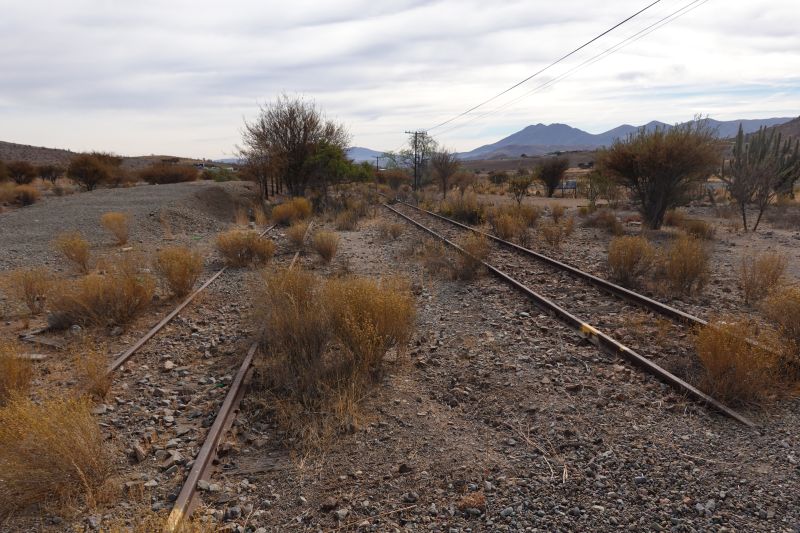
Up and over the top brought us back down to another slightly drier valley. The scenery was spectacular though! We zipped downward with layers of huge mountains behind us. We were hot and tired by the time we crested the last small hill (an overpass for an ancient and disused railway line) and rolled into town.

More endless hills. It was beautiful

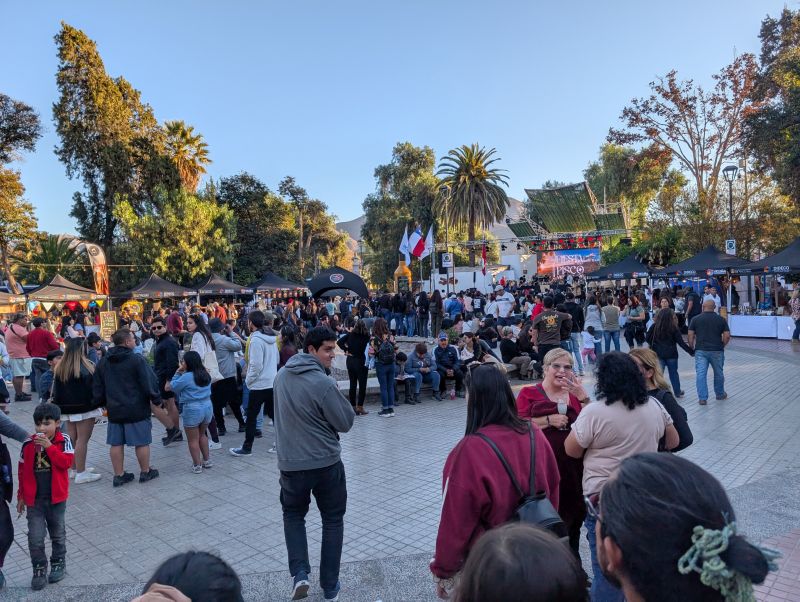
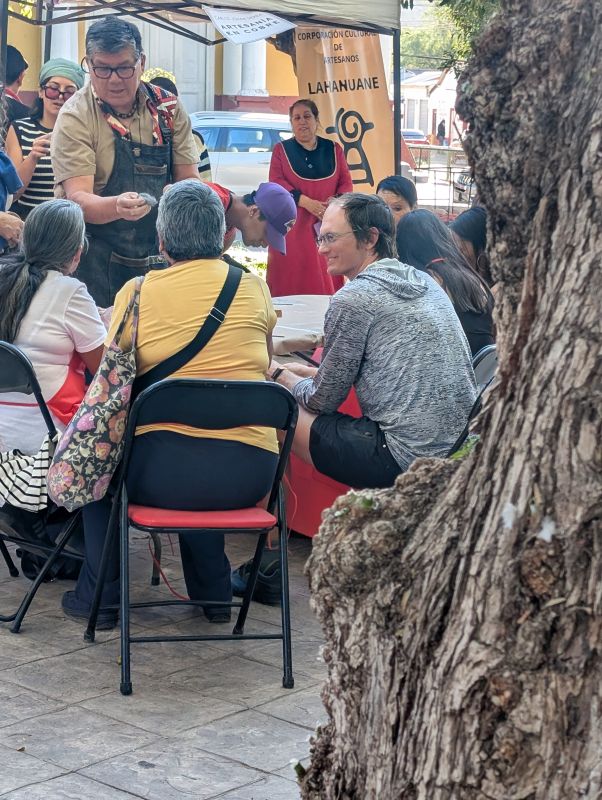
The little town of Combarbala was a surprise. It is laid out in a compact and perfect grid with a leafy plaza in the middle. When we rolled up the plaza was packed with booths and people. After we checked into our hostel we went down to investigate. It turned out to be National Heritage Day, so the booths were all celebrating and educating some part of the history and culture of the area.

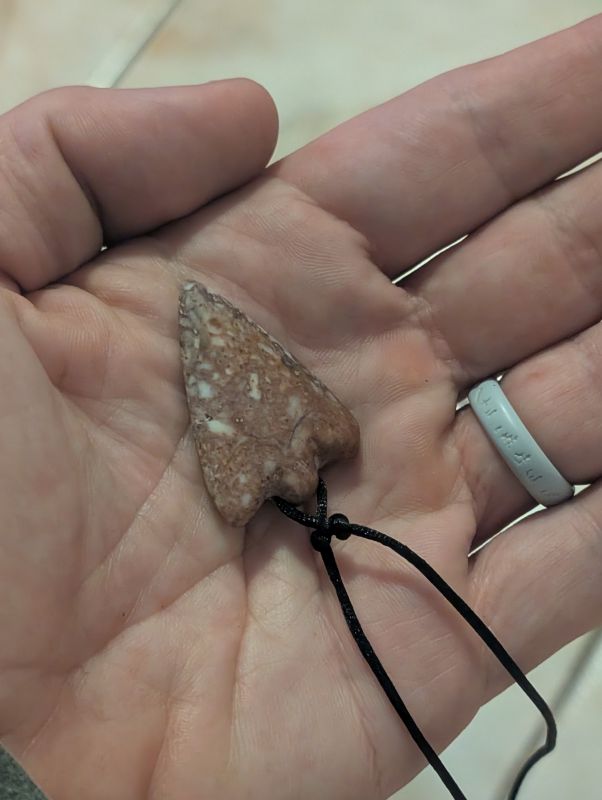
A local grabbed A and Jason and convinced them to sit down at a table. Soon after, they learned they were making arrowheads out of the local stone, called Combarbalite, which is famous in Chile for its beautiful colors. H and I wandered around and saw displays about making mud bricks, wood furniture, and reed whistles. Jason and A signed up for a tour of the nearby observatory. It was such a busy day!

We ordered sushi bowls for dinner on WhatsApp. Everything works through WhatsApp here in Chile. For example, this sushi place is running out of a non-descript home near the plaza. It only takes orders (and only over WhatsApp) for take-out or delivery and you can only get food for a few hours in the evening. It was a puzzle to get the food but it was certainly yummy!

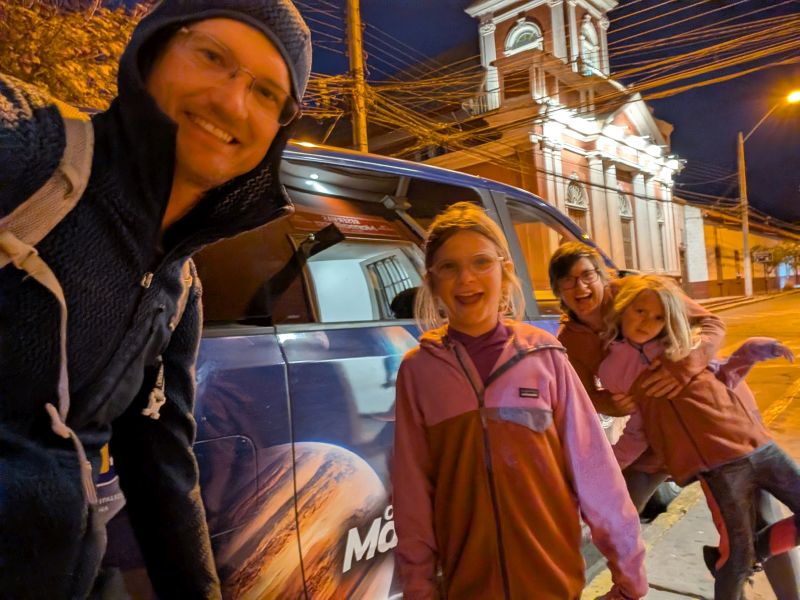
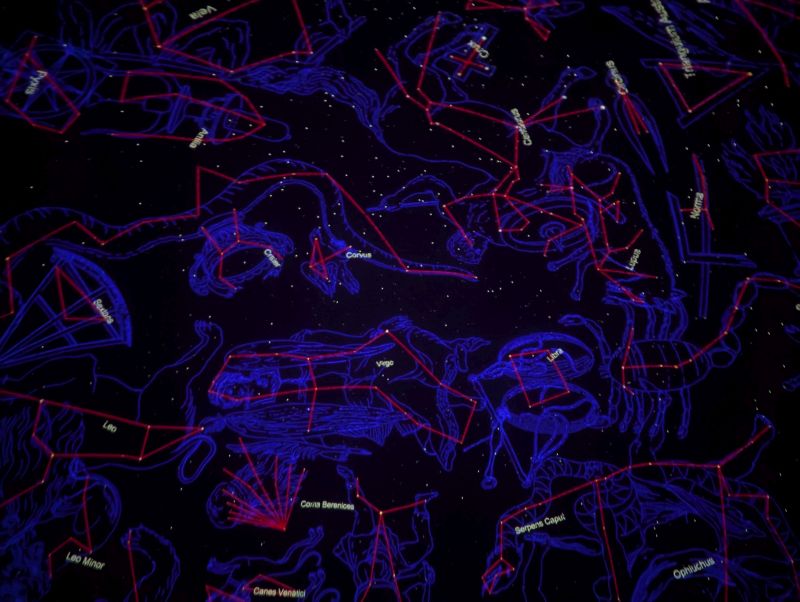
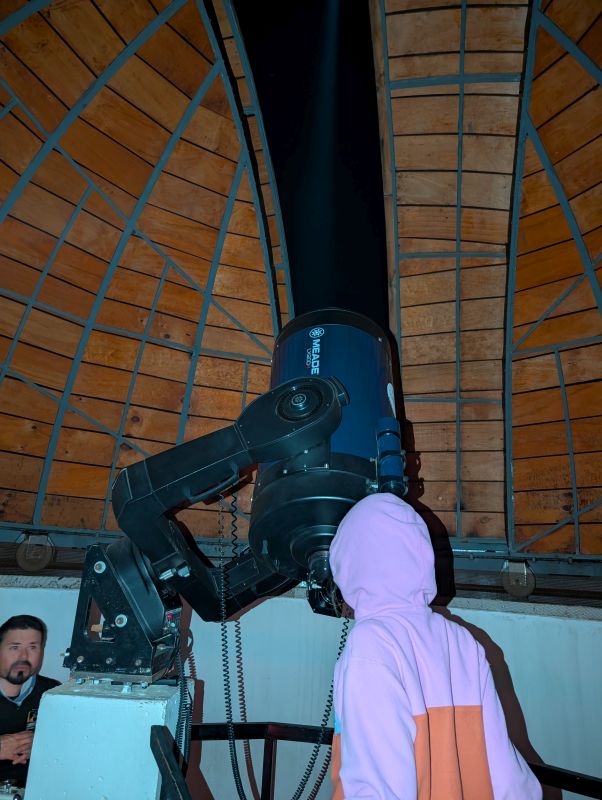
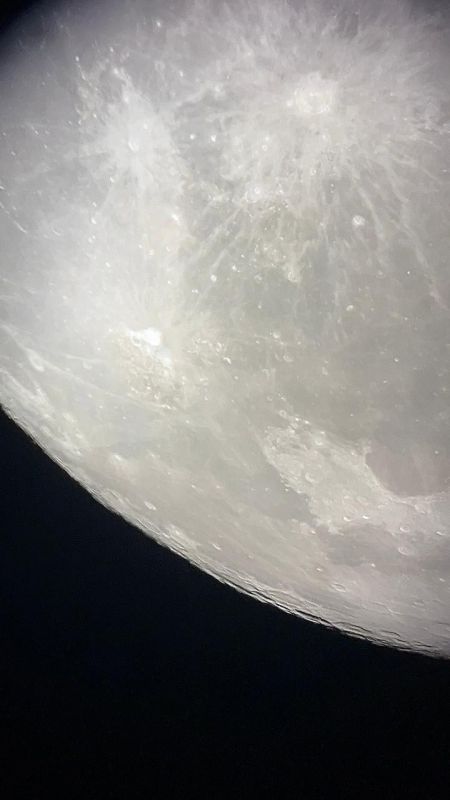
At 8pm Jason and A climbed into a transport van for their astronomy tour. Jason: We took a curvy road up and over the hill behind town to arrive at the ‘Cruz del Sur’ Observatory, which has four 14-inch telescopes set up to do educational tours. We watched a video in the planetarium and then went outside for a Q&A with the stars. I did my best to translate from Spanish to English for A, and at one point asked her if she understood what they were discussing about the speed of light. She said ‘Of course we wouldn’t know what was happening over at a distant star until the time for the light to get here’, correctly summing up what took about 10 minutes for the guide to explain to the other 50 tourists. The last event was looking through the telescope at an open star cluster, globular star cluster, and the edge of the moon. We were impressed at the vastness of space!

Day 149: Rest day in Combarbala

After all the excitement of yesterday we laid low today and did a deep relax. I did a load of laundry in a big sink and we hung it up to dry in a corner of our room. We wandered town a bit, and got lunch out at a local restaurant. We went searching for a supermarket that Google said was at the edge of town… but there was nothing there. We wandered around searching for the supermarket, then finally gave up and walked back towards the center.

When we approached the center the supermarket magically appeared! Google just had the location wrong. We did a resupply for the next few days of riding, played videogames, and relaxed some more.

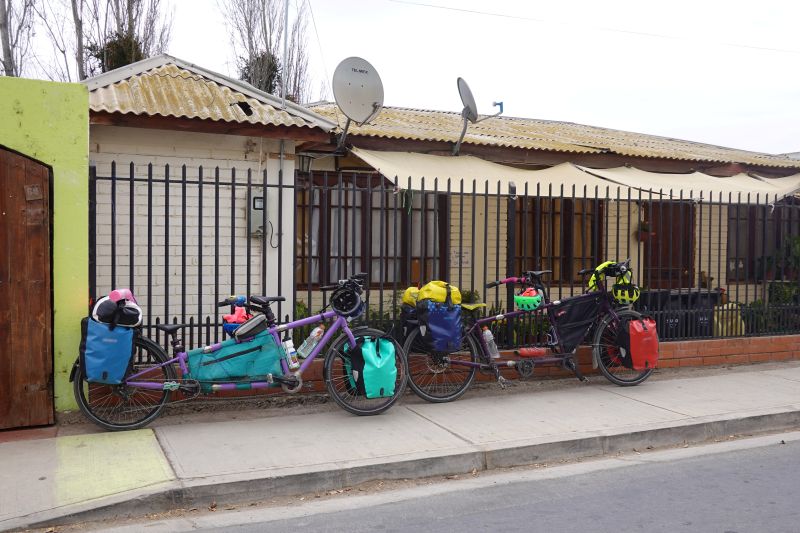
Our hostel was close to the center of town and attached to a restaurant. By luck we were staying on Saturday and Sunday nights, so the restaurant was closed and our bikes could live in the dining room. We were the only people here, so we had a quiet rest. I think it would have been a very loud place to stay if the restaurant had been open!

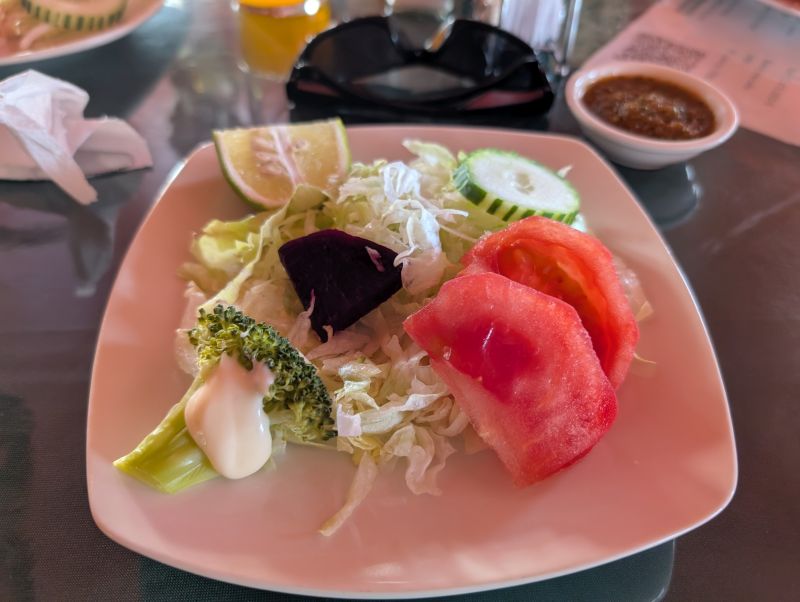
Typical Chilean salad, well separated, with a dollop of mayo
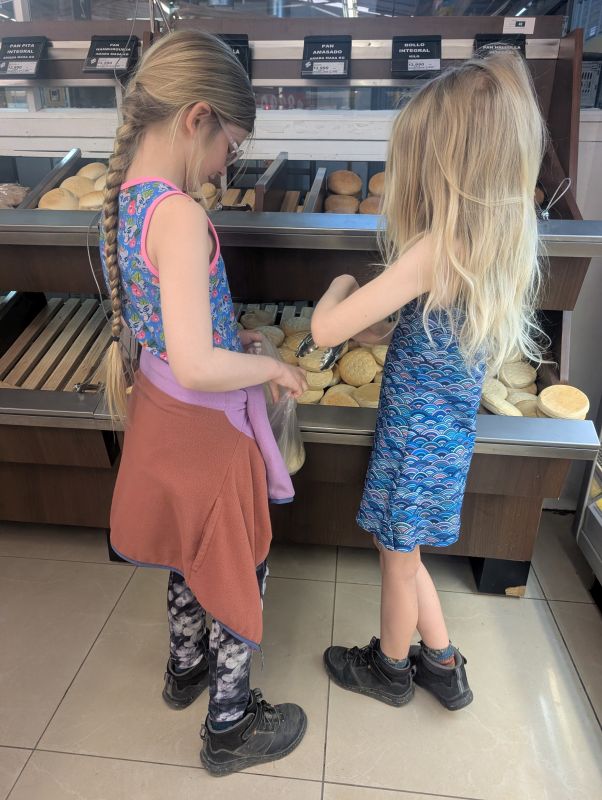
The girls getting bread from the grocery store

Day 150: Combarbalá to El Palqui (62 km / 39 mi)

You’d never guess that today we… rode another 2,000′ pass. Or maybe you would? This section of riding has been pass after pass. We are getting used to the rhythm.

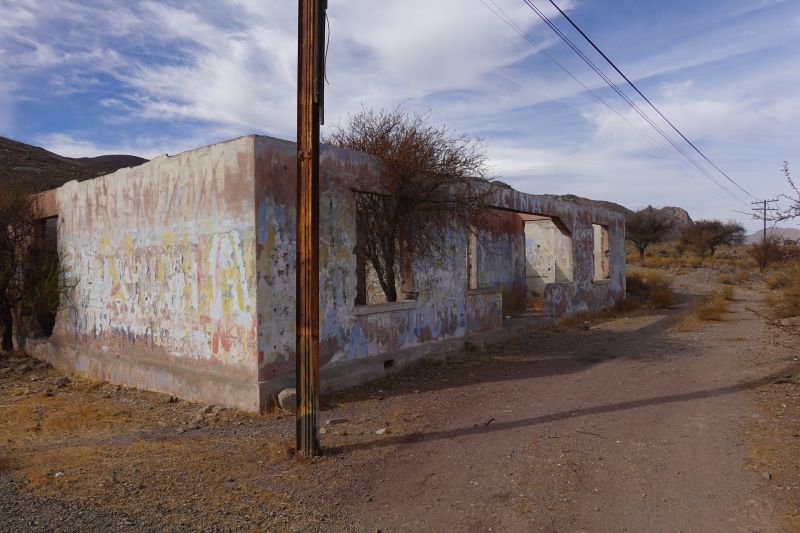
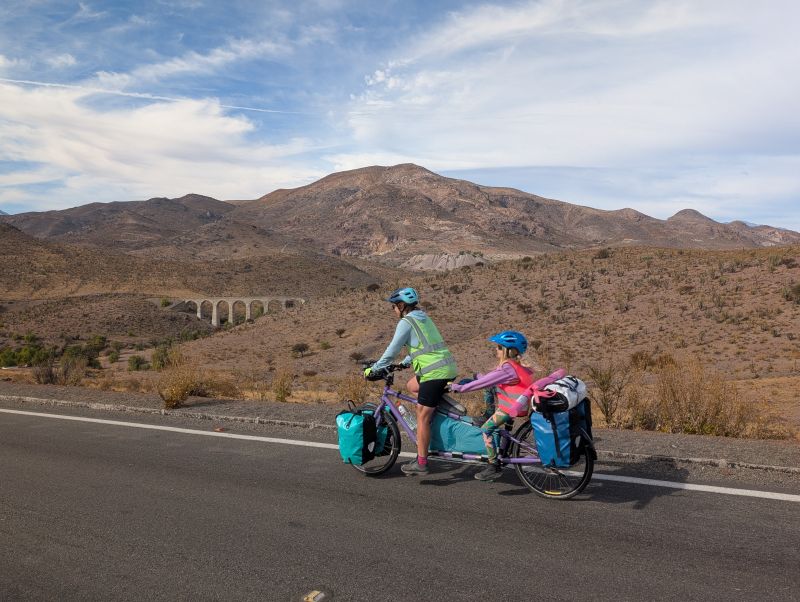
The riding this morning was particularly lovely though. The views were so big it’s hard to explain the scale. We saw a beautiful railroad bridge and an abandanoed railroad station. We zoomed down some huge hillsides before going back up steep climbs. In the afternoon we finally moved into the next valley.

Daisy and H with the railroad bridge
We loved the view so much, we got Jason and A with the same background!
Don’t think this rail line is still in use
Abandoned railroad station building
Heading down
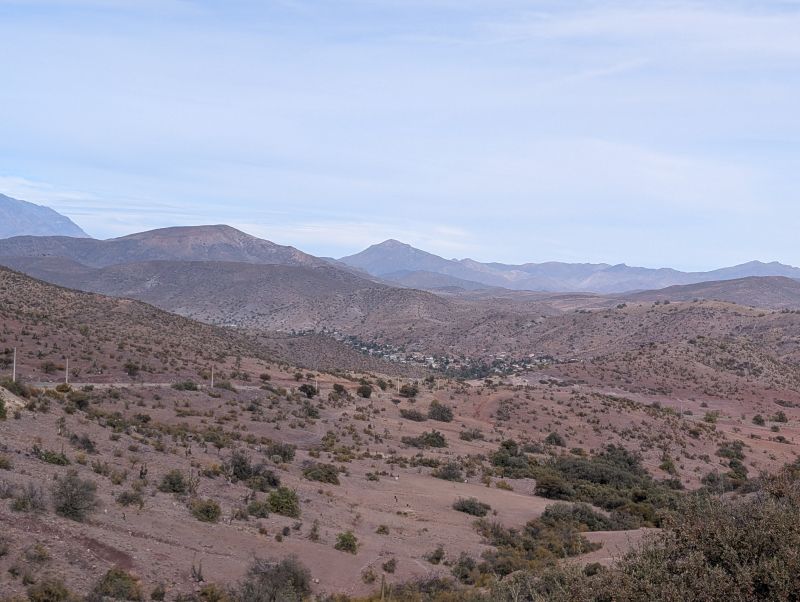
Open vista

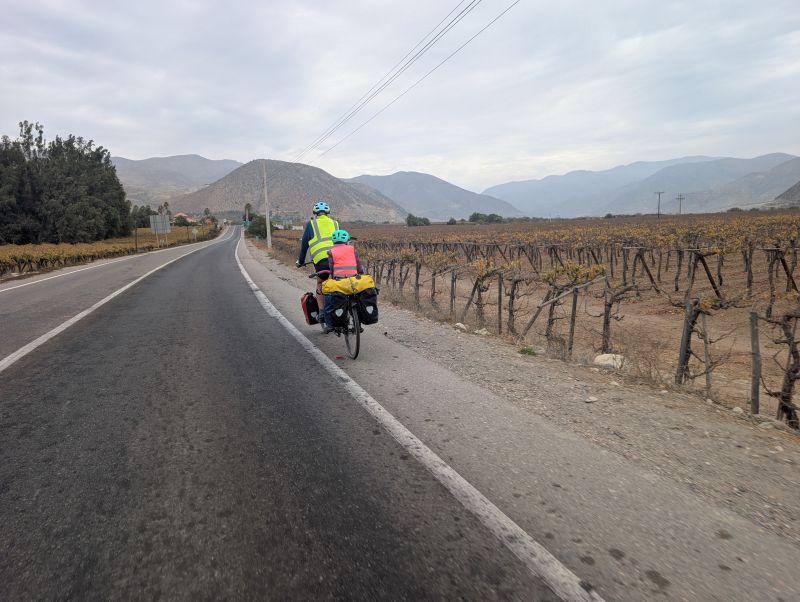
Instead of the typical ‘slightly more dry’ valley, this one was alive with agriculture! There were vineyards and orange trees and small farmlands, all fed by the (very small) river in the middle. We rode down the river valley, but the ‘down’ included a lot of steep up as we veered around and through settlements. On one steep downhill a huge pit bull came charging out of a driveway to bark at me and H. That was fine, except that he then stopped in the middle of the road – right in front of Jason and A! They were barely able to avoid slamming into him.

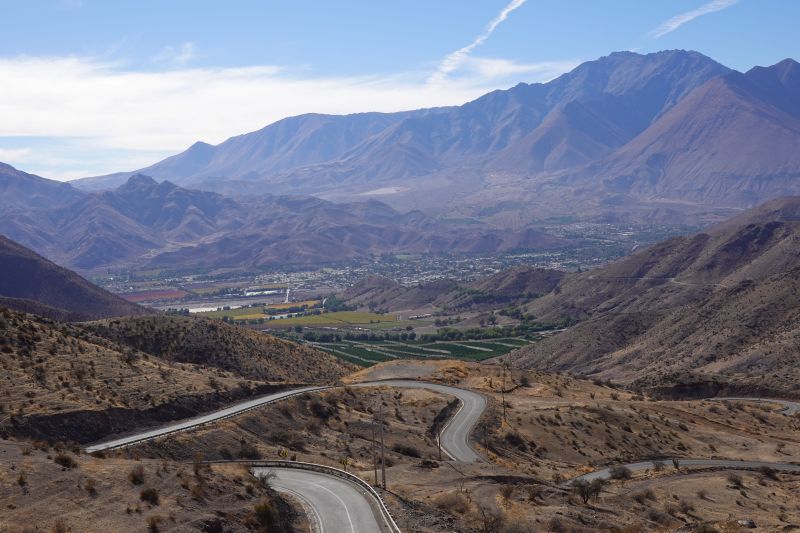
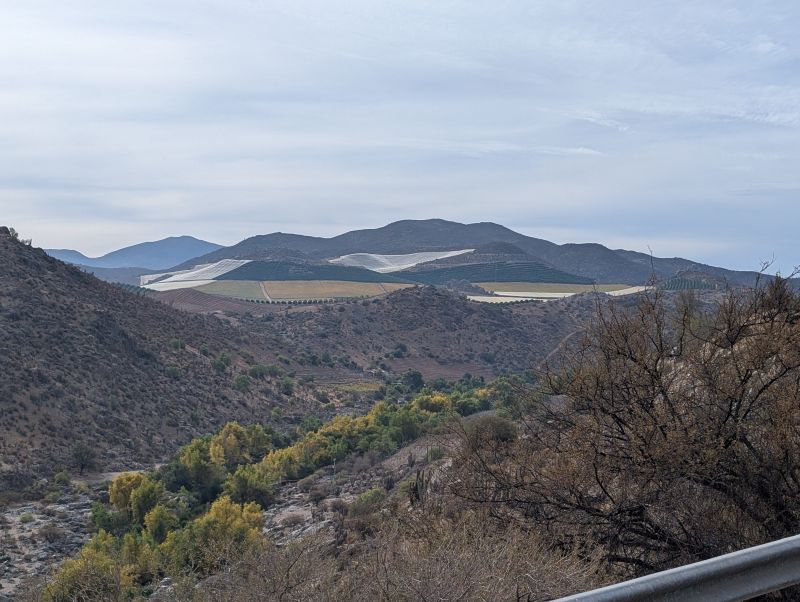
High irrigated vineyard valley
Goats – you never know when you might see them, even if you don’t think there’s anything edible!

The heat and the steep hills got to us. I got so upset with H not pedaling much (as well as pestering me for being slow) that near the top of one hill I just stopped and made her get off and walk. That was a shocker! After that we had a more peaceful rest of the day.

It was a long day for us, but as always we arrived to our intended destination “between 3 and 5 pm.” That’s what we always tell the hostel owners when they ask when we plan to arrive. This time, we rolled into a small town just as the local school was letting out. We rode right past the school and waved to the dozens of parents waiting to collect their children. It’s a delight to see the daily rhythm of other families.
Our hostel for the night mainly catered to construction workers. Most of the rooms were full with young folks away from home and working long days. Everyone was nice, and it was fun to see their work shoes lined up in the shared hallway. Jason made us dinner on our camp-stove on the counter of the shared dining area. He had tried to set up in the courtyard but the owner inexplicably asked him to go inside!

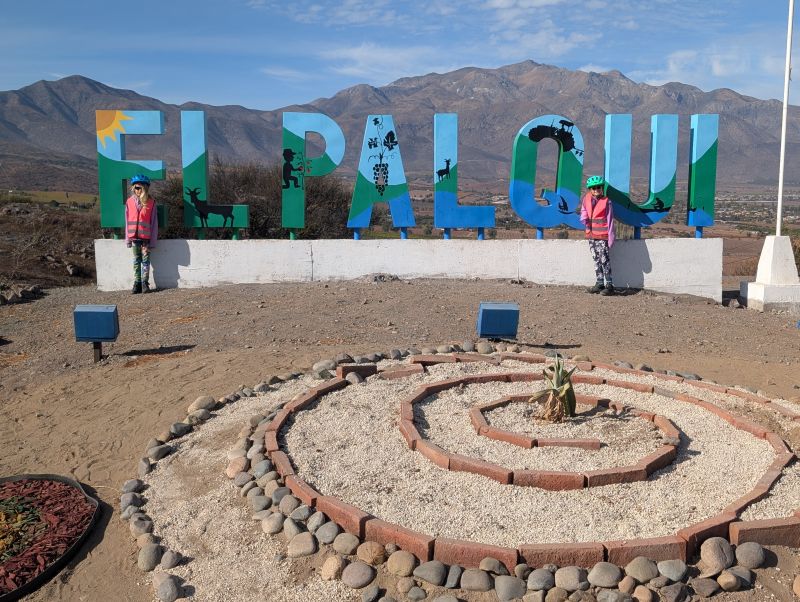
Letters of El Palqui

Day 151: El Palqui to Ovalle (43 km / 27 mi)

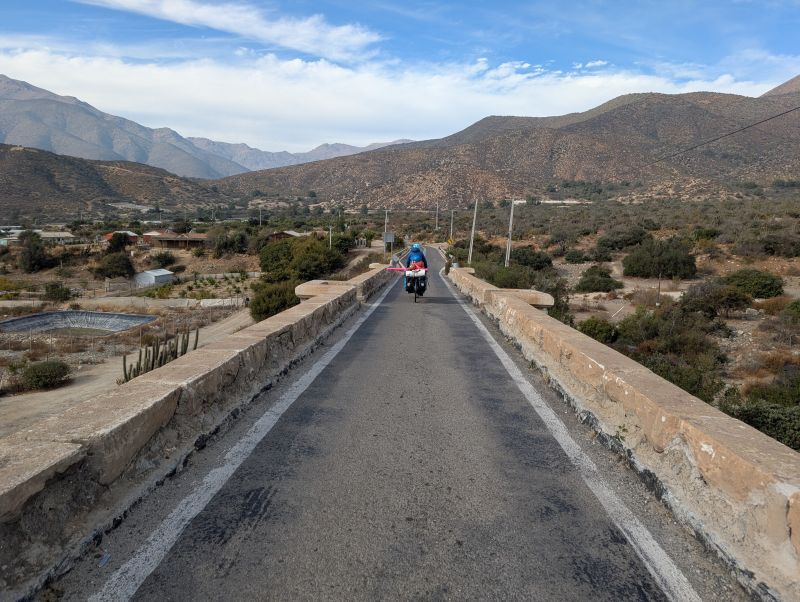
Today was planned to be pretty easy – short and mostly downhill, so we weren’t in a rush. It was another beautiful sunny day. As we left town there was a bit of a climb which was a surprise. We were surprised because as we approached on the road we could see a huge cut-out of the mountainside; we assumed the road would go through. Nope! Instead, the crumbling remains of a rail-line stayed low and the road went up high.

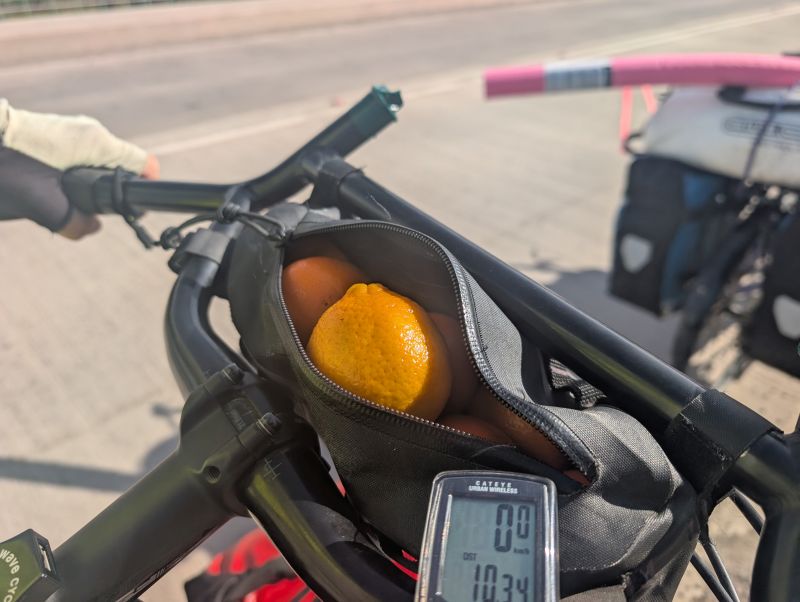
At the top of the small climb a nice man was waiting next to his parked car. He loaded us up with a pile of small oranges. Our handlebar bags, feedbags, and pockets were all full by the time he waved us goodbye and drove off.

We got loaded with oranges. Jason couldn’t even shut his handlebar bag

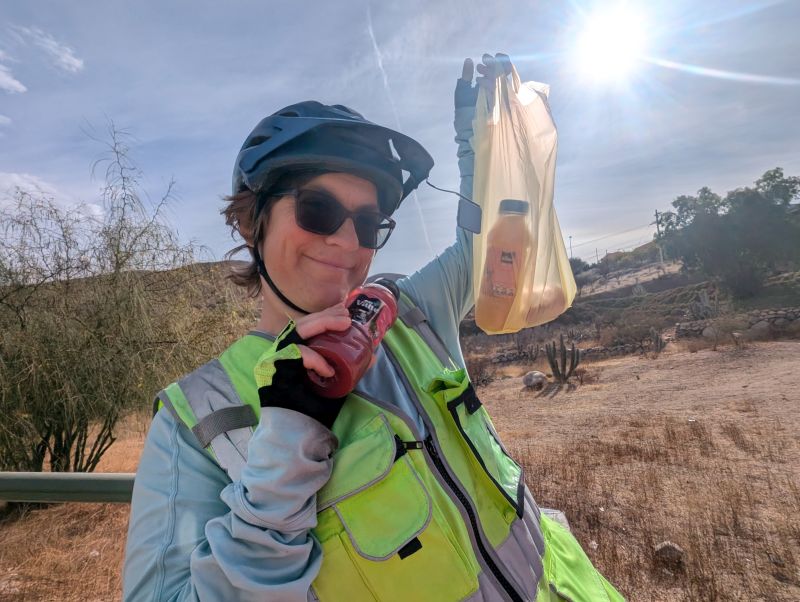
We descended into the town of Monte Patria (Heritage Mountain), which was in a lovely green valley. When we stopped to eat some of the oranges (which were delicious) another car stopped nearby. A woman came out carrying a bag of four fruit juices for us. Apparently her husband had seen us, bought us juice, and then made her present the gift! We were very grateful and wished her well. Then we loaded up the juices and got back on the road. This is one example of why we don’t bother trying to be ‘ultra light’ cyclists. Sometimes we get five pounds of oranges and juice gifted to us!

Our drinks! Thanks to more friendly drivers
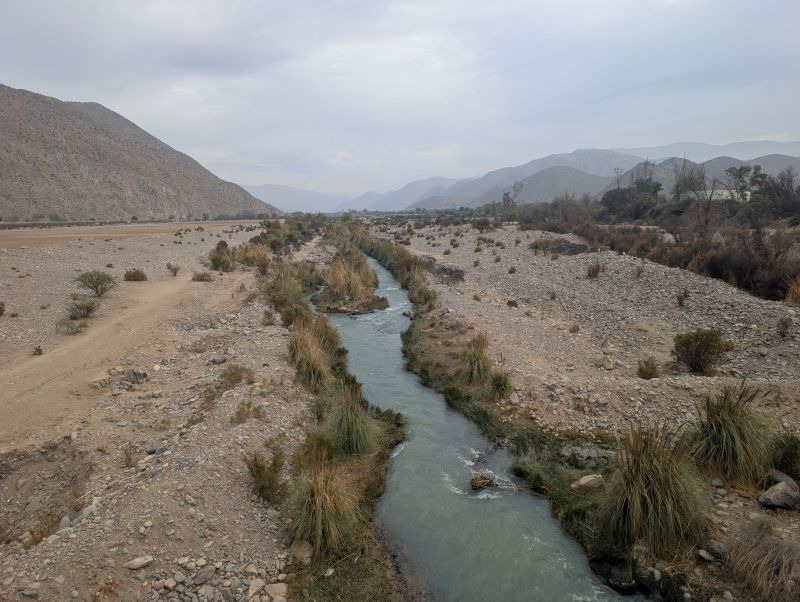
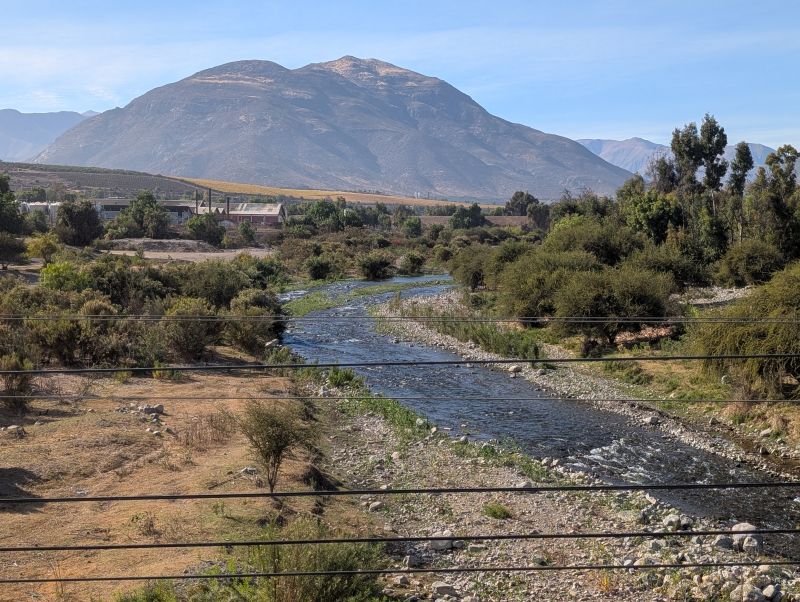
This river actually had a lot of water

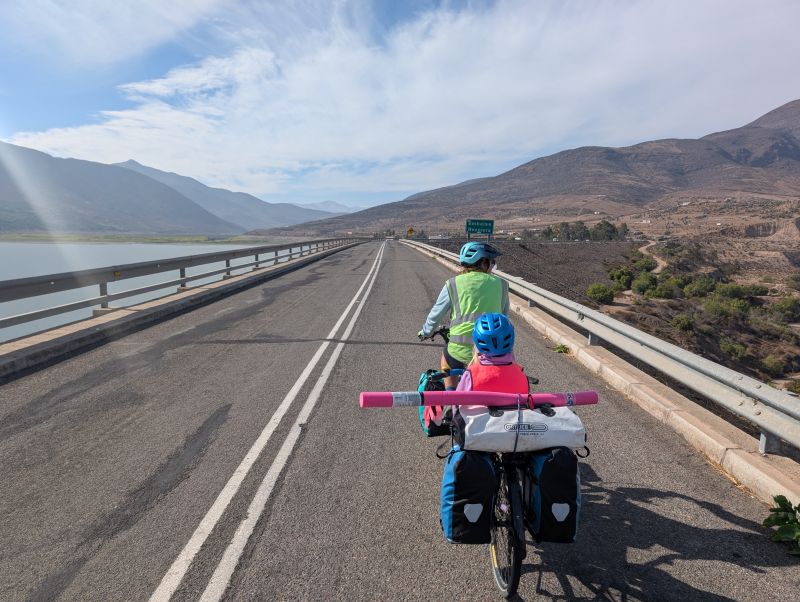
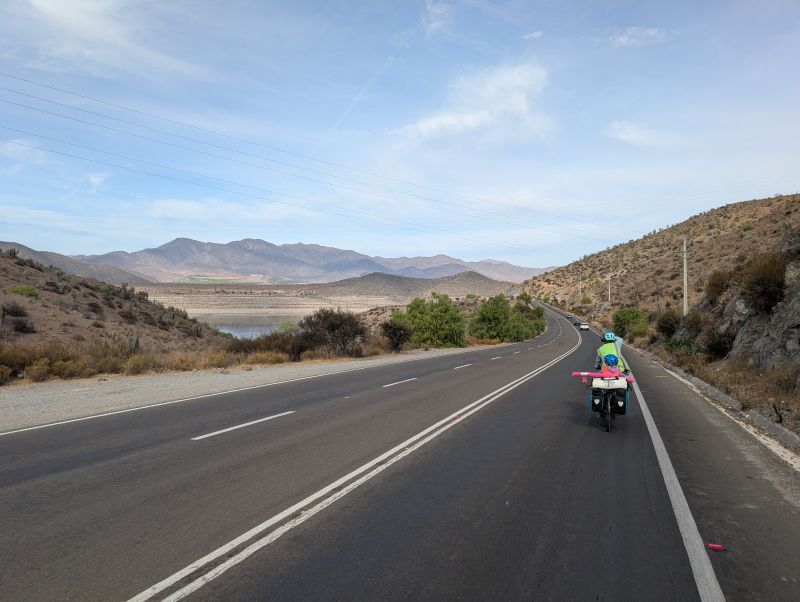
The road snaked along a hillside above a huge, mostly empty reservoir. We really enjoyed drinking some of the juice as we stopped to lament the dry state of the area. On the other side of the dam we zipped down into the lower part of the valley and found a humble food stand for a lunch of completos and french fries. As far as we could tell, it existed to serve a group of five guys that worked at a nearby construction site. In any case, the hot dogs were good and the fresh made fries were delicious.

It was a quick downhill to the big city of Ovalle, population 120,000. We found our hostel, “Casona Campos.” Despite being one of the more official places we have stayed (we paid with a credit card), it was just an unassuming house in a normal neighborhood next to a big school. Inside it was also a normal house, but then attached to the rear was basically another house full of rooms for travelers, with two shared bathrooms. We would have never known it was a hostel from the outside.

Entering Ovalle
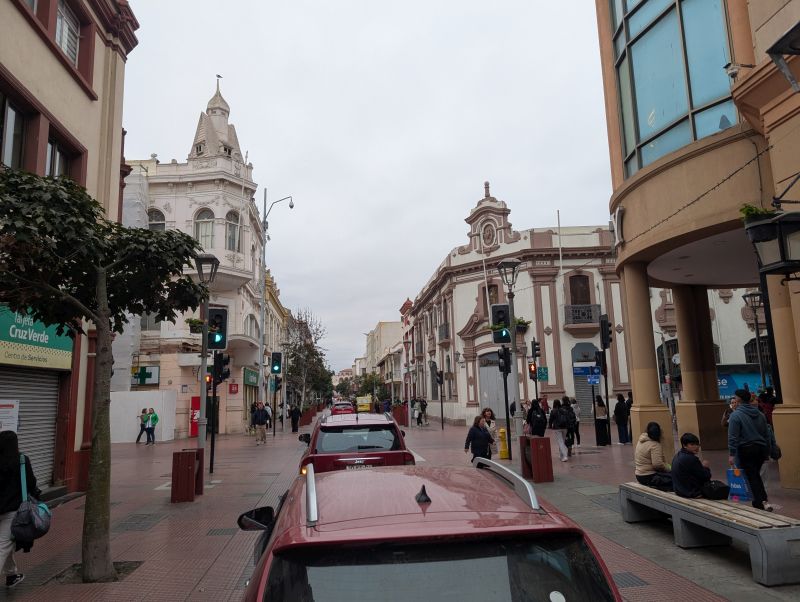
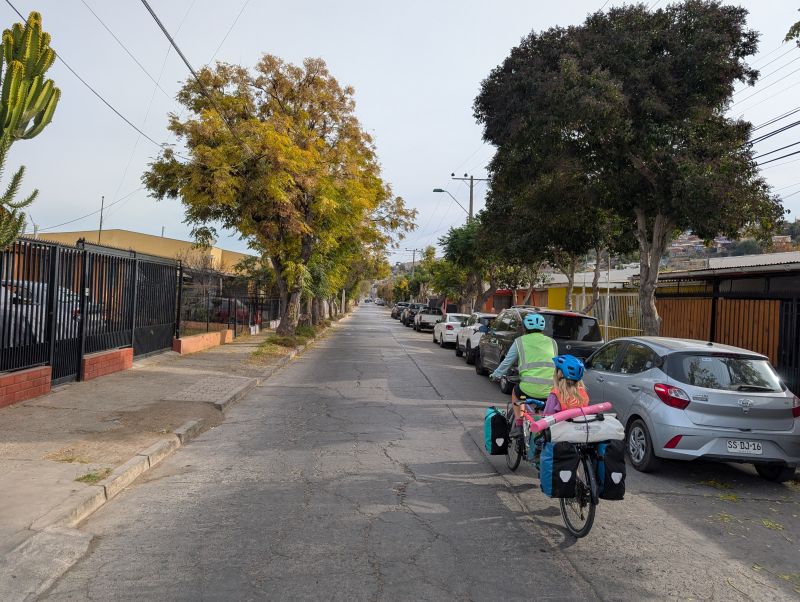
A residential street in Ovalle

Luckily the host, Luz Marina, met us on the sidewalk. We sent the girls to rest and play videogames while we chatted with her. She had moved to Chile a couple years ago from her home country of Venezuela. She had a lot of hot takes about Chileans to share with us! We enjoyed her company.

Later in the evening we made dinner and ate with some of the other guests: two women from Santiago doing social work in Ovalle. They were really interesting and fun. We talked for hours and learned about the history of women in Chile and their first woman president.
Camping in the desert is fun, but so is sharing stories with the people that live here! We settled in to take a rest day in Ovalle before our final push to our end destination of La Serena.

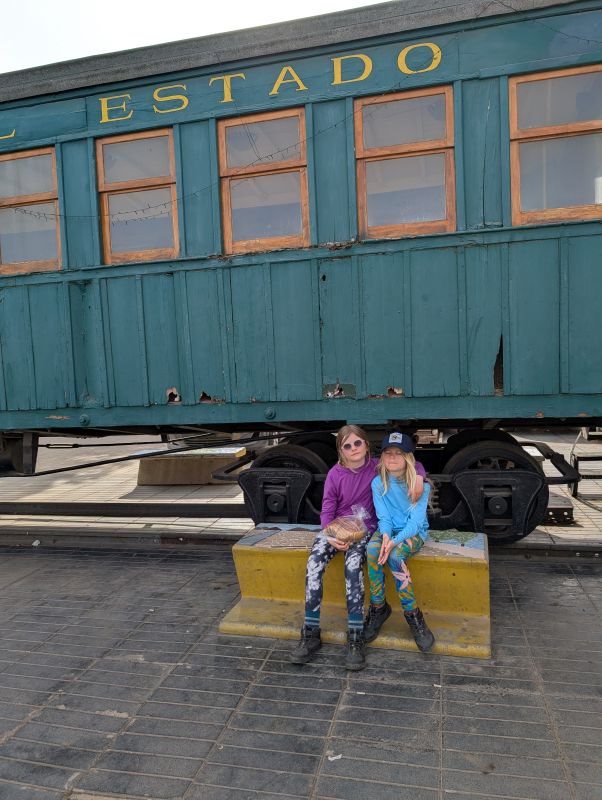
At the train “museum” in Ovalle, which was an old car and several posters
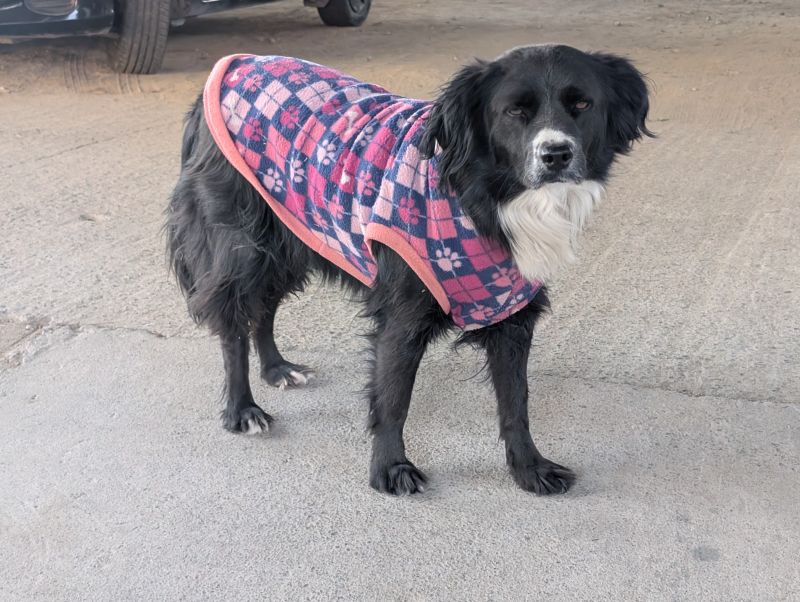
Many dogs were wearing fleece jackets. We didn’t think it was really that cold

Riding Chile’s tunnel route: Cabildo to Illapel

In this entry we spend four days riding the interior of Chile through incredible mountain ranges and along a historic rail route. We pass through tunnels carved through the mountains in the early 1900’s and still in use today. The four days felt much much longer, since each day involved a lot of climbing and most days we started out without knowing our destination. Without kids, it is absolutely typical to not know where our destination is. With kids… we try to know where we will end up most nights. They like knowing ‘how many kilometers more?’ and we like knowing there is food and water awaiting us at a set location! But in any case, we had a spectacular time. Here is the day by day.

One of our wonderful wild campsites

Day 140: Cabildo to Palquico (31 km / 19 mi)

We chose to make this a rather short and easy day for us, since the lodging and even the campgrounds further along the route were full. The route is also very… slanted… so finding a flat campsite on our own would be a challenge. Jason worked some real magic texting various places along the route. If one place was full he would ask if they knew anyone with an available spot. Eventually someone gave him the number of the owner of a small minimarket that also had a small camping/party area nearby!

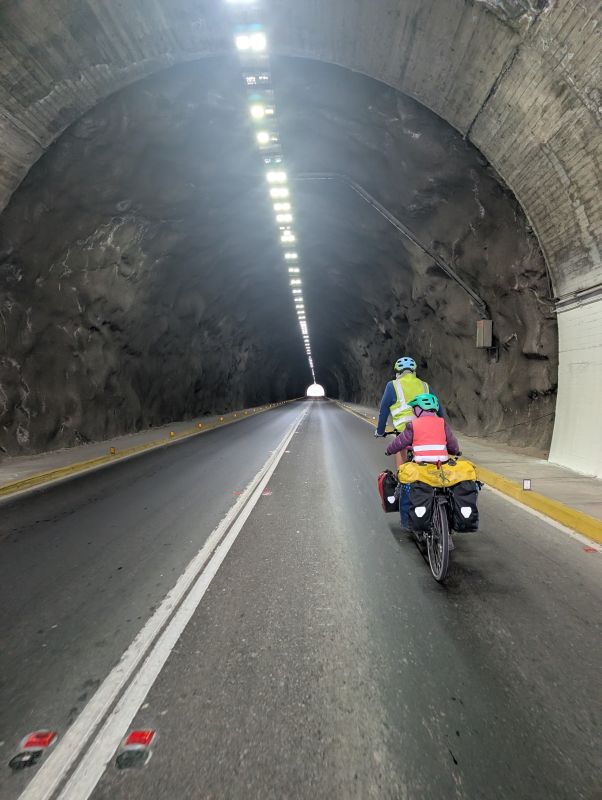
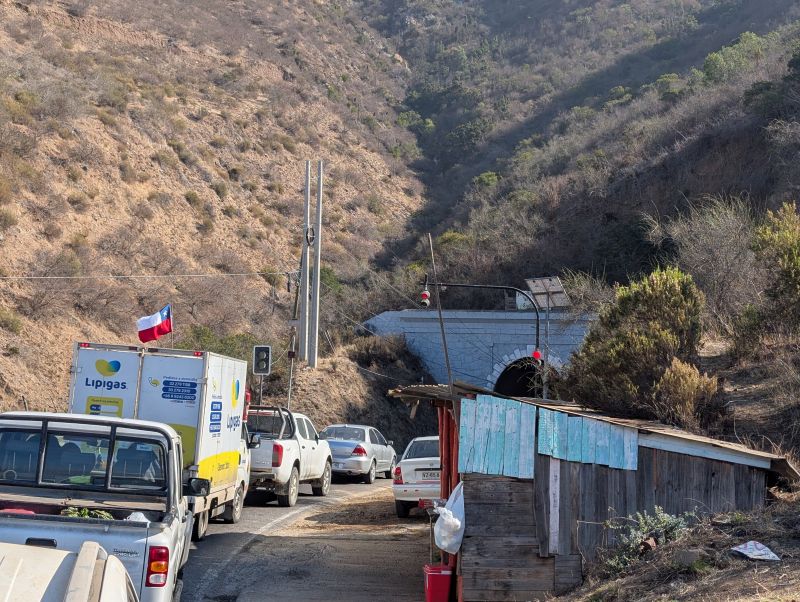
Anyways, back to the day. We dragged ourselves out of Cabildo and right away started climbing up to our first tunnel. The opposing traffic came through in bunches, which makes sense because the first tunnel was just above us. It’s a one-lane tunnel so a traffic light controls which cars go through. It wasn’t long before we were waiting at the traffic light too. We waited out a cycle to make sure we had cars ahead and behind us who were on board to make sure we didn’t get run over, then when the light turned green we entered the dark tunnel.

Looking back down to Cabildo before entering the tunnel. It was much larger than we initially expected
Tunnel entrance

It was really dark! It was really long! We were racing through as fast as we could to make it in the designated amount of time. At first it was slightly uphill, so it felt impossible, but somewhere in the middle it changed to downhill, so by the end we were flying through the tunnel. On the other side we were delighted to see that the opposing traffic still (just barely) had a red light!

From there we descended quickly into the next town, then we cruised along a lovely valley with a tailwind. We stopped in a small town for sandwich supplies, since the restaurants weren’t open yet. A nice man came by to chat with us in the plaza as we ate. He told us all about the mining in the area (lots!) and the fruit (lots!) and the water (not much anymore). The rail lines came through in the early 1900’s and left behind station buildings and tunnels. Now the entire region is tourism and mineral extraction.

A conversation while waiting for lunch sandwiches

After lunch we pedaled away and up the next valley. It was easy, lovely riding on a quiet road. In the ‘town’ Palquico, which was more like an intersection, we found the minimarket (actually a small shack with just a few goods) that also would let us stay in their nearby camping/party space.

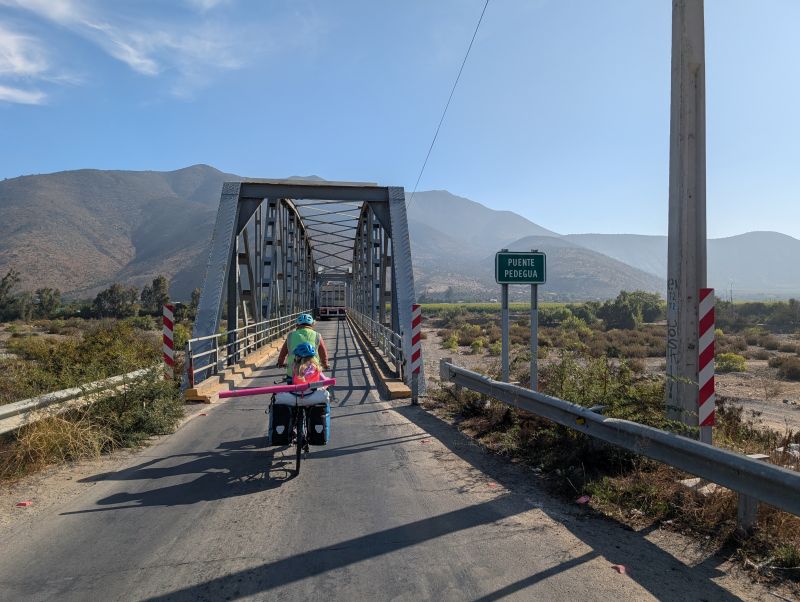
Some of the bridges are one-lane in this region
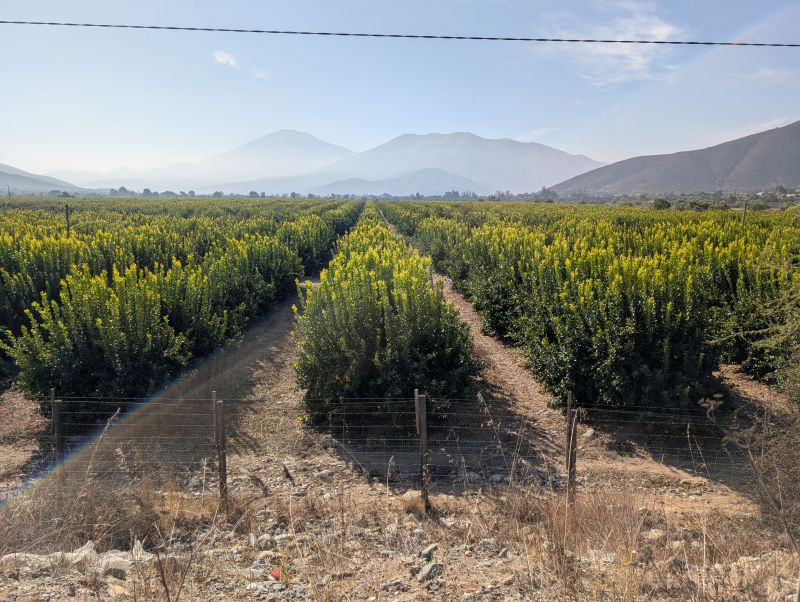
Lemon tree farm
Arrived at our destination of Palquico, and of course the kids still have energy!

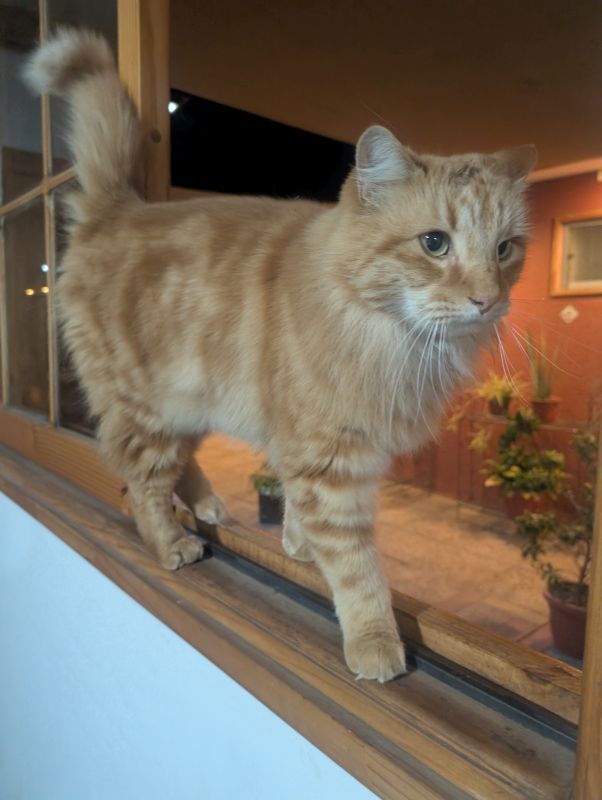
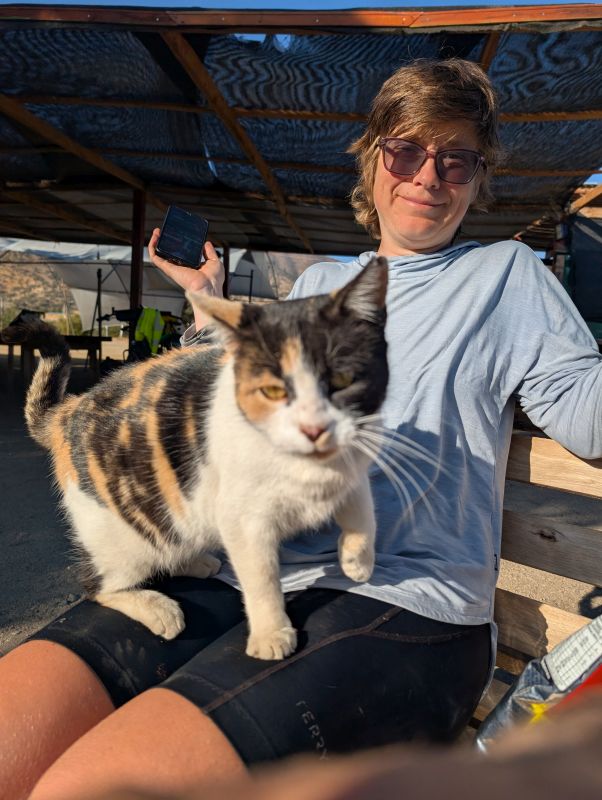
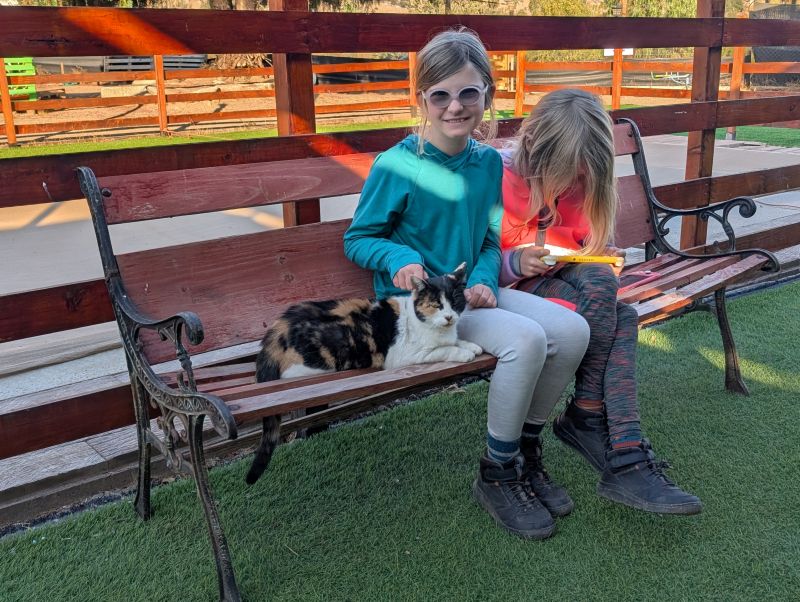
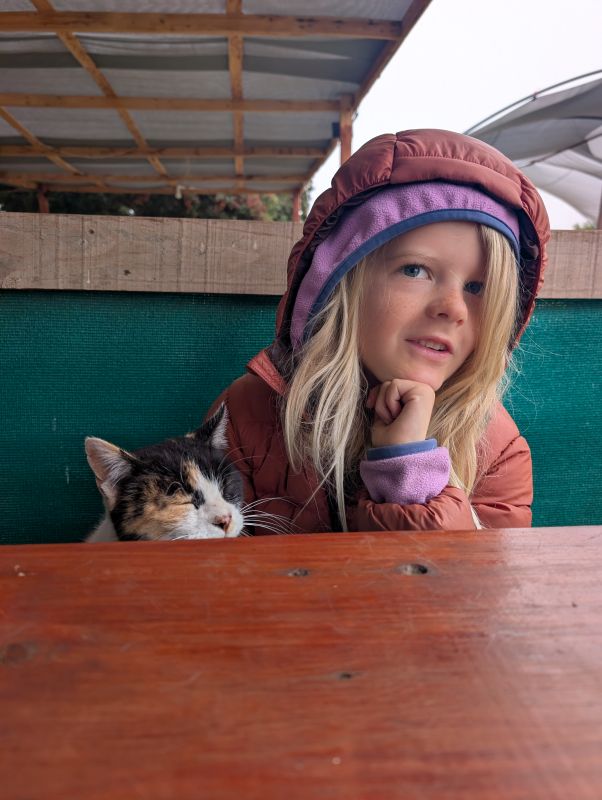
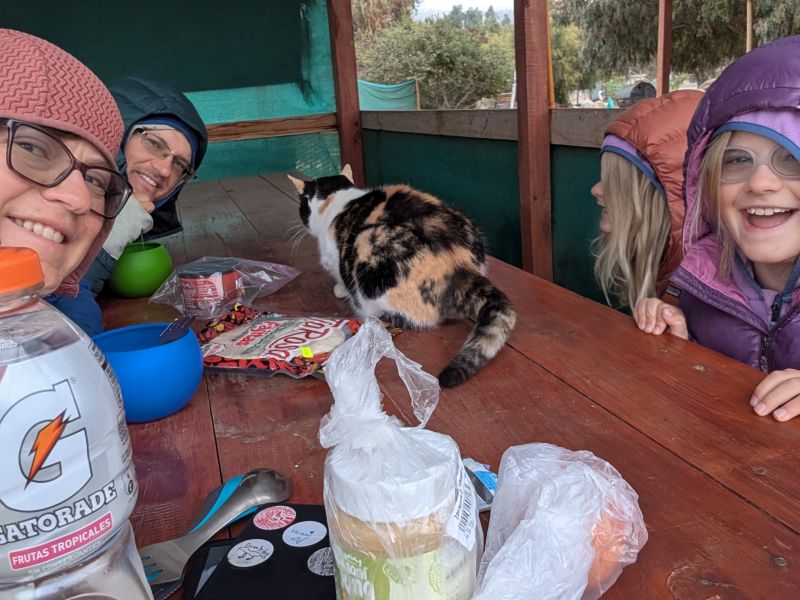
It was actually a delight! There was a large covered area with tables, an outdoor kitchen with lights and power outlets, and a bathroom with running water! We were in such good spirits as we set up camp. We ate instant noodles from the minimarket, munched on chocolate, and peeked at the goats and dogs next door. The dogs barked and barked. Three very friendly cats begged us for scraps, sometimes hopping into our laps to get close to the food. One of them peed on the tent (rude!). There were over a dozen barking dogs as we laid down, but somehow we still slept soundly all night long.

What is up with this cat!?
Yes, it is very friendly
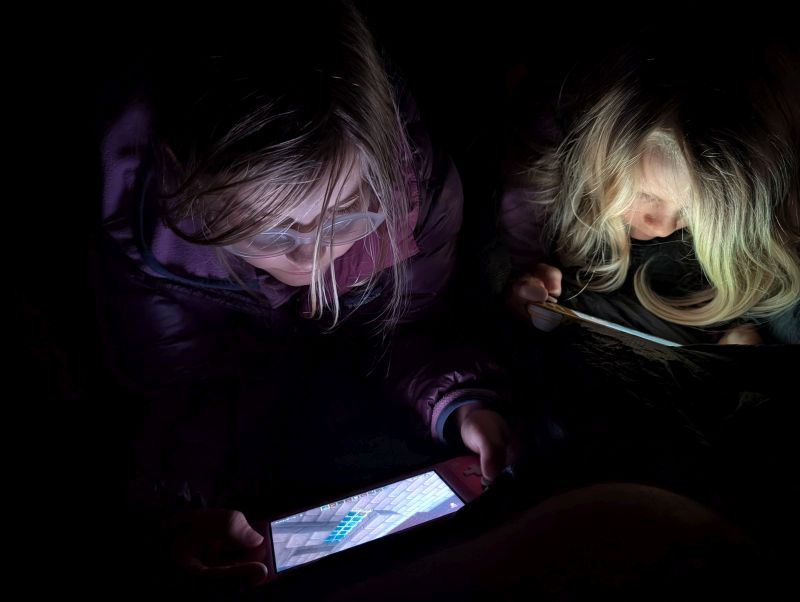
Game time in the tent

Day 141: Palquico to Tilama (25 km / 16 mi)

When we awoke the whole valley was covered with thick, low clouds. We couldn’t see the road above us or the mountains next to us and it felt cold. The only logical thing to do was wait. We ate a slow breakfast and packed up the tent. The clouds retreated just a bit, then a bit more. Eventually they were far enough away that we could confidently ride.

The cat is back in the morning
OK, cat, now that is just ridiculous!
Getting started while the clouds/fog is still low

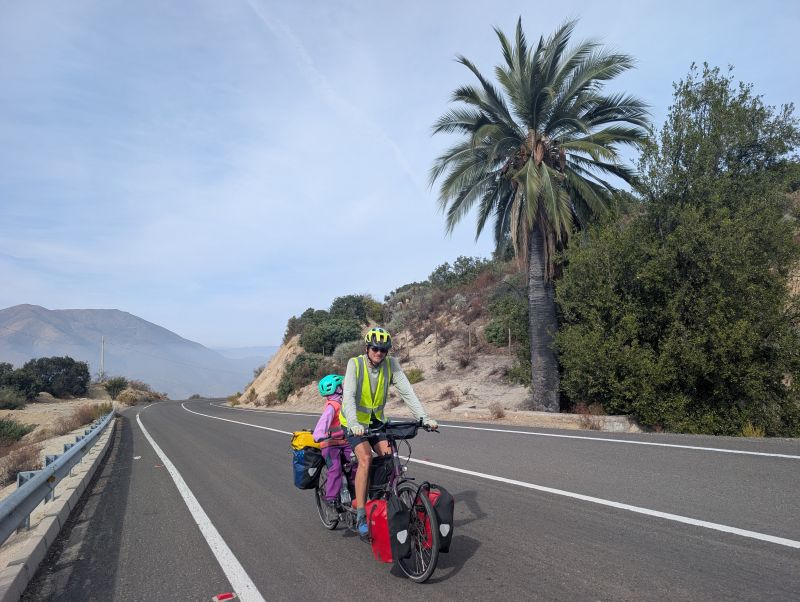
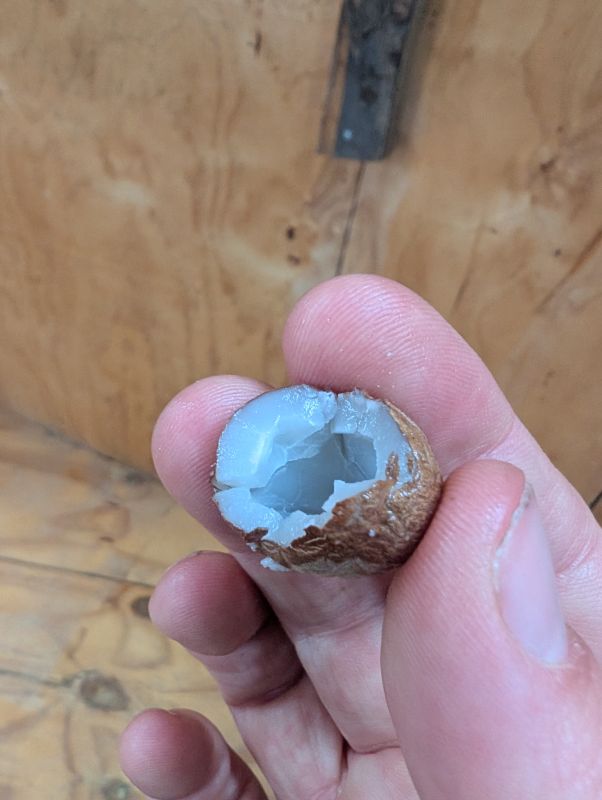
All morning we climbed. Slowly, for the most part, but the grade was gradual enough that we didn’t have to push. As we climbed we noticed more and more plant life. By the time we were nearing the high point of the road there were trees and bushes all around us. There were many Chilean Palm trees in the valley, which was a delight. These trees have teeny, tiny coconuts as fruit!

Going up from Palquico
Climbing
Jason, A, and a Chilean Palm tree

At the top of our climb was another tunnel, this one over a kilometer long and controlled by a shorter stoplight. We flagged down a passing truck and asked the driver if they would go ahead of us at the next light, then stop on the other side and make sure no one else entered until we had exited. The driver was happy to help! With this extra reassurance we really enjoyed the long tunnel this time. It was dark and full of echoes, and at the end there was a bit of a waterfall from the side of the tunnel!

Another tunnel

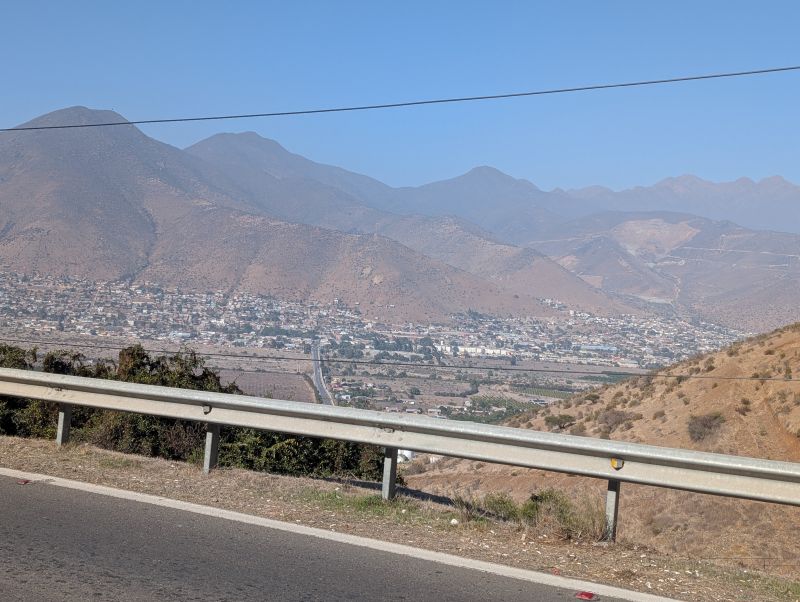
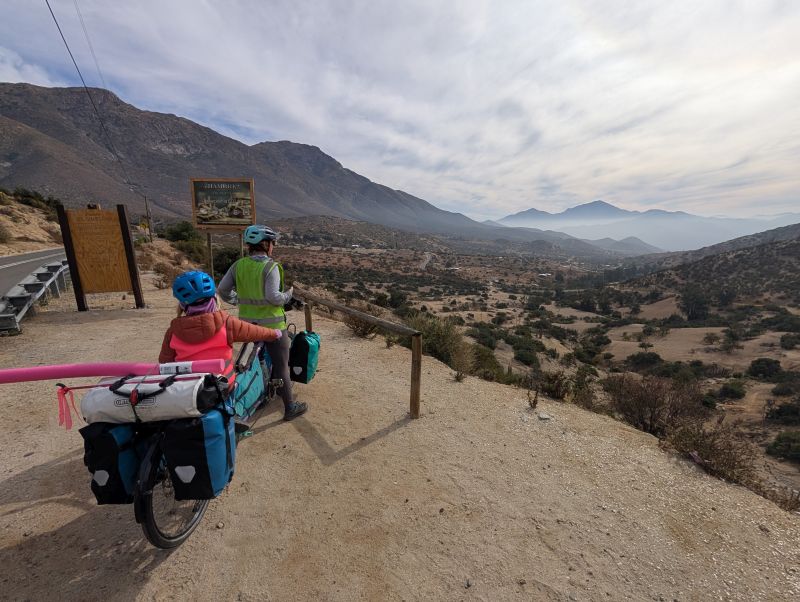
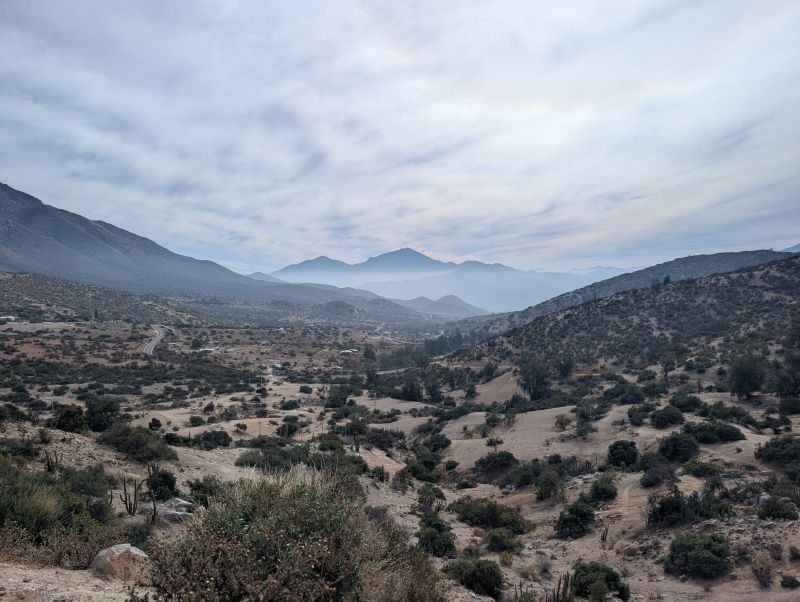
We emerged into a bright day, a new valley, and a spectacular view. Each time we climb from one valley to the next we are greeted by mountains that are just a teeny bit drier. This time the view was truly spectacular.

Looking into the new, slightly drier valley

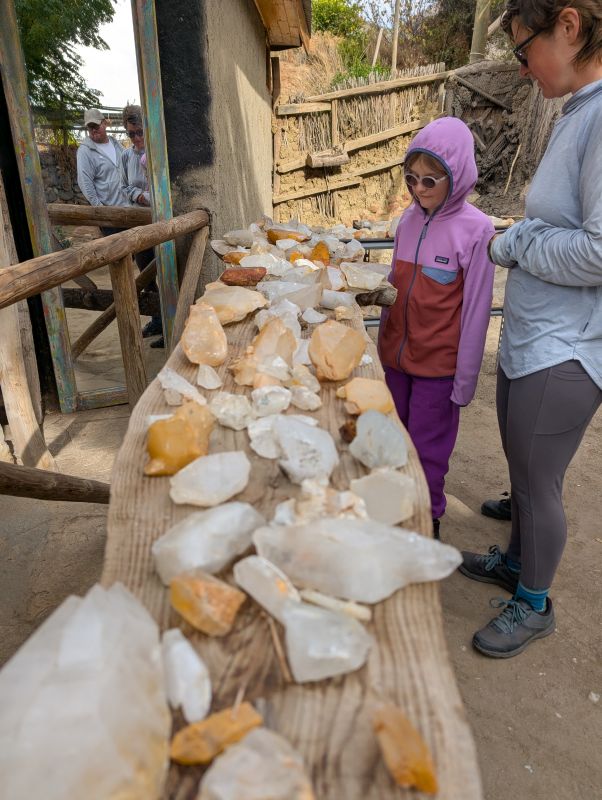
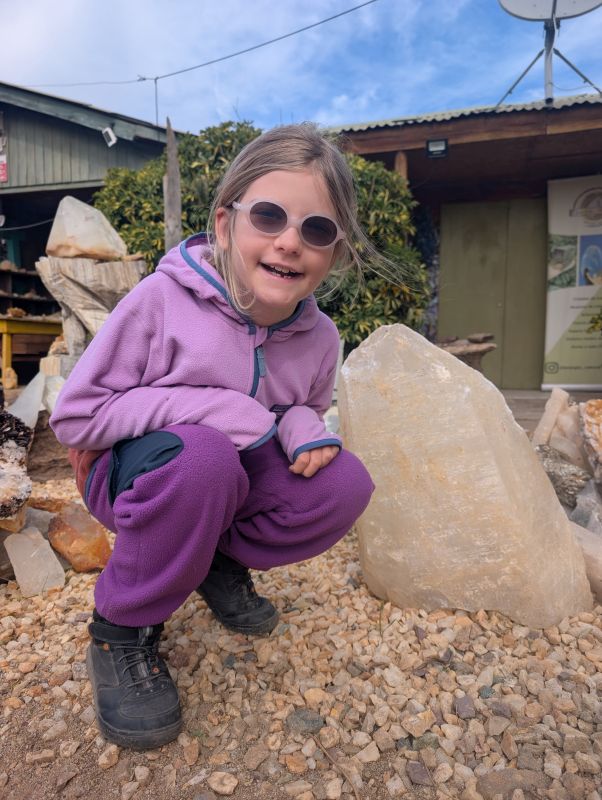
The road descended just a bit to a little shop selling sandwiches and quartz crystals. We were cold and hungry, and the owners there were so kind to us. We ordered drinks and sandwiches, and when the noticed how starving the kids were they brought us slices of apple cake. They also gifted the girls some quartz crystals, which is so sweet and kind but also now we carry rocks I guess.

Checking out the quartz rocks
I think A might want to take this one…

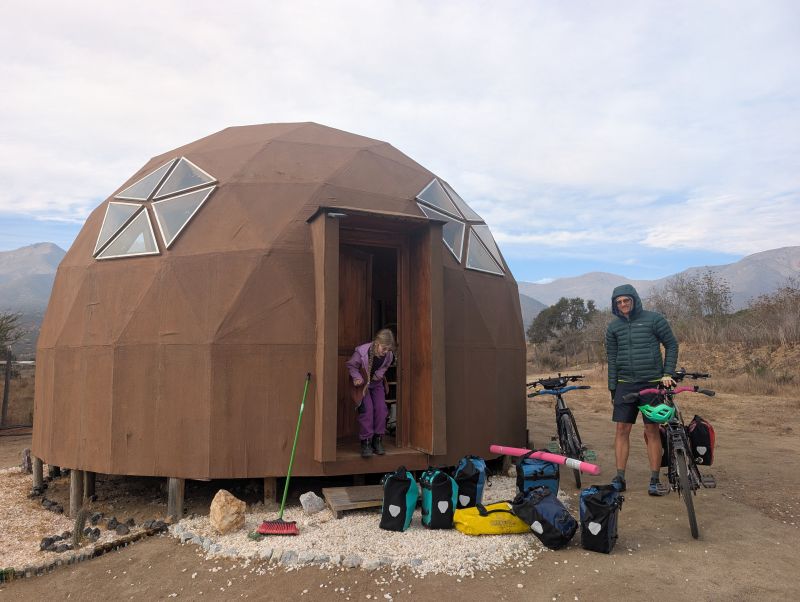
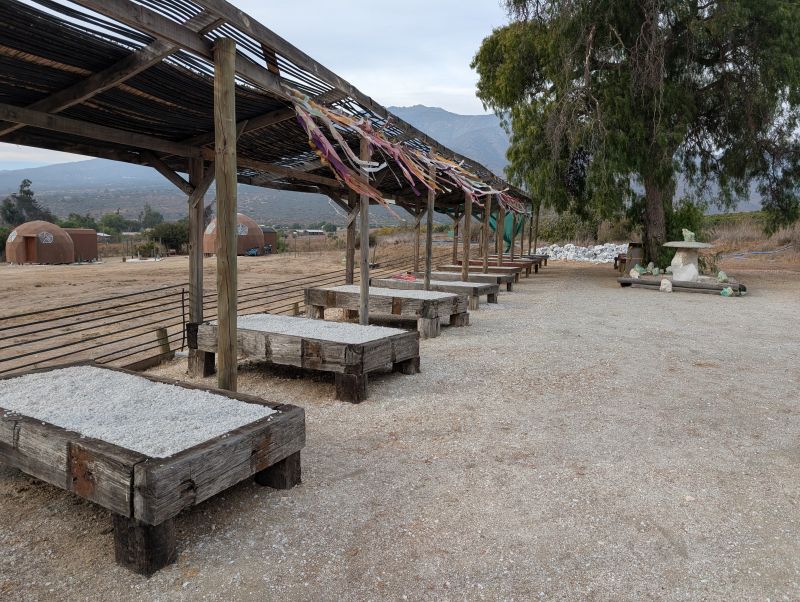
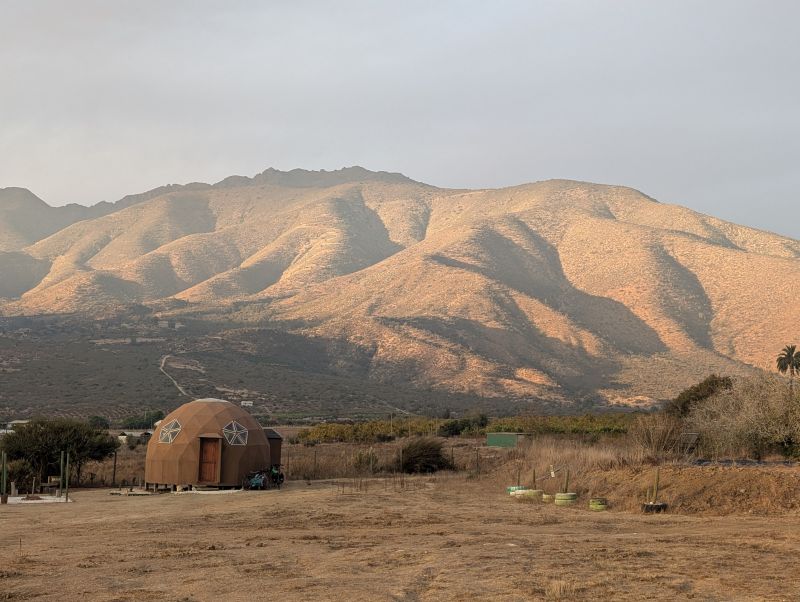
We zipped down the mountain, which was truly magnificent. There were big vistas and little one-lane bridges over a dry creekbed. In the ‘town’ we saw a small sign for a campground, which also offered geodesic camping domes. We followed a dirt track to a big field with quartz beds, a restaurant full of Chilean tourists, and two domes. We were absolutely delighted when we were allowed to rent the big dome for the night.

Coming down the mountain. In down jackets
Another one-lane bridge, presumably created for the railroad 100 years ago
Our dome, with two beds
This is what quartz beds look like. We were told that they have good energy

While the girls rested, Jason and I went in search of food. This town is so small that there is only one place to buy food. When we rang the bell an older gentleman came out and told us the owner was at mass and that we’d have to come back in a couple hours. Then he proceeded to ramble on about all kinds of interesting topics, including his aunt that moved to DC to work at the Chilean embassy there. He mused that we should go find her and tell her about him so he could inherit her money, since she never married nor had children. Odd conversation with that one.
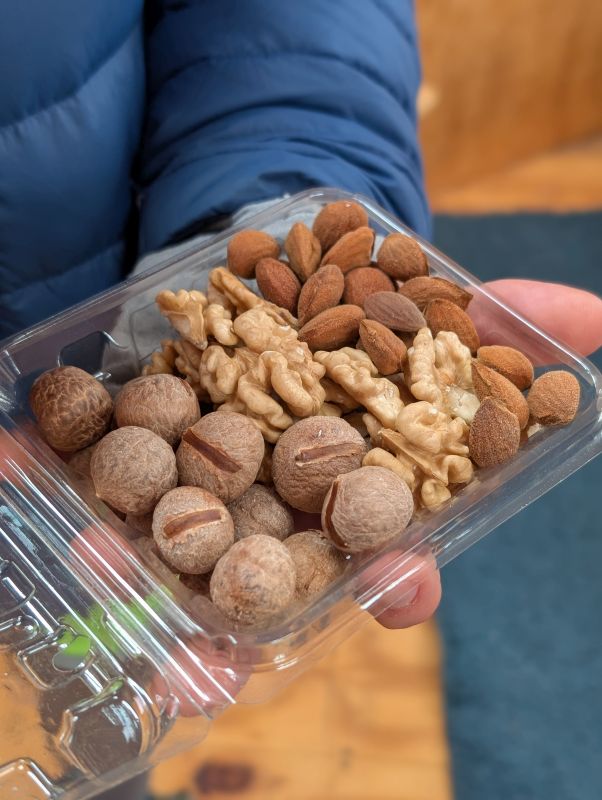
We decided to take a little stroll up the street and back. By luck we found a very nice woman selling random things from her car. We bought avocados, strawberries, and a container with shelled Chilean coconuts!

Nut selection: Chilean palm coconut, walnuts, and almonds
It really does look just like a teeny, tiny coconut
Ah, there’s some monster in the background

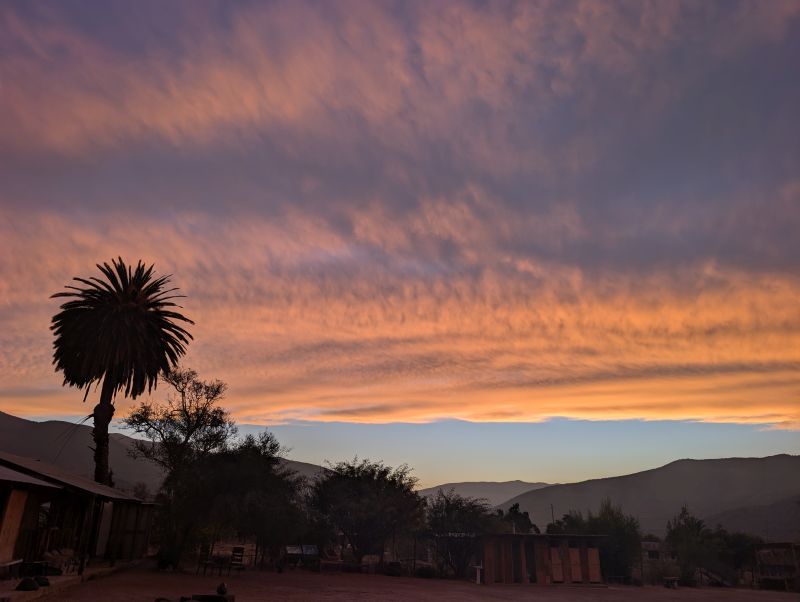
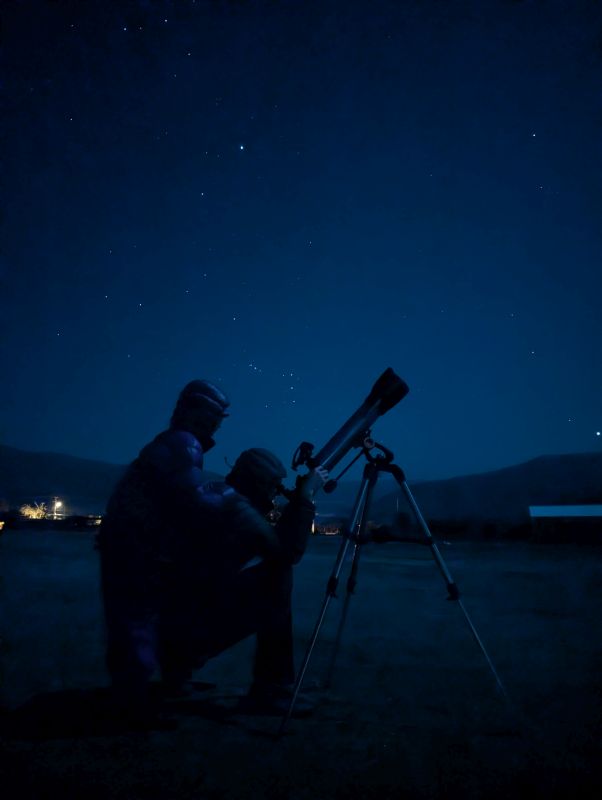
We were treated to a fantastic sunset. In the evening we took the small telescope out of the dome. We looked at a few stars, the moon, and a distant street light.

Sunset is starting in Tilama
Yeah, A!
Telescope time

Day 142: Tilama to wild camp north of Caimanes (26 km / 16 mi)

It was a cold night in the dome, so we weren’t moving quickly to get out of town. It was cloudy, with a heavy dew on our bikes, but no fog at least. When we finally got moving it was straight back up into another climb. This one was only half the vertical gain as yesterday, so it was over quickly. There were no Chilean palm trees or hidden lush ecosystems either. I suppose the high valley from Day 141 was truly special.
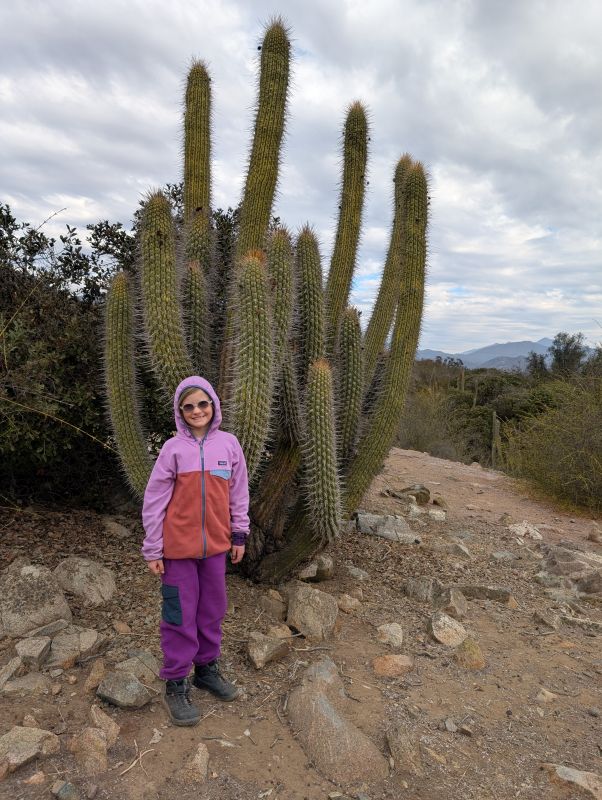
A wants to show you how big some of the cactus are
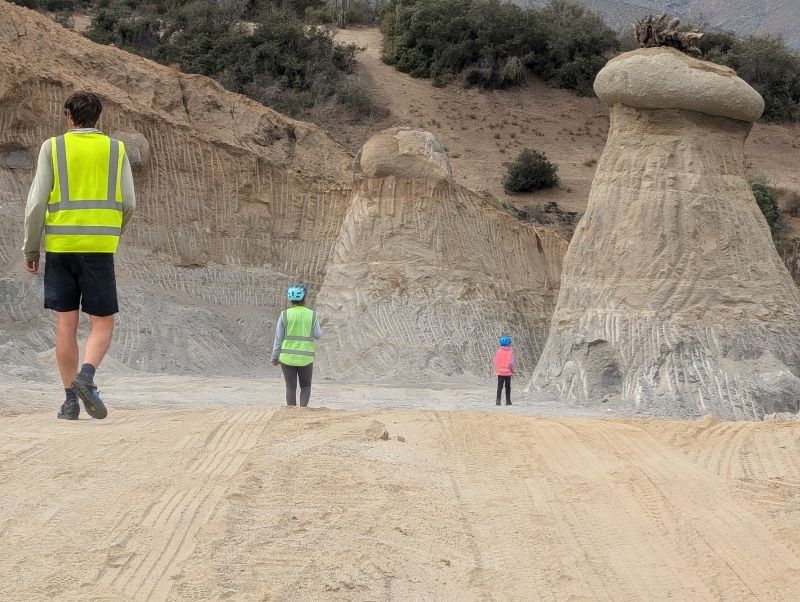
We were enthralled by these rocks in this quarry
Two happy sisters

The next valley over was, as expected, just a wee bit drier. It was also a lot less lovely. The region is overtaken with waster processing from an immense copper mine in the Andes. We arrived in the main town, Caimanes, before lunch. The main road was under construction and the streets were teeming with workers from the mining companies.

We had already messaged about a dozen hostels asking if they had space, and not a single one had said yes. There was optimism that we’d find a place to stay once we were actually in town, so we started asking around. We asked at the minimarket, who sent us to a sprawling complex of accomodations. They didn’t have any space either, but sent us to another hostel that ‘might’ have space. Nope. We popped in at every place with a ‘lodging’ sign out front. Nothing. Every lodging was only for ‘la empresa’ (the company). We asked at the fire station if they had a place we could camp, and their only solution was a nearby parking lot. No thank you!

Finally around 3pm we gave up. We loaded up on water at a mini market near the edge of town (the owner was very curious about our trip but had no ideas about where we could stay in town). Then we rode out, looking for a safe place to camp on the next climb.

It didn’t take long before an opportunity presented itself. We found a sheltered spot between two roads (visible to neither) that goat herders clearly used to transit their livestock between locations. Lots of goat poop, cacti, bushes, rocks… and a nice sheltered flat spot for the tent. We dragged the bikes and gear up the path and set up camp. It was a peaceful, scenic night after all that.

Relaxing at our wild camp
Dinner time in camp

Day 143: Wild camp north of Caimanes to Illapel (52 km / 32 mi)

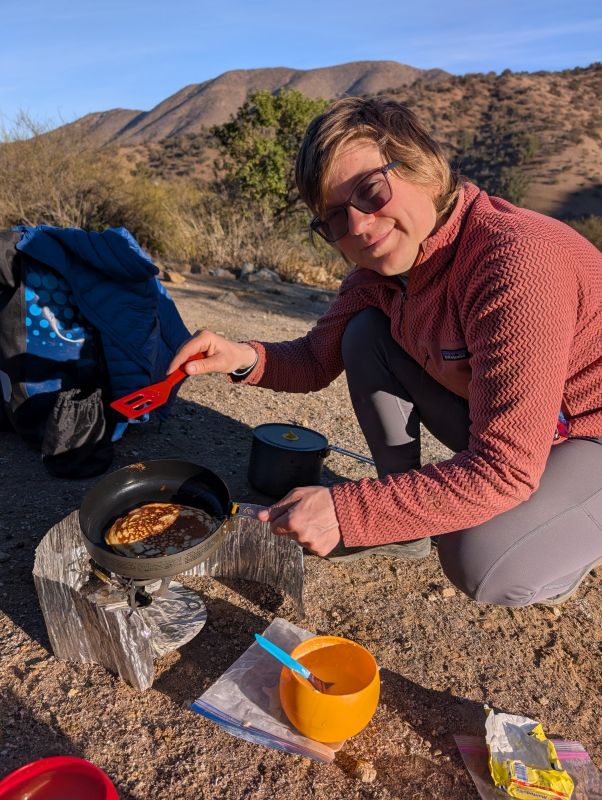
We woke up to a sunny, warm day. We were running a bit low on food supplies, since it had been many days since we passed a proper super market. Remarkably, I had the supplies for pancakes still, so in our goat-poop wild camp we chowed down on fresh pancakes and coffee.

The chef cooks pancakes in the middle of nowhere
Our bikes – just about ready to go!

As is normal on this route, we started the day climbing. This time we criss-crossed the same mountainside overlooking Caimanes. When the road got steep and my legs got tired I would rant a bit about the town overtaken with mining.

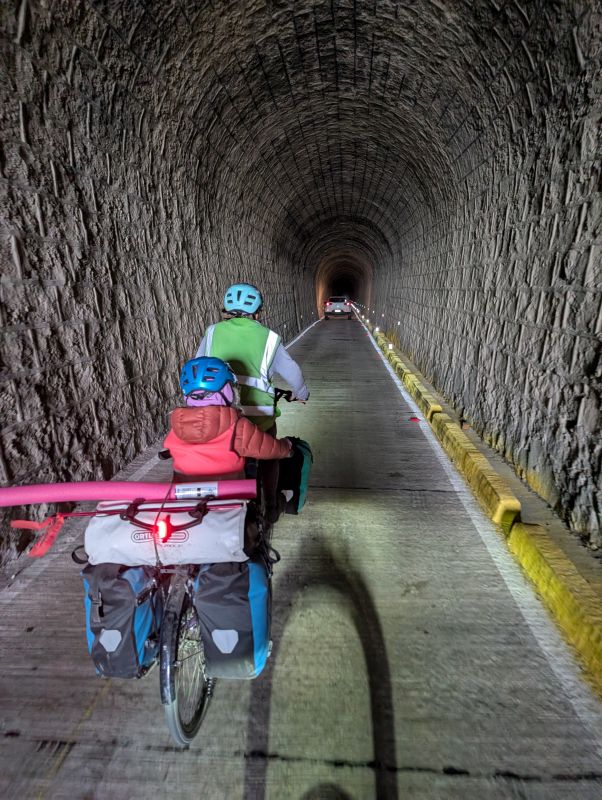
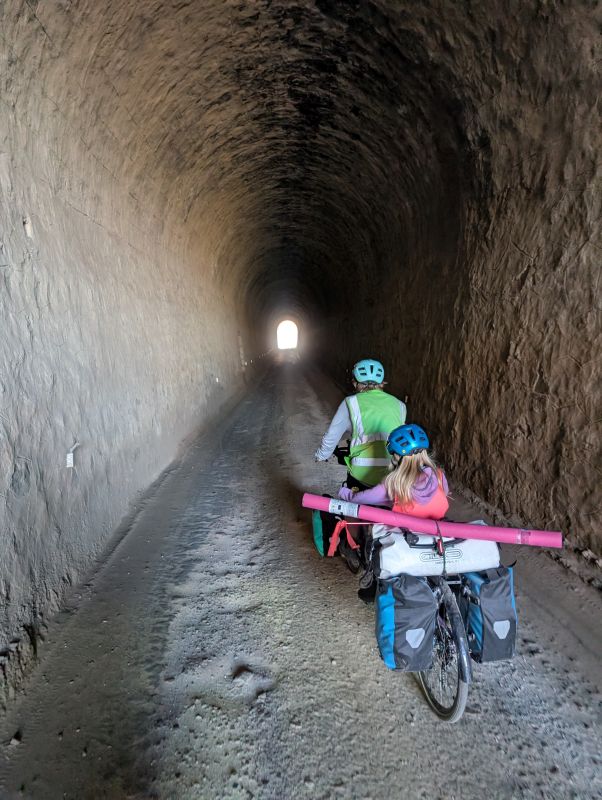
We had three tunnels today, all with dirt road surfaces, all one-lane and built between 1910 and 1912. The first tunnel was short and straight. The second tunnel was a bit longer and also curved. That one was a bit spooky since there was a stretch in the middle when we could see neither the entrance nor the exit. Finally the last tunnel was very long, with a very rough surface. By the end of it the surface was actually cobblestones!

Another tunnel

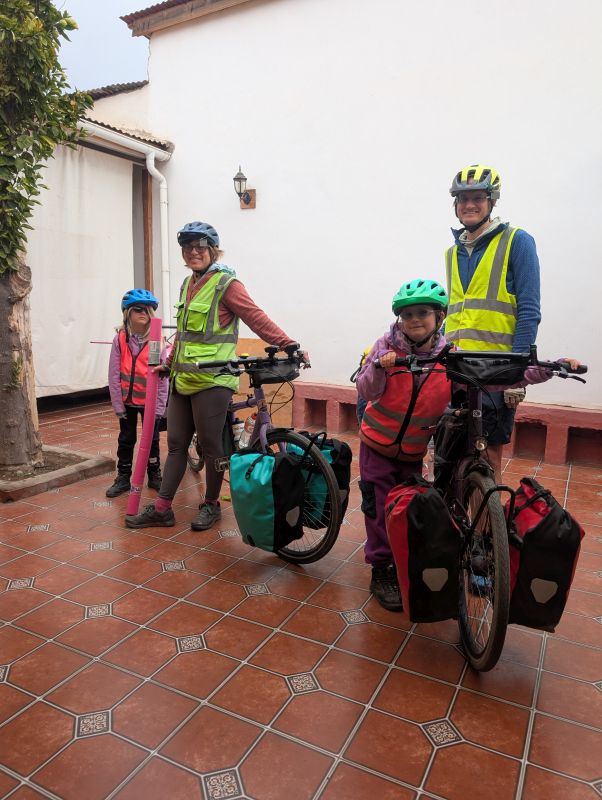
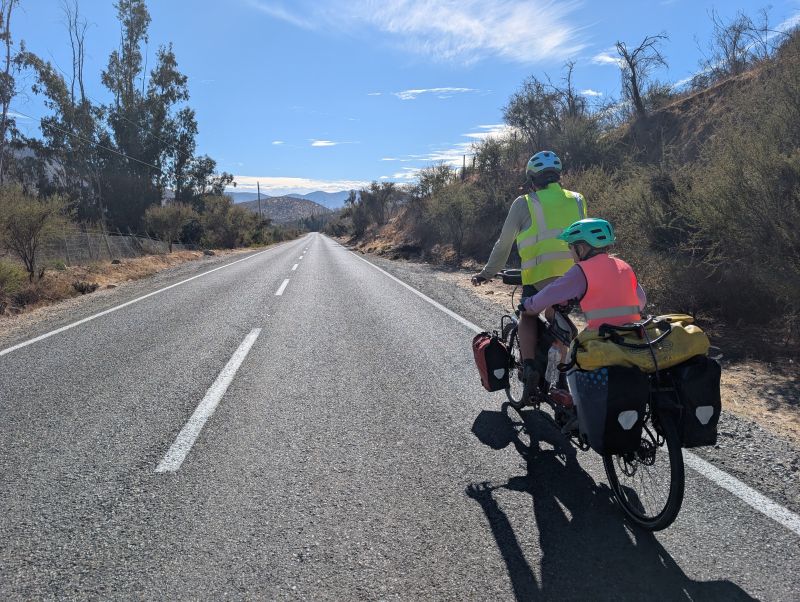
For all the tunnels we flagged down a passing vehicle to be our safety escort, and of course we had our reflective vests on and all our bicycle lights on bright. We felt very safe, so we could enjoy the unique experience of being inside these century-old tunnels.

Outside the last of the three tunnels we emerged into… yet another slightly drier valley. The descent was magnificent. It was a perfect grade on a smooth road with layers on layers of mountains stretching out to the north. We loved it.

Nearly endless mountains
Heading downhill

We grabbed some lunch supplies at a minimarket then got on a very quiet side road for our approach into the city of Illapel. This side road was what we call ‘peak cycletouring’. It was narrow, with almost no traffic, with good views down the valley and farms around us. We eventually entered large groves of citrus trees before reaching the final approach to Illapel.

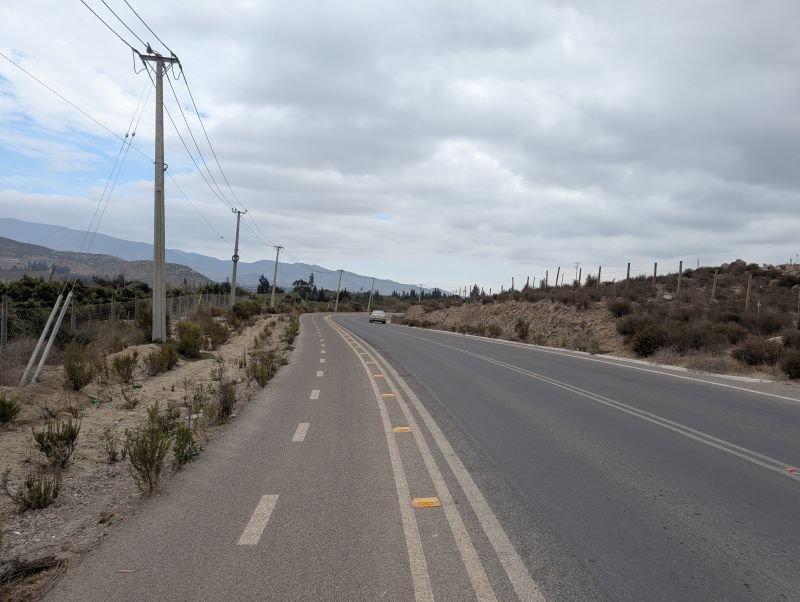
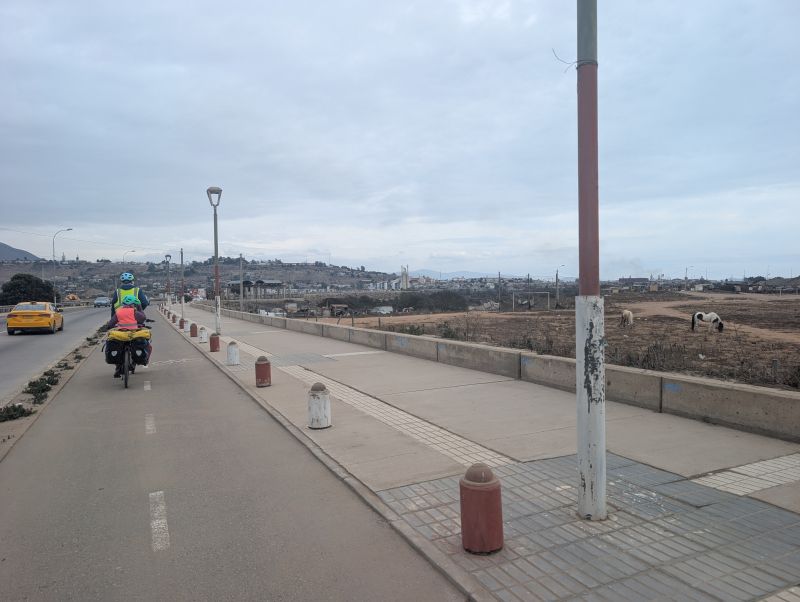
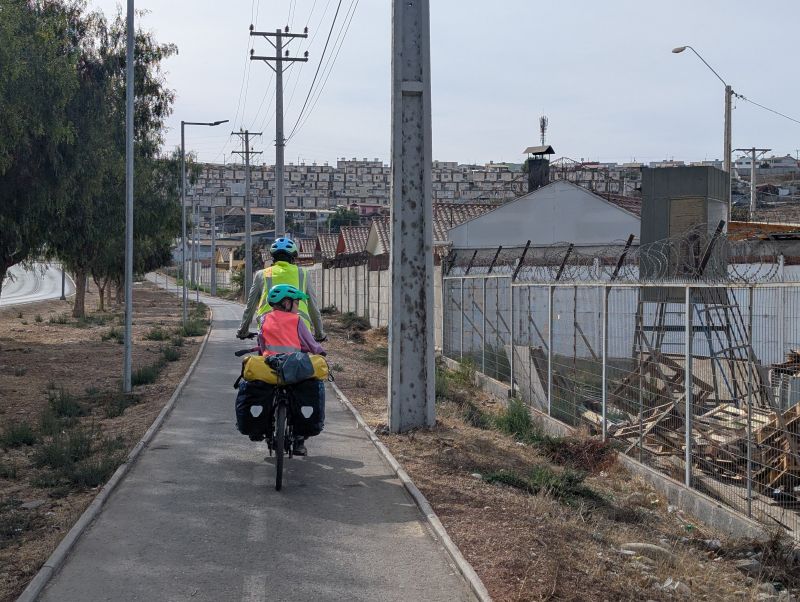
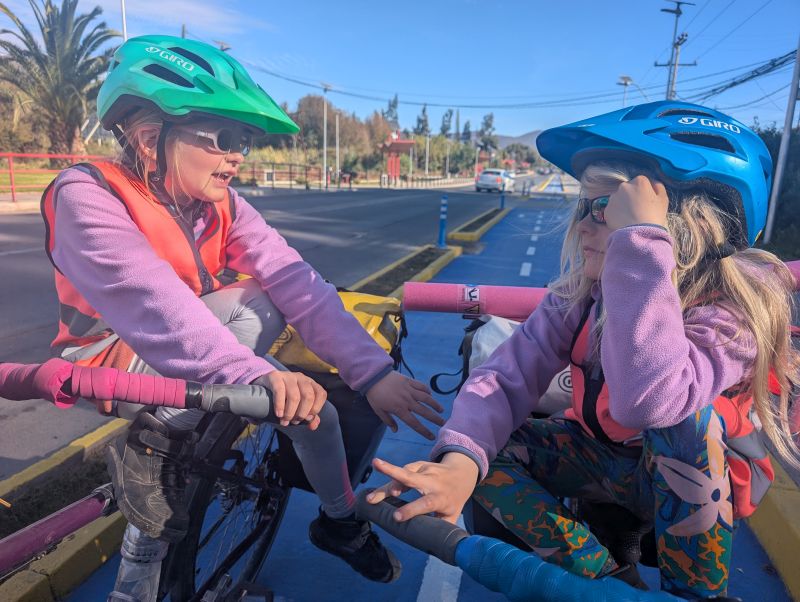
Bike path discussion in Illapel

Illapel is the largest town in the region. We made our way to a hostel where we were welcomed with open arms. It was one of those places that cycletourists frequent and write their names on a wall. Flags from different countries hung in the courtyard. We decided to rest for three nights and two days here. After our long stretch of desert it felt like an oasis.

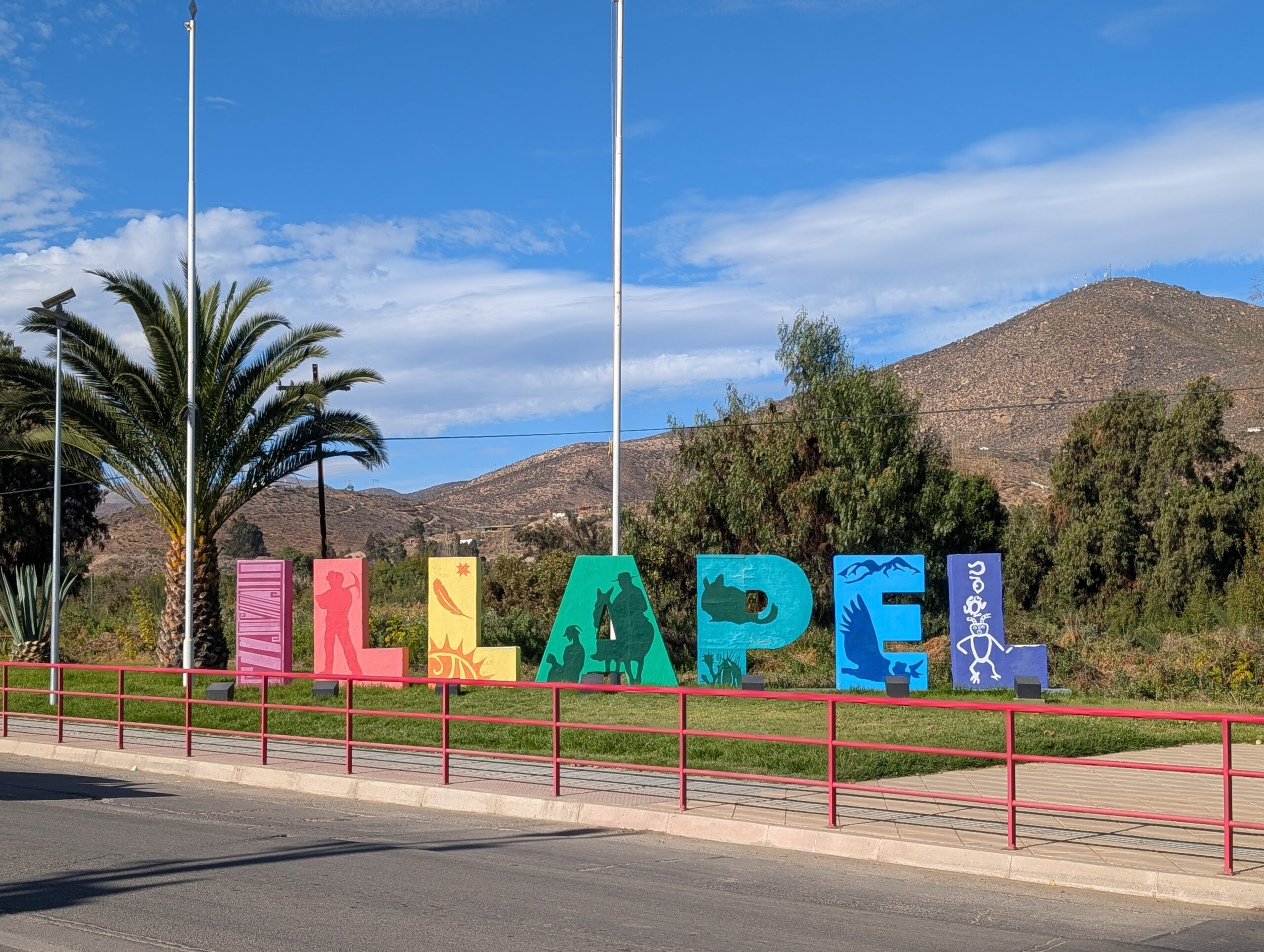
Welcome to Illapel

Riding through Conguillio National Park

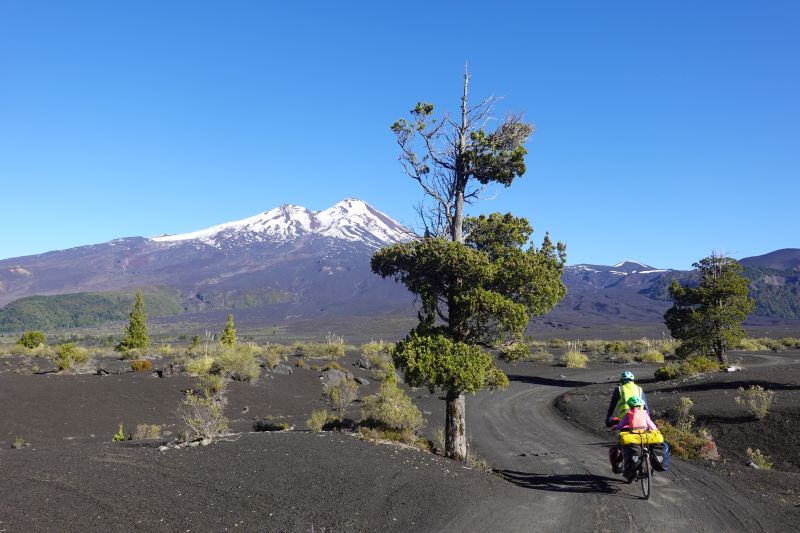
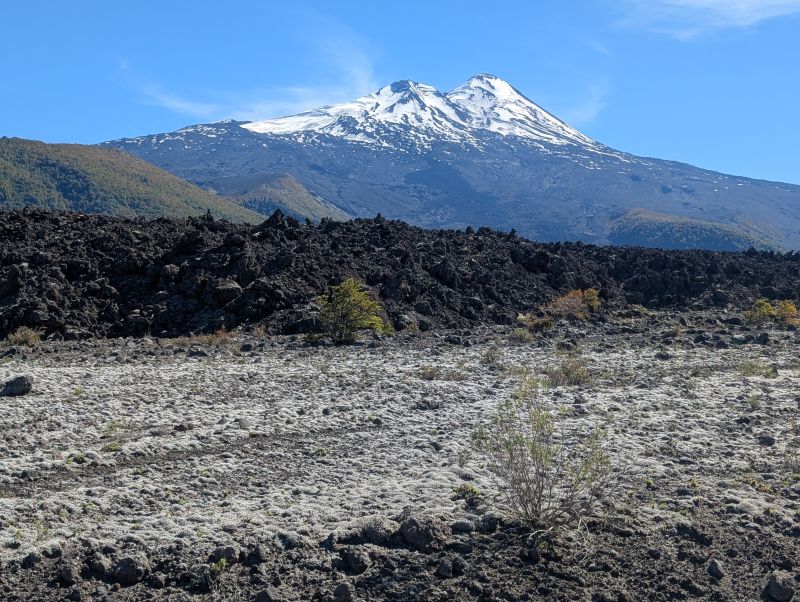
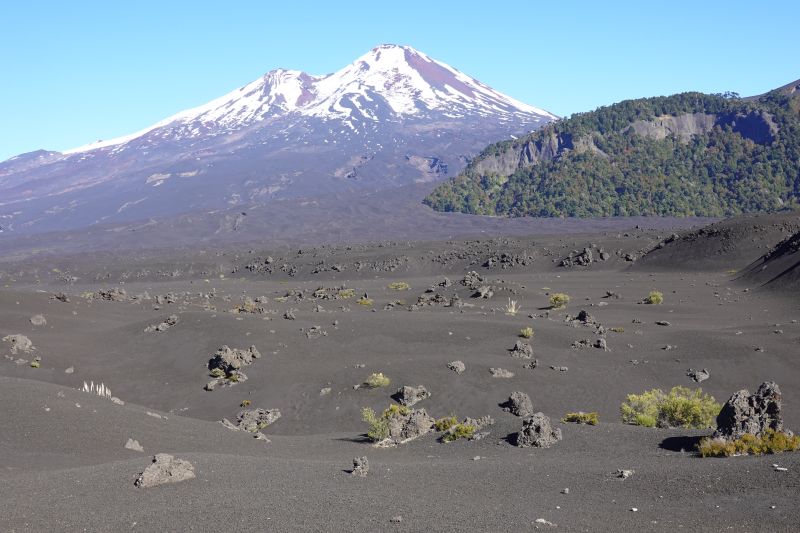
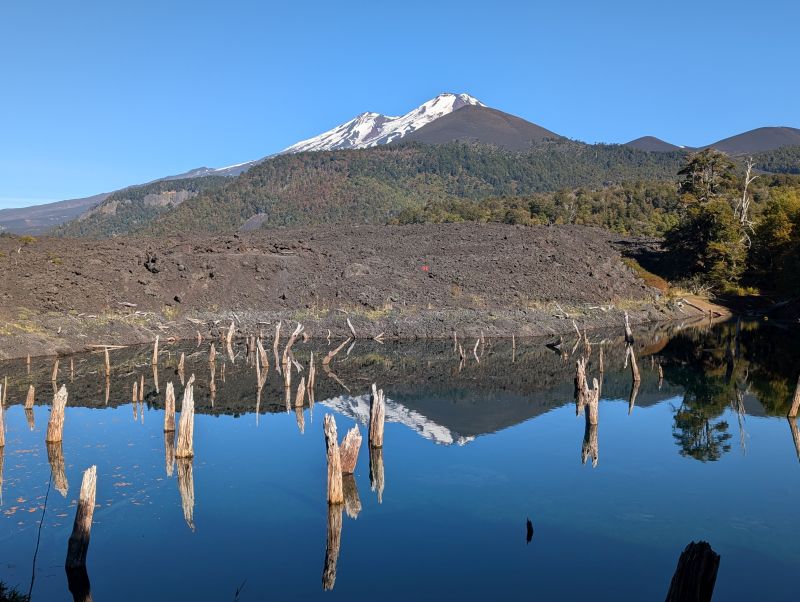
Volcan Llaima has two peaks, and we could see the lava flows on the hillsides as we rode around it over three days.

On paper, it looked simple: Ride through the national park around the Volcano Llaima, a total of 72 km from Melipeuco to the next town of Curacautín. We knew there was a substantial pass in the middle, but we had done bigger passes before. We knew it wasn’t pavement, but we had ridden hundreds of kilometers on gravel already. Even so, we planned to cover the 72 km in three short days of 20km, 28km, and 24km. We thought there’d be plenty of time each day to stop and enjoy the sights. Gosh were we wrong!

I’m going to do this entry a wee bit different: I’ll summarize the highlights (and low lights) up front, then leave the girls journal entries for the day-to-day. I save the pics for after the girls’ entries so if you’re only here to see those, skip ahead now!

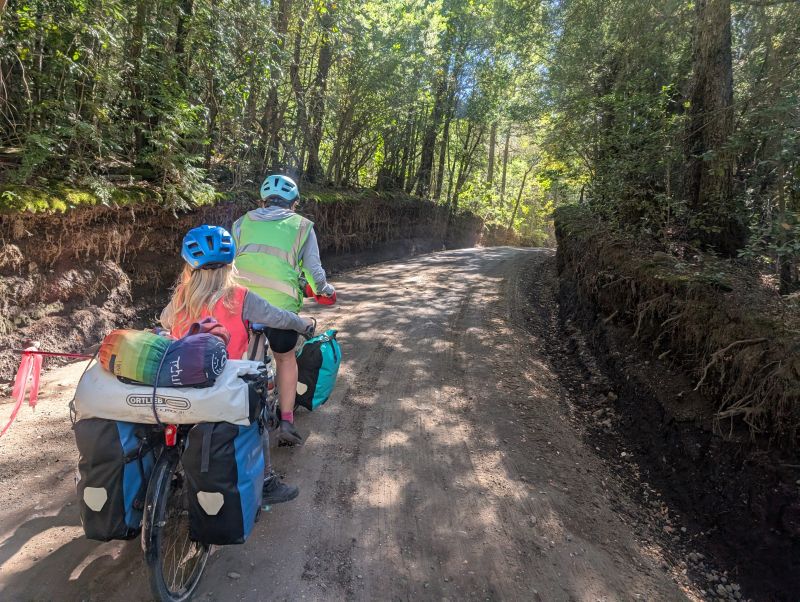
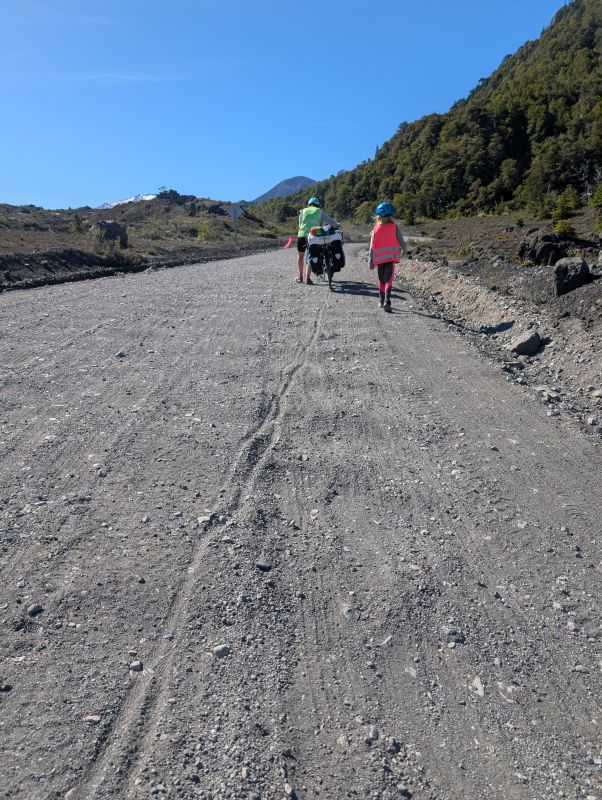
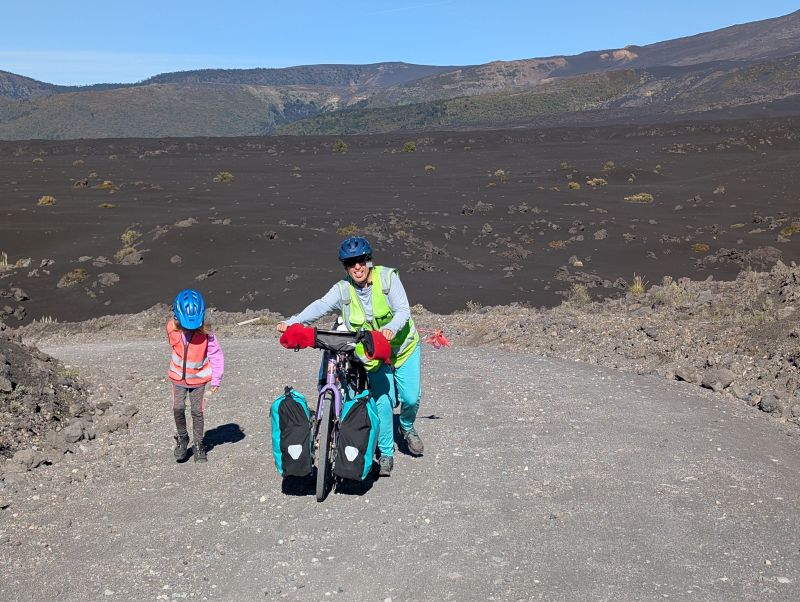
It turns out that the unpaved road through the park was less gravel and more… SAND. If you’ve ever ridden on sand on a bicycle, well you weren’t riding a fully loaded tandem. I know, because it’s actually impossible, especially with a kid on the back. The wheels sink, then slide, and if you try to power through they slip too. There were bits of the first two days that were ridable, but slowly. There were more bits that seemed rideable until the wheels slid out from under us. We ended up walking long stretches.

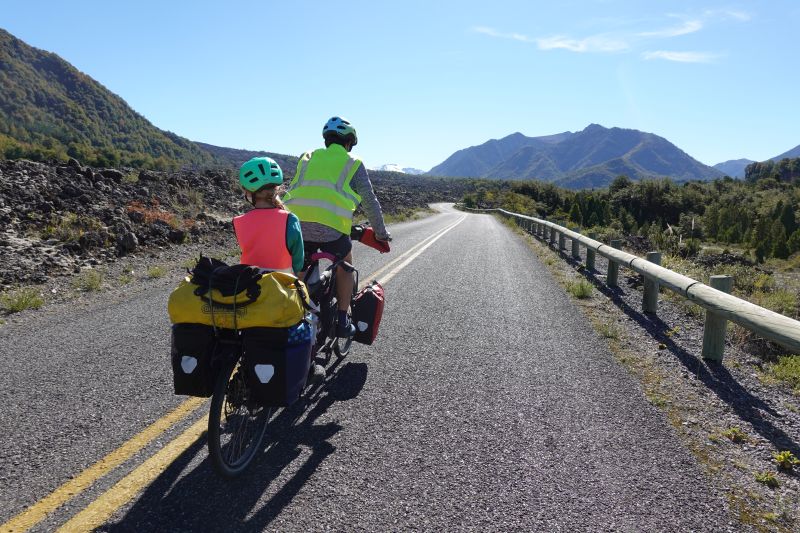
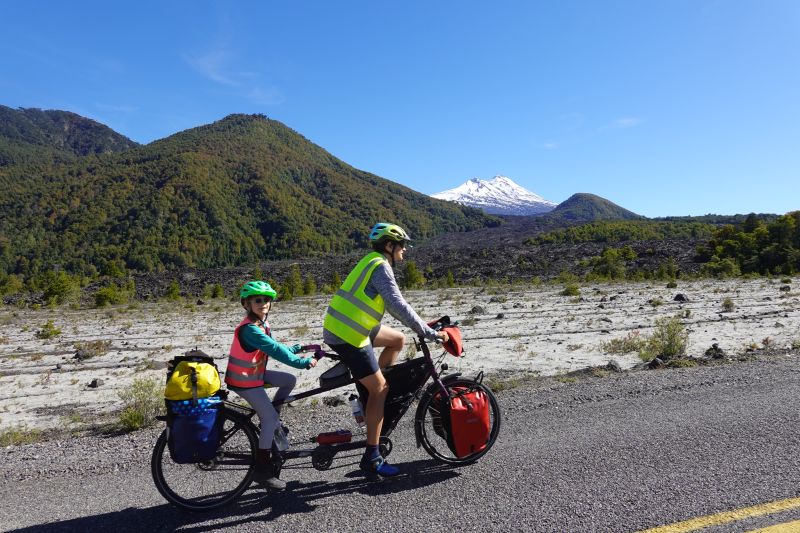
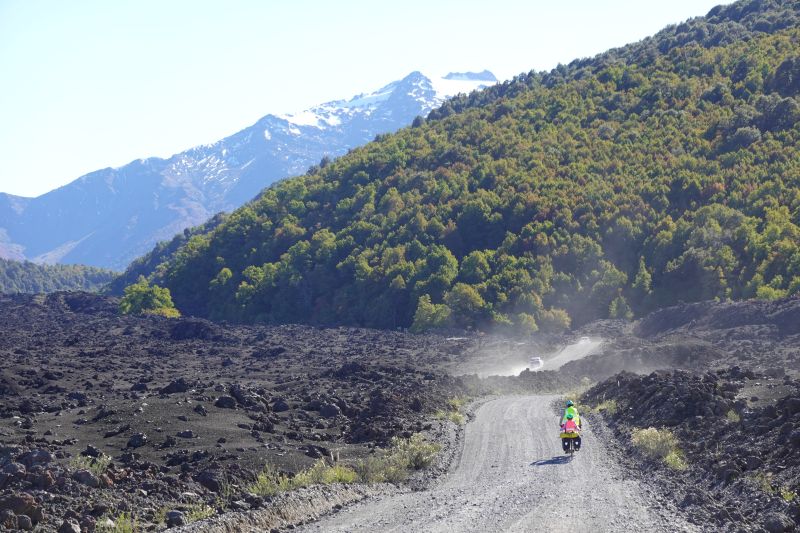
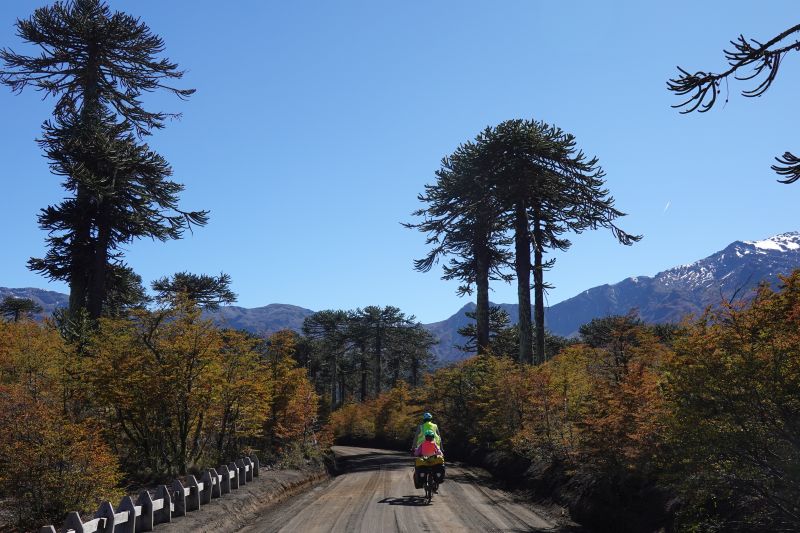
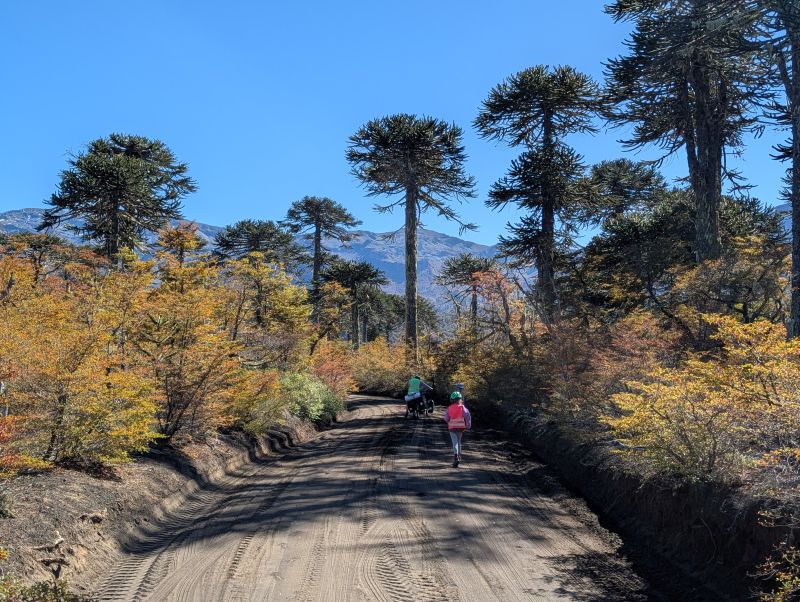
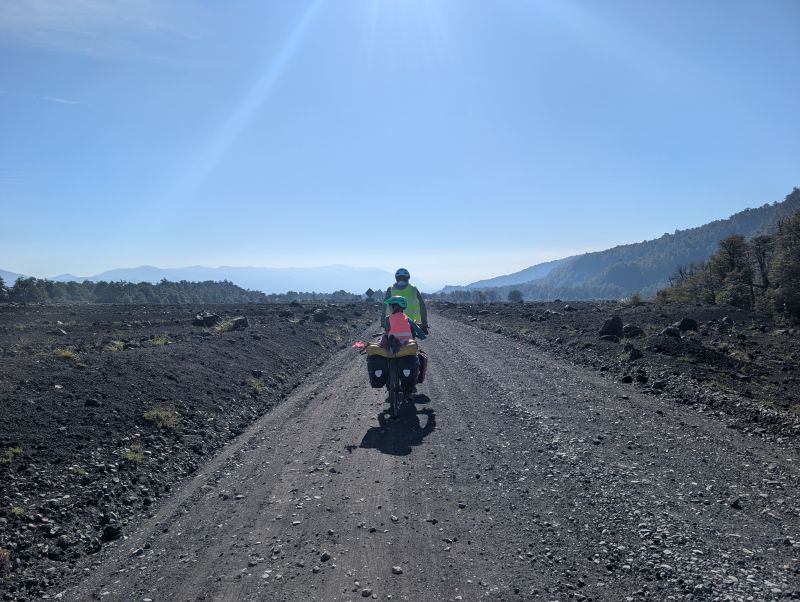
Of course, the scenery was spectacular. We rode through lava fields, and through araucaria forests with golden fall-foliage undergrowth. We rode past sparkling lakes and rainbow lakes. We rode in the shadow of the incredible volcano. We slept inside the national park and saw the milky way. We saw a waterfall. There was a second volcano. It was all beautiful. It was also the most challenging terrain we’ve had on this trip.

The girls were incredible – they understood the task. We just had to keep making forward progress. On our first day, that meant riding when we could (walking when the road was too soft), and also despite the heat. That’s right, we were baked on the road in the middle of the lava field. Despite it being mid-fall in this area, an unusual heat wave was coming through. Sure it wasn’t actually *hot* at 72 F, but for us it was!

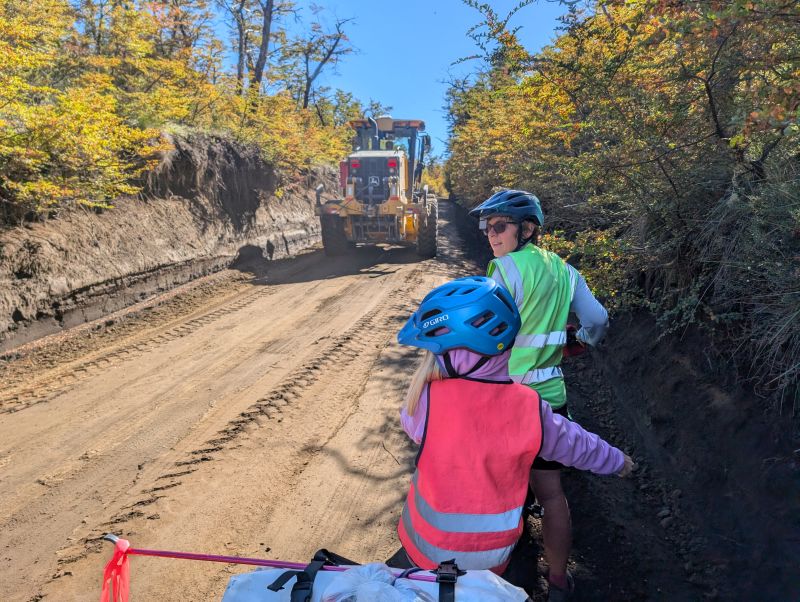
On our second day in the park we battled sand for kilometers, and then when the road entered the deep forest and became dirt and the girls found out what a ‘dream-smasher’ is. Jason and I have coined the term ‘dream-smasher’ for a particular type of construction vehicle that smooths a thick layer of loose dirt evenly across a road. It renders the newly treated road surface unrideable. The vehicle that sometimes follows and squishes it all down is what we call a ‘dream-maker’. Unfortunately on this day the dream-smasher had come through and there was no dream-maker in sight.

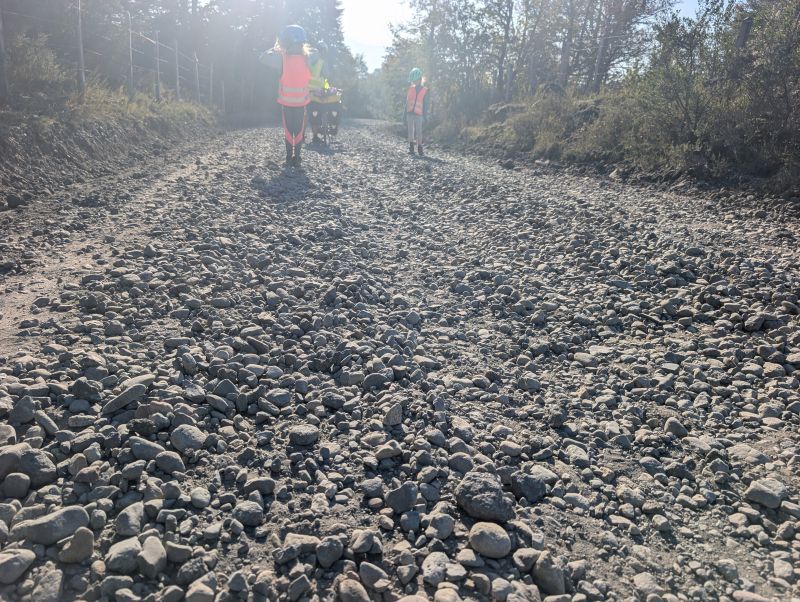
Once we finally past the dream-smasher for the last time we were also over the pass. We looked forward to the long downhill! But that turned out tragically as well, as the dirt road turned to gravel road turned to… huge loose rocks. It was, as you may have guessed already, also unrideable. I believe we walked at least 5 miles that day to get past the awful road surfaces. For a single bicycle much of it would have been fine, but it just wasn’t for our setup. The girls were so amazing at each obstacle. They just got off the bikes and walked.

We also had our only two mechanical issues that day. A small rock lodged itself in Jason’s belt drive, popping it off entirely. We had to flip the tandem upside down, remove a wheel, and fix it. Of course it was in the middle of a lava field! Then, a screw on my front rack somehow came loose and disappeared. The arm of the rack that holds up the bag just swung free! Luckily this happened as we were taking pictures at the exit of the park, so it was an easy fix with a spare.

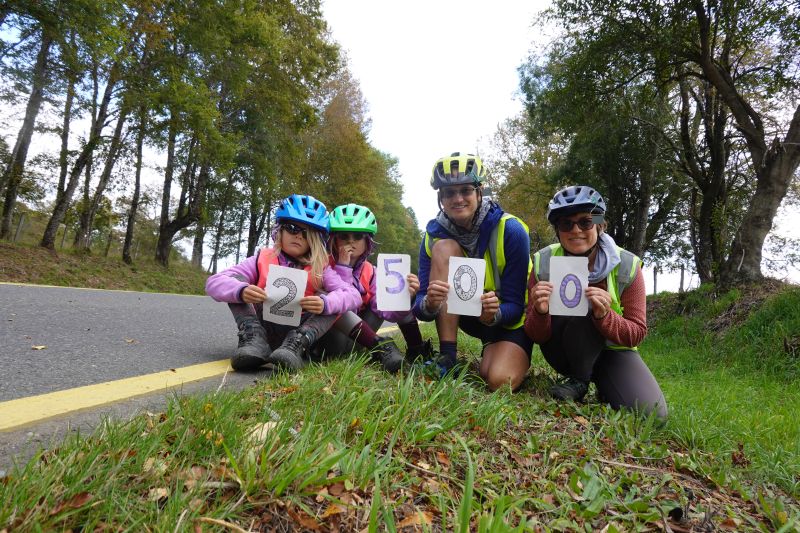
Our third day out of Melipeuco was almost entirely on pavement and was blissfully uneventful. We flew through the mellow farmlands and took our 2,500 km photo before town. We arrived in town and went straight to order pizza!

Day 97: Melipeuco to Camping Ngen-Trayenko (20 km / 12 mi)

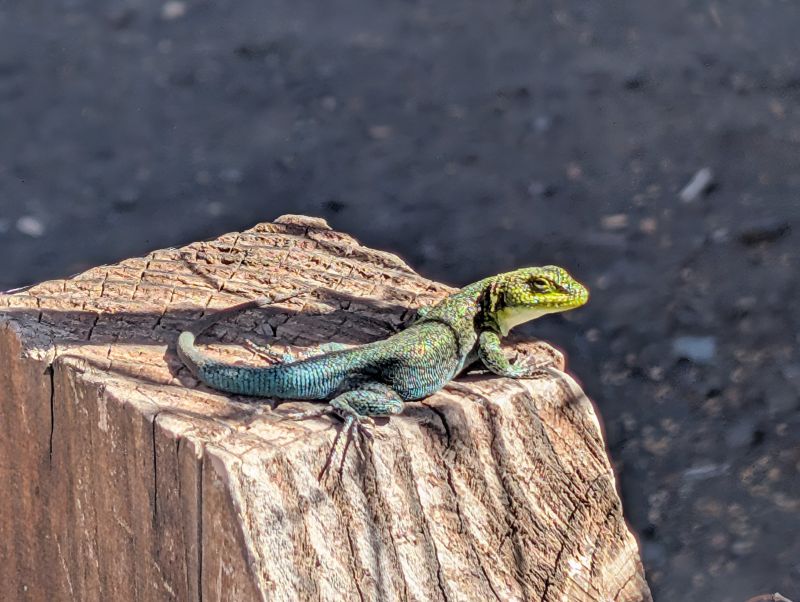
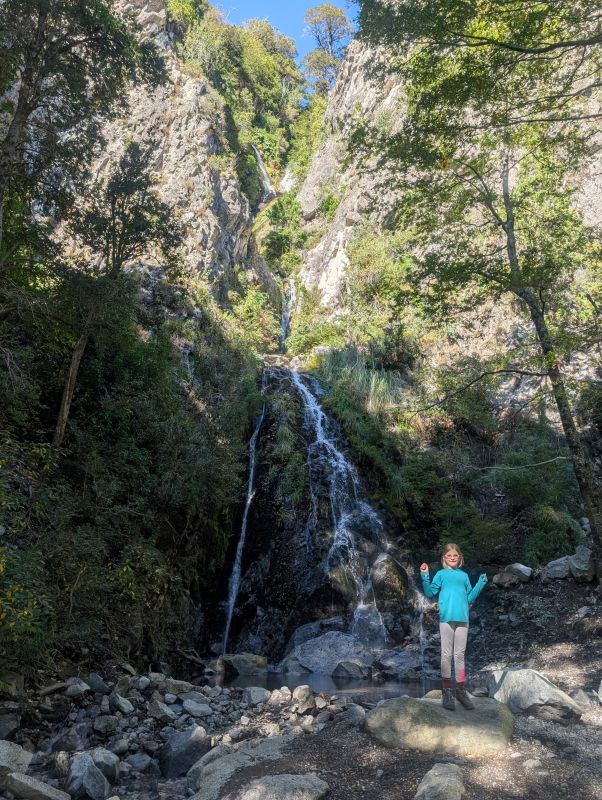
A: For breakfast we had pancakes and fried eggs. We eventually got out of the house and started riding to the national park. At the entrance station to the national park we had lunch. Lunch was ham, barbeque, and bread sandwich. I got a couple good pictures of green lizards. We rode on pretty bad gravel the rest of the way to the campground. It was also really hot, but only slightly uphill. We finally made it to the shady campground. I already felt hot. We took a walk to a little waterfall that was quite tall. I touched the cold water that was supposedly melted ice. (I didn’t think it was cold enough!) We walked back, set up the tent, and played some video games. Mama unlocked the Ginger Islands in Stardew Valley! Dinner was avocado tuna pasta with broth. It was good. Yay! Bye! Now that’s all for today! See you later! <picture of horse with bridle and saddle>

H: I finished a hard Spanish lesson. It was supposed to be all uphill but there was downhill. I had a ham sandwich. The gravel was so bad it took forever. I played Zelda in my camping chair.

The first bit away from Melipeuco was on this lovely paved road (until we hit the park boundary)
We were in such good spirits and making excellent time as the road entered the first lava field
Volcano sighting before entering the park!
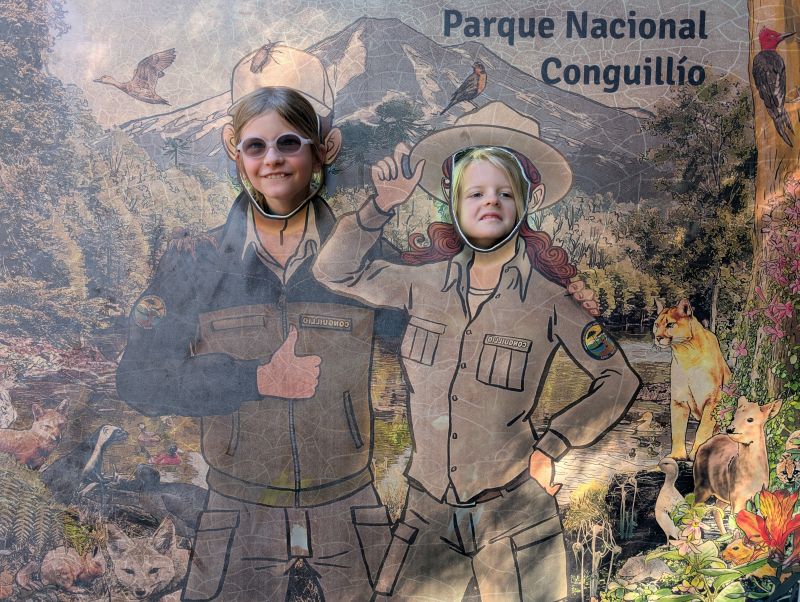
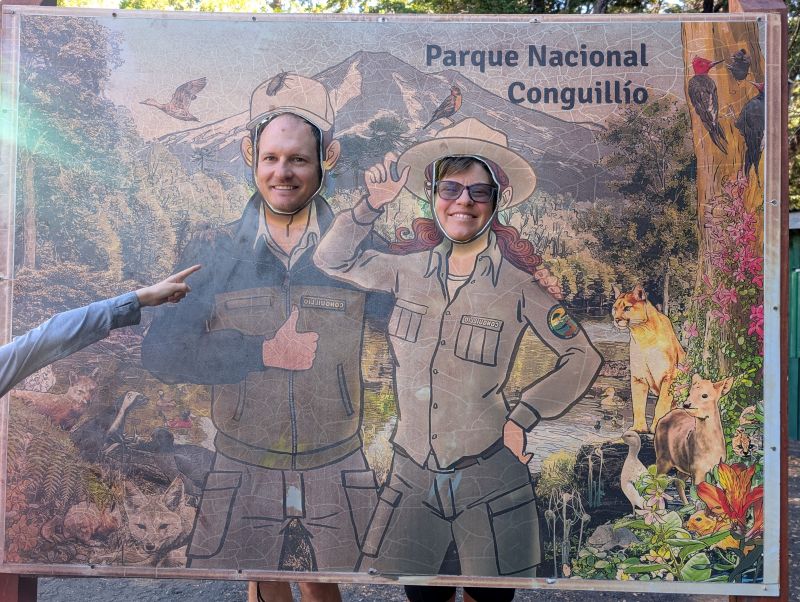
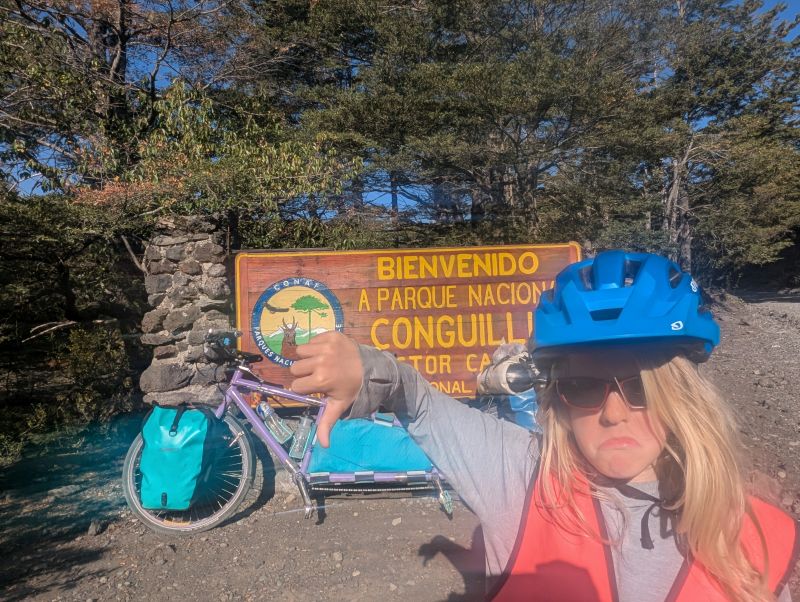
At the park entrance the girls were excited by this stick-your-head-in-a-picture
One of A’s lizard photos. These lizards were about three inches long.
There was a bit of good dirt through the forest as we left the park entrance…
Whoa, what a cool sight! We loved seeing the different kinds of lava and the plants surviving
Our first taste of unrideable surface. It wasn’t even that bad here in retrospect.
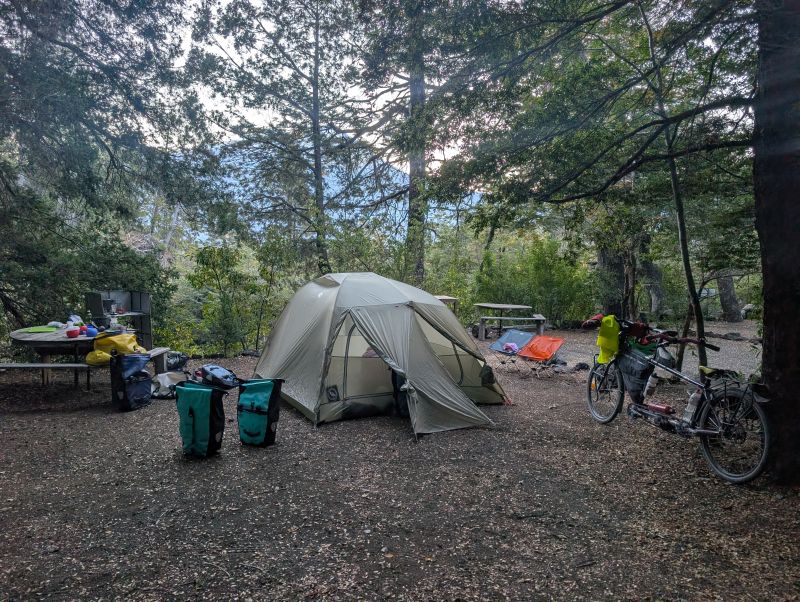
This was a lovely campsite and you can see how the chaos unfolds as we open up our gear.
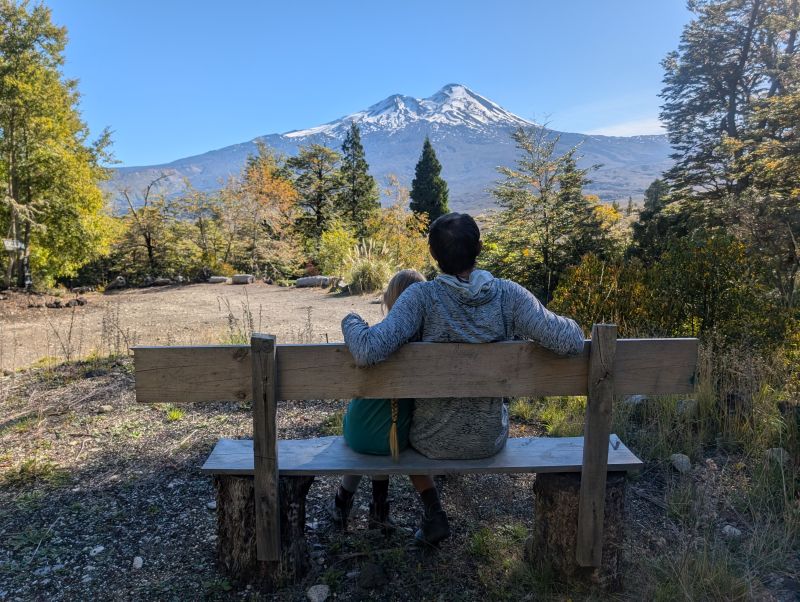
What a view!
The small waterfall near the campground. It was the only water we saw in the park – no idea where the stream goes after this!

Day 98: Camping to Llaima Camp Cabin (28 km / 17 mi)

A: Today a LOT of bad luck things happened. I’ll list them:

  1. First our chain popped off. We had to take the wheel out.
  2. Some of the gravel was really sandy and our tires sank down.
  3. Very steep uphill. It was like the road sunk into the hill.
  4. There was a dreamsmasher and the road got quite soft.
  5. Terribly steep downhill.
  6. At the almost bottom of the hill the gravel got really loose and rocky as we went through another lava field.
  7. It was gravel until our cabaña, even out of the national park.
  8. The whole day was on gravel. Wow!
  9. Mama’s front rack came apart.

But there were some cute friendly dogs that I got to pet at the place we were staying in. That’s about it. Oh, my feet are really tired. Now bye! See you later! <picture of horse with fancy bridle and saddle>

H: Bad thing number 1 chain popped off. Bad thing #2 sand. Bad thing #3 crazy uphill. Bad thing #4 dreamsmasher. Bad thing #5 steep downhill. Bad thing #6 bad gravel. Bad thing #7 gate closed. Bad thing #8 all gravel no pavement. Bad thing #9 rack came apart.

First loose climb of the day. I’m still in my wool long underwear!
Excellent scenery in the morning though
Right after I took this photo Jason’s belt drive popped off
“Rainbow lake” was formed when a lava flow cut off a stream
Up high in Chile in the fall
The sand surface strikes!
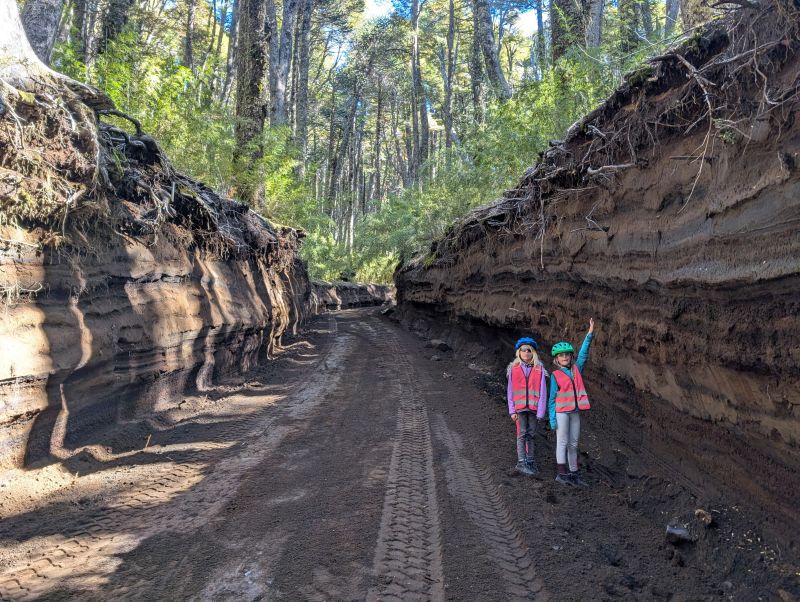
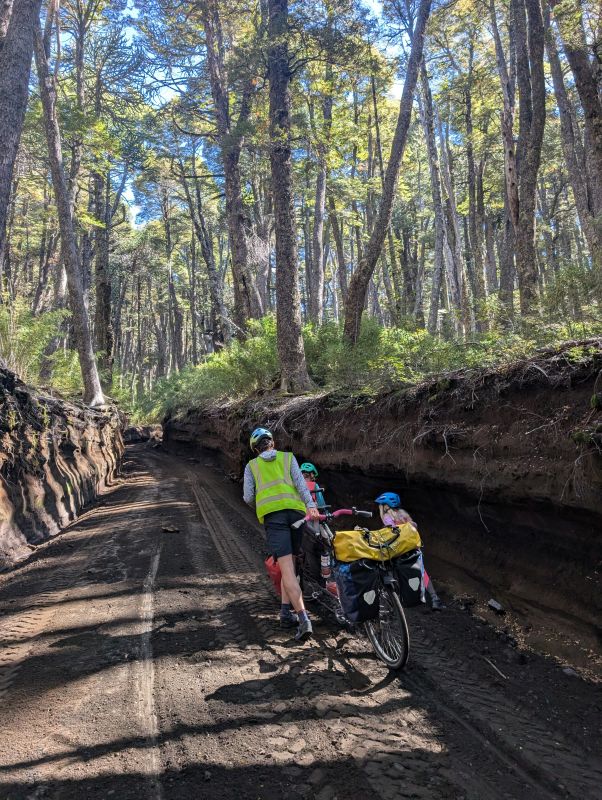
Here the road entered the deep forest and formed its own deep canyon
Bad luck for us – the dream-smasher had just paid this section a visit
A dream-smasher sighting!
Finally on the descent with the volcano behind us, hoping for a rapid exit from the park
NOOOOOO! This surface is too dangerous to ride on
H’s review of the park: one star
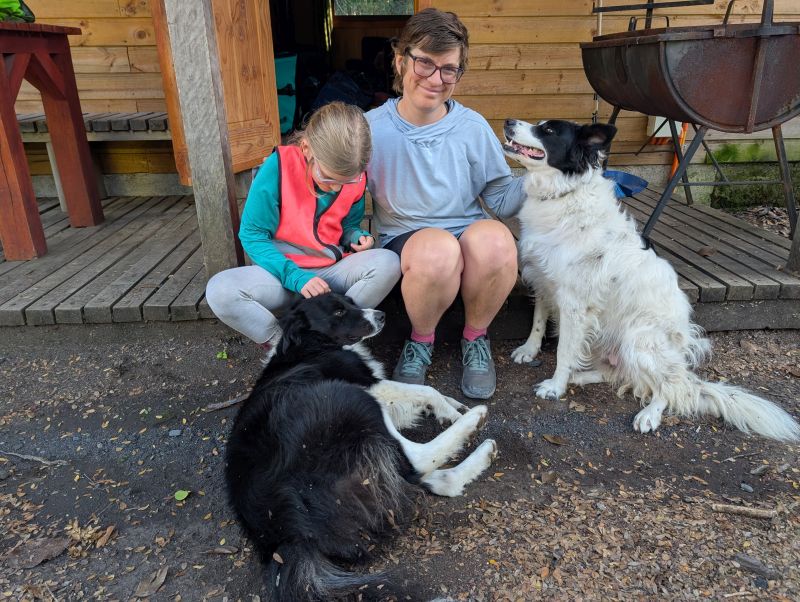
The welcoming committee at our cabin was particularly lovely

Day 99: Cabin to Curacautin (23 km / 14 mi)

Today was basically a rest day. For most of our morning in the cabaña we played Zelda and Stardew Valley till we started riding around 10:30 AM. The two young cute doggies led us for a bit. The old one stayed I the campground. The riding to town only had one stop and was mostly downhill. We took our 2500 kilo photo and the camera ran out of battery so we didn’t get to see the photo till later. We rolled into town (which had a surprisingly nice pike path on the main street!) and stopped for lunch at a nice pizzaria. We ordered barbeque chicken pizza, shrip pizza, and a giant, delicious plate of fries. It was good. Really good. Next we found our cabaña and then played our video games till dinner. For dinner we had eggs, avocado and quesadillas. It was also delicious. (Almost as good as lunch.) And H is getting Zelda and downloading my saved profile on her Nintendo. And, finally that’s all for today! Bye! See you later! <picture of Volcano Llaima and cyclists saying “gravel!”>

H: In the morning I had extra video games. We took the 2500 photo and it was downhill. We had pizza and played a lot of Zelda.

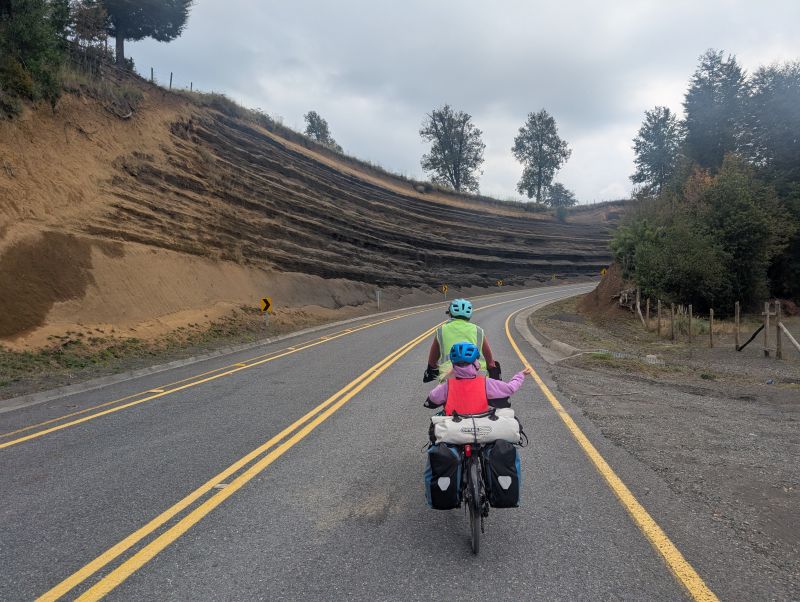
Another deep cut-out, but this time the pavement was perfect.
The clouds really moved in overnight and the volcano was no longer visible. What good luck we had to ride when we did!
Tree tunnel
2,500 kilometers for our family in South America
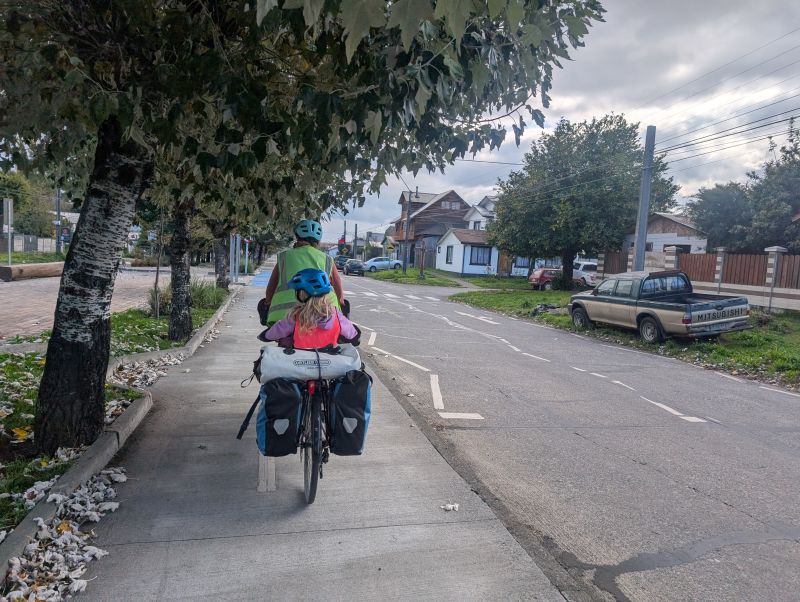
We always use the bike paths in the Chilean towns, even when Jason is too tall and would hit the low hanging branches

Riding the seven lakes region

In this entry we ride the famous seven lakes (“Siete Lagos”) route through Argentina, rest in the fly-fishing destination of Junín de los Andes, and ride past the mighty Volcano Lanín to re-enter Chile.  This section of riding felt like a greatest hits of the western USA.  The first two days reminded us of the high Sierras in California, then we were reminded of Eastern Washington, and back in Chile it was similar again to Western Washington or Oregon.

Riding with volcano Lanín and the famous Araucaría trees

Day 85: Villa La Angostura to Camping Pichi Traful (52km)

After weeks of rain in Chile it was such an odd feeling to climb on the bikes under a cloudless blue sky.  Of course, it wasn’t *warm* exactly, and it was downright cold in the shade, but the sun was shining!  This day was just a series of beautiful lakes and mountain views.  Pictures below:

There are lots of options for camping in this region, including designated free camping areas, but for whatever reason the girls had their hearts set on a campsite by a lovely lake that had real bathrooms and picnic tables.  It was absurdly expensive for a campsite in Argentina (about $50 USD) but they insisted and we went with it.

Our tent at Camping Pichi Traful

In the end it was a beautiful camping area.  The girls ran around for a long time chasing butterflies.  The grownups enjoyed the lake and river views.  Anticipating another cold night, we got to bed early and bundled up.

Lago Traful

Day 86: Camping Pichi Traful to San Martin de los Andes (60km)

Shockingly, we awoke to a rather warm morning… with clouds and drizzle.  It wasn’t what we were expecting but as usual we knew how to handle it. Rain coats on and ride!

The rain didn’t last long and the clouds moved away by afternoon.  We passed a beautiful river and then spent the morning climbing.  The traffic here has been very nice – zero trucks and polite tourist cars.  Jason and A continued their quest to read all the info signs at the lake overlooks. 

The viewpoint view for one of Jason’s favorite’s: Hidden Lake (Lago Escondido)
We met two friendly Austrians, and enjoyed chatting as we crossed paths over a week of riding

There was a lot of climbing to get up and over the hills between the lakes – over 2,500 feet over the course of the day.  Near the end of the biggest climb we saw our most amazing info sign yet: a description of the divided stream.  The nearby stream (that we filtered water from and were drinking as we read the sign) is near the continental divide.  As it flows down it hits a large boulder that splits the stream in two directions.  One side eventually drains to the Pacific and the other to the Atlantic.  We thought this was just incredible.

Teacher A, explaining the Divided Stream
The source of this “cool” stream is right up there

After the divided stream we started a long descent towards San Martin de los Andes – a tourist town that reminded us of Big Bear Lake in California.  The descent was spectacular, and even more remarkable was how warm the wind was as we got close to town.  No one needed to bundle up.  Suddenly we emerged onto the shores of Lake Lácar with the brilliant sun shining.  On the far side of the lake we could see deep into the Andes.  On the other was the hopping tourist town.  The road along the lake shore was packed with people out walking and enjoying the view.  Honestly, it was pretty spectacular and we were a bit shocked.

We made our way across the bustling and fancy town to our cabin.  The food in the grocery stores was expensive in this town, and we thought it was simply because of the tourism density.  In later towns in Argentina we would simply find that grocery stores are very expensive, at least compared to Chile.  My understanding of this region was that Chile is the more expensive country, but apparently in the last year there has been a huge surge in food prices here in Argentina. 

This sign was in Junín, but we missed the one in San Martin so it will suffice!

Day 87: San Martin de Los Andes to Junín de los Andes (43km)

San Martin was a great place to resupply, but it was a bit too hopping for our tastes.  We prefer the smaller, slower towns.  Even knowing that San Martin was busy didn’t prepare us for just *how* busy the road would be on the way out.  It was PACKED.  There were tons of passenger vehicles, big buses, little buses, pickup trucks, delivery trucks, and semi-trailers.  Of course, there was no paved shoulder to speak of.  When a bike path magically appeared we got right on it.

Bike path out of San Martin. We were thankful to avoid the traffic!

The lovely, paved bicycle path eventually became a not-quite-paved path and finally disappeared.  Then it was back to the road.  Luckily by this time there were enough huge speed bumps in the road that we were able to ride about as fast as traffic.  By the time the bumps disappeared we were able to duck off on a side road.  We wandered through a little Argentine town that truly didn’t have a whisper of tourism.  It was mostly gravel roads and dirt sidewalks, but there was also a tidy plaza and kids walking around. 

The side road took us up a very steep hill to the next small city.  We were slow enough that a pedestrian overtook us, but we were able to ride! When we emerged at the top of the hill the scenery had changed dramatically.  Instead of the green hillsides we’d been seeing for days it was dry and dusty and tan.  It was like suddenly riding across the Sierra Cascades in Washington State.  Hello, Eastern Washington!

We enjoyed a gentle downhill with a tailwind for about an hour.  It was an utter thrill to literally not have high enough gears to even bother pedaling.  We stopped for lunch and gave some cheese to a black lab that waited patiently for our scraps.  After lunch the road turned… and the tailwind became a headwind.  It felt like we slowly approached the flat riverside town of Junín for half a day, but it was only an hour. 

Junín was a really fun town.  It has about 20,000 inhabitants and is laid out in a perfect grid along a river.  Most of the tourism focus in the area is on fly fishing.  The main road is pavement, but the side roads through town, even downtown, are gravel.  The sidewalks are just dirt paths.  We saw the locals riding bikes to get around. We decided it was the perfect place for a rest day.

Day 88: Rest day in Junín (0 km)

In addition to our typical rest day activities (laundry, resting, eating, planning) we walked downtown to visit the tourist info and a small museum.  The museum seemed to be mainly random items people had donated, but it was good fun all the same. 

We also walked down to the river to enjoy the fall colors of the trees lining the banks.  After a South American summer that was honestly pretty darn cold, we are enjoying this beautiful moment of fall.

Day 89: Junín to wild camp by a yellow bridge (45km)

Today was another one of those rare cycle touring days when the beauty is everywhere and the conditions are perfect.  It felt like a dream come true.

We left Junín with the blue sky above us and the fall colors blazing around us.  We turned off the main route and onto an almost traffic-free road that led back towards the Andes.  For lunch we ate leftover pizza and gazed across the big open landscape.  The volcano Lanín peaked over the hills, waiting for us.

The ride from Junín to the Chilean border climbs up only about a thousand feet over 40 miles, so the ascent is gradual through a huge open landscape in the shadow of the looming volcano.  For visa reasons, we needed to dilly dally in this section for two nights.  The campground we had planned for was inexplicably closed, so we carried on through the beautiful valley looking for a free place to camp. 

Volcano peek-a-boo

We decided to camp near a small bridge about 2km off route.  It was down a gravel road past a quarry that was busy with dump trucks making trips up the pass to redo the road near the border.  Our intended campsite was in a stand of glowing yellow trees next to a river, and when we rolled up we found a group of fly fishermen drinking mate.  We asked if they were planning to spend the night, but they were just there to stage their fishing gear.  They were very friendly, on a ten-day family fly fishing trip.  We set up our tent and used their camping table for dinner while they went out to fish.  It was an incredibly picturesque spot to spend a (cold!) night.

Day 90: Wild camp to Camping Tromen (25km)

It was a perfectly peaceful night and a chilly morning.  When we walked away from the river to do our business we found ice curls in the volcanic sand.  I also found a yellow jacket nest about one foot away from where I had decided to pee. Yikes!

Today we’ll pass that volcano

As we passed the quarry that morning on our way back to the main route we made a decision to try and befriend the dump truck drivers.  There were so many of them making trips up and down the next section of highway, it seemed like a good idea to wave and smile at them.  Sure enough, they gave us lots of space and honks and waves.  I think most of them passed us four or six times as we slowly made our way up the pass.  Our progress slowed quite a bit as the road turned to gravel. 

Road work and some locals running their horses

We entered a forest of Araucaria (monkey puzzle) trees.  These are the national trees of Chile and extremely distinctive.  It is a magical feeling to ride through them in the Andes.  As we slowly made our way through the forest a dump truck driver stopped and waved us over.  He gave us lunch!  It was incredibly generous and honestly we were extremely excited to eat some fresh food.  We immediately stopped and ate the entire thing, waving wildly in thanks as he drove off. 

When we finally reached the construction area all the workers and drivers stopped to take our picture.  This route is extremely popular with cyclists (for obvious reasons) but it sure seems like very few cycling families make it through! 

Throwing a frisbee in camp

We stopped for the night at a campground right at the base of the volcano and extremely near the top of the pass.  It was unbelievably picturesque.  The clouds blew in overnight and were gorgeous in the light of the full moon, and in the early morning I saw a pink cloud resting atop the volcano.  The pictures just don’t do it justice.

Volcan Lanín at night

Day 91: Camping Tromen to Pucón (78km)

The morning dawned a bit cloudy, but there wasn’t any rain (yet) so we happily rode away from the campground to cross the border back into Chile.  Unlike our last border crossing, the two border stations were less than a kilometer apart.  Leaving Argentina was easy – they hand you a piece of paper when you enter the area, stamp it twice to prove you stopped and answered their questions, then they collect the stamped paper when you leave.  They don’t even stamp our passports!  Entering Chile is always a more complicated process.

Just like last time there were three steps.  1: Passport control.  We got our stamps and permission to be in the country for 90 more days. 2. Bicycle import.  We have to describe the bikes and get documentation to import them temporarily.  The process was different here than in Tierra del Fuego, but since we are leaving with the bikes in boxes on an airplane in 88 days time we didn’t worry about the details. 3. Food inspection.  No fresh products are allowed to enter Chile.  Many cyclists end up getting a thorough bag inspection, but we have been lucky.  We had a pile of food that clearly couldn’t enter (lentils and raw eggs), a pile of food that we weren’t sure about (powdered milk, cheese) and the clearly ok food was packed away.  The official took our sacrificial eggs and lentils, waved through the cheese, and made sure to take our photo with us on the bikes before we rode away.

Near the top. The road was gravel on the Argentine side, and paved on the Chilean
Back to Chile! Seems like a few too many stickers on the sign

The fall colors up high at the pass level were truly lovely.  The clouds had really rolled in though, and it even started to sprinkle.  There was also a headwind.  We made a quick joke about how it rains on us in Chile, but we didn’t linger and pedaled to leave the high country behind.

The Aracuaría trees received National Monument status in Chile in 1990, preventing their destruction. So, the road got built around this one!

With over 3,000’ to descend we zipped down past the clouds and around a lot of tight curves.  We emerged from the clouds and mountains to find ourselves in a flat river valley.  We would spend the rest of the (long) day riding along the flat road towards the big fancy city of Pucón.  Happily, when we got close and traffic got busy a separated bicycle path appeared and whisked us all the way downtown to our lodging.  It was quite a shock for the whole family to pedal into a bustling town resembling Boulder, CO. 

Again, so happy for a bike path to lead us into the busy town of Pucón

We took a rest day here before getting back on our bikes. The girls have grown, and we found replacement fleece jackets with longer sleeves.