Author Archives: Daisy

Riding the seven lakes region

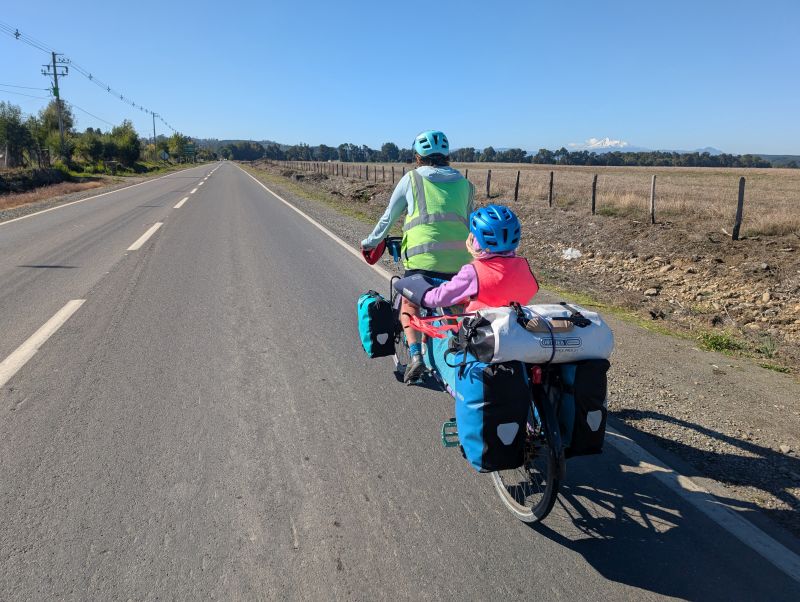
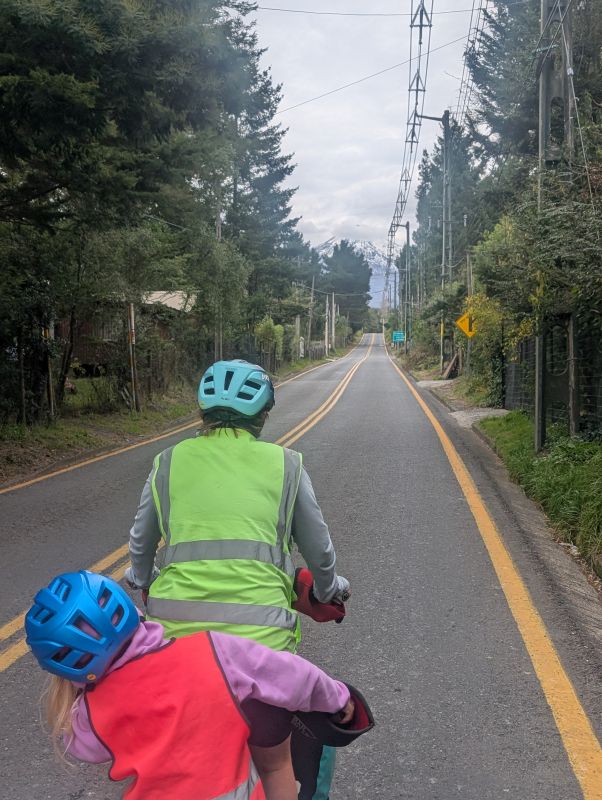
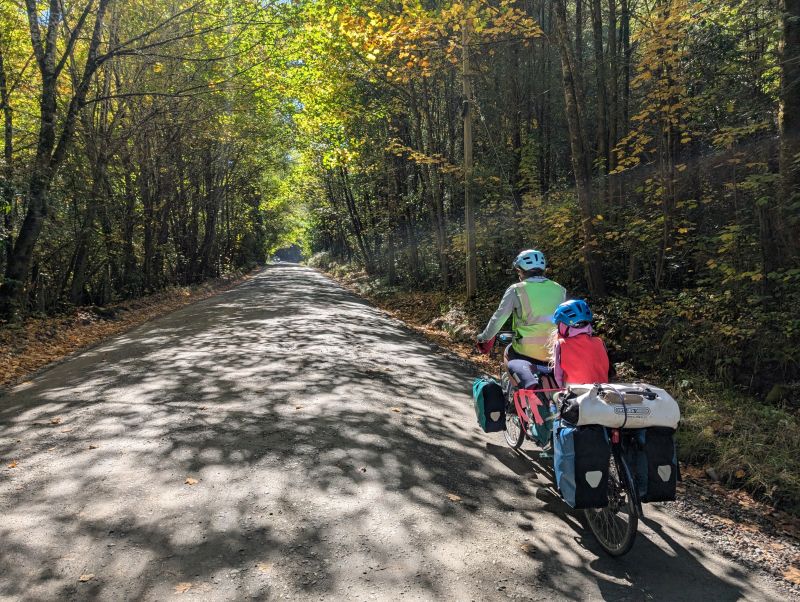
In this entry we ride the famous seven lakes (“Siete Lagos”) route through Argentina, rest in the fly-fishing destination of Junín de los Andes, and ride past the mighty Volcano Lanín to re-enter Chile.  This section of riding felt like a greatest hits of the western USA.  The first two days reminded us of the high Sierras in California, then we were reminded of Eastern Washington, and back in Chile it was similar again to Western Washington or Oregon.

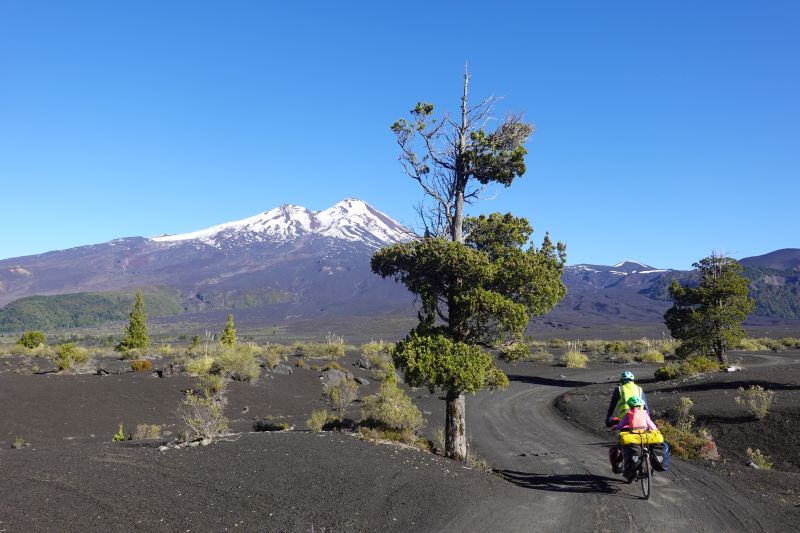
Riding with volcano Lanín and the famous Araucaría trees

Day 85: Villa La Angostura to Camping Pichi Traful (52km)

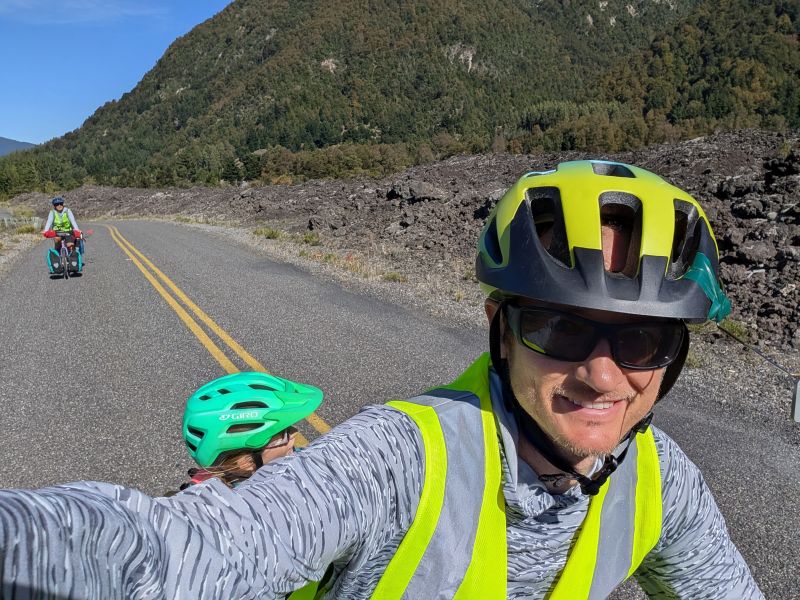
After weeks of rain in Chile it was such an odd feeling to climb on the bikes under a cloudless blue sky.  Of course, it wasn’t *warm* exactly, and it was downright cold in the shade, but the sun was shining!  This day was just a series of beautiful lakes and mountain views.  Pictures below:

There are lots of options for camping in this region, including designated free camping areas, but for whatever reason the girls had their hearts set on a campsite by a lovely lake that had real bathrooms and picnic tables.  It was absurdly expensive for a campsite in Argentina (about $50 USD) but they insisted and we went with it.

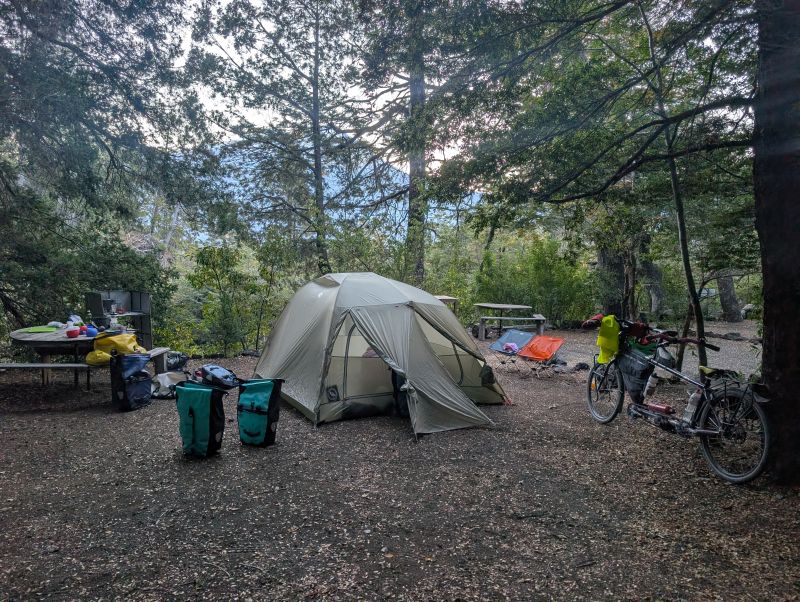
Our tent at Camping Pichi Traful

In the end it was a beautiful camping area.  The girls ran around for a long time chasing butterflies.  The grownups enjoyed the lake and river views.  Anticipating another cold night, we got to bed early and bundled up.

Lago Traful

Day 86: Camping Pichi Traful to San Martin de los Andes (60km)

Shockingly, we awoke to a rather warm morning… with clouds and drizzle.  It wasn’t what we were expecting but as usual we knew how to handle it. Rain coats on and ride!

The rain didn’t last long and the clouds moved away by afternoon.  We passed a beautiful river and then spent the morning climbing.  The traffic here has been very nice – zero trucks and polite tourist cars.  Jason and A continued their quest to read all the info signs at the lake overlooks. 

The viewpoint view for one of Jason’s favorite’s: Hidden Lake (Lago Escondido)
We met two friendly Austrians, and enjoyed chatting as we crossed paths over a week of riding

There was a lot of climbing to get up and over the hills between the lakes – over 2,500 feet over the course of the day.  Near the end of the biggest climb we saw our most amazing info sign yet: a description of the divided stream.  The nearby stream (that we filtered water from and were drinking as we read the sign) is near the continental divide.  As it flows down it hits a large boulder that splits the stream in two directions.  One side eventually drains to the Pacific and the other to the Atlantic.  We thought this was just incredible.

Teacher A, explaining the Divided Stream
The source of this “cool” stream is right up there

After the divided stream we started a long descent towards San Martin de los Andes – a tourist town that reminded us of Big Bear Lake in California.  The descent was spectacular, and even more remarkable was how warm the wind was as we got close to town.  No one needed to bundle up.  Suddenly we emerged onto the shores of Lake Lácar with the brilliant sun shining.  On the far side of the lake we could see deep into the Andes.  On the other was the hopping tourist town.  The road along the lake shore was packed with people out walking and enjoying the view.  Honestly, it was pretty spectacular and we were a bit shocked.

We made our way across the bustling and fancy town to our cabin.  The food in the grocery stores was expensive in this town, and we thought it was simply because of the tourism density.  In later towns in Argentina we would simply find that grocery stores are very expensive, at least compared to Chile.  My understanding of this region was that Chile is the more expensive country, but apparently in the last year there has been a huge surge in food prices here in Argentina. 

This sign was in Junín, but we missed the one in San Martin so it will suffice!

Day 87: San Martin de Los Andes to Junín de los Andes (43km)

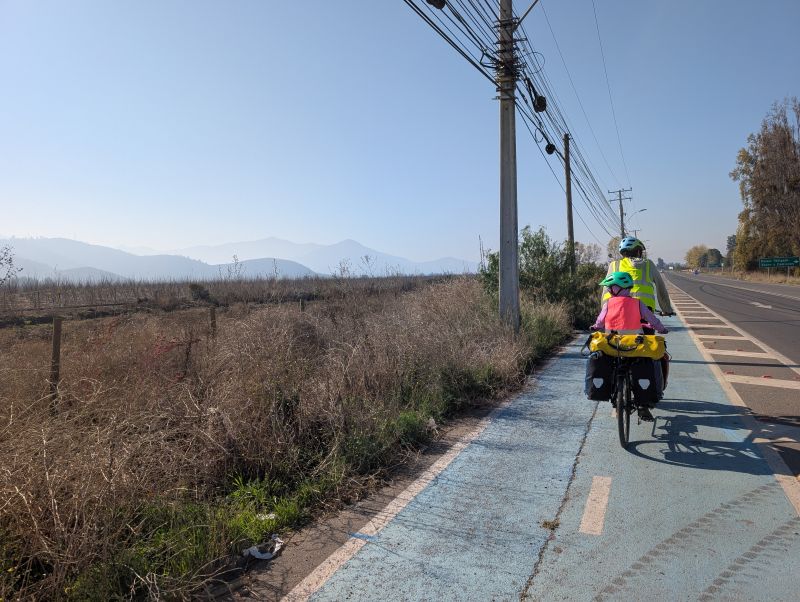
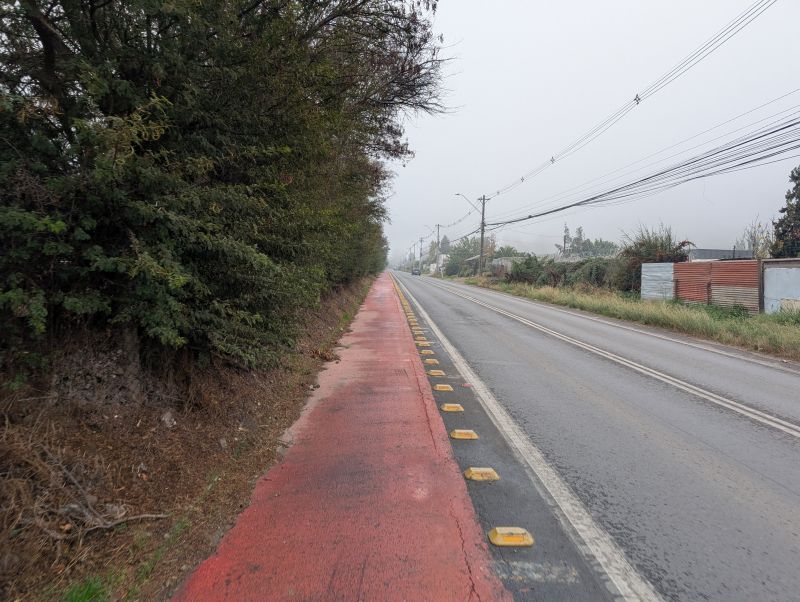
San Martin was a great place to resupply, but it was a bit too hopping for our tastes.  We prefer the smaller, slower towns.  Even knowing that San Martin was busy didn’t prepare us for just *how* busy the road would be on the way out.  It was PACKED.  There were tons of passenger vehicles, big buses, little buses, pickup trucks, delivery trucks, and semi-trailers.  Of course, there was no paved shoulder to speak of.  When a bike path magically appeared we got right on it.

Bike path out of San Martin. We were thankful to avoid the traffic!

The lovely, paved bicycle path eventually became a not-quite-paved path and finally disappeared.  Then it was back to the road.  Luckily by this time there were enough huge speed bumps in the road that we were able to ride about as fast as traffic.  By the time the bumps disappeared we were able to duck off on a side road.  We wandered through a little Argentine town that truly didn’t have a whisper of tourism.  It was mostly gravel roads and dirt sidewalks, but there was also a tidy plaza and kids walking around. 

The side road took us up a very steep hill to the next small city.  We were slow enough that a pedestrian overtook us, but we were able to ride! When we emerged at the top of the hill the scenery had changed dramatically.  Instead of the green hillsides we’d been seeing for days it was dry and dusty and tan.  It was like suddenly riding across the Sierra Cascades in Washington State.  Hello, Eastern Washington!

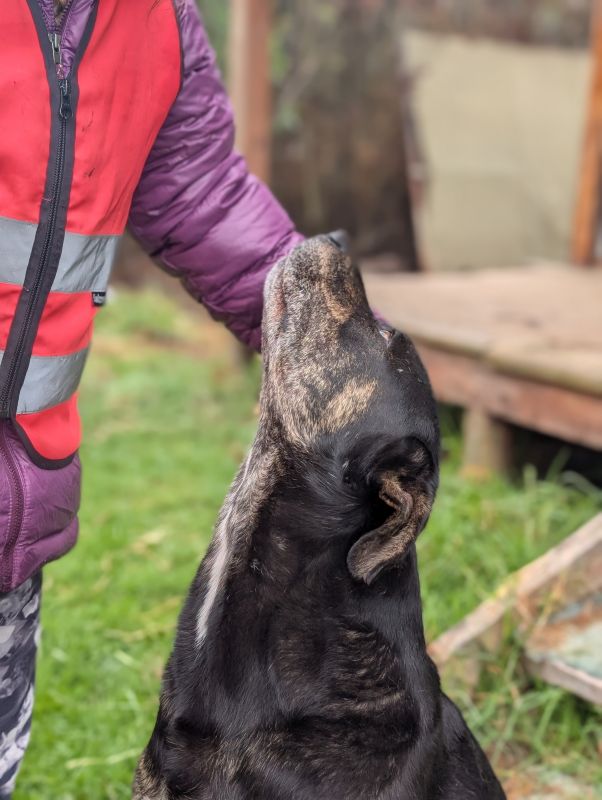
We enjoyed a gentle downhill with a tailwind for about an hour.  It was an utter thrill to literally not have high enough gears to even bother pedaling.  We stopped for lunch and gave some cheese to a black lab that waited patiently for our scraps.  After lunch the road turned… and the tailwind became a headwind.  It felt like we slowly approached the flat riverside town of Junín for half a day, but it was only an hour. 

Junín was a really fun town.  It has about 20,000 inhabitants and is laid out in a perfect grid along a river.  Most of the tourism focus in the area is on fly fishing.  The main road is pavement, but the side roads through town, even downtown, are gravel.  The sidewalks are just dirt paths.  We saw the locals riding bikes to get around. We decided it was the perfect place for a rest day.

Day 88: Rest day in Junín (0 km)

In addition to our typical rest day activities (laundry, resting, eating, planning) we walked downtown to visit the tourist info and a small museum.  The museum seemed to be mainly random items people had donated, but it was good fun all the same. 

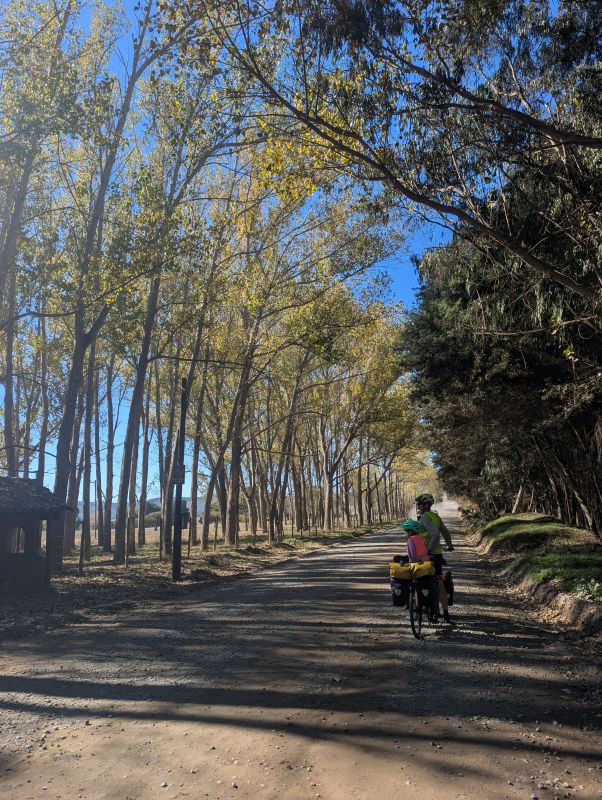
We also walked down to the river to enjoy the fall colors of the trees lining the banks.  After a South American summer that was honestly pretty darn cold, we are enjoying this beautiful moment of fall.

Day 89: Junín to wild camp by a yellow bridge (45km)

Today was another one of those rare cycle touring days when the beauty is everywhere and the conditions are perfect.  It felt like a dream come true.

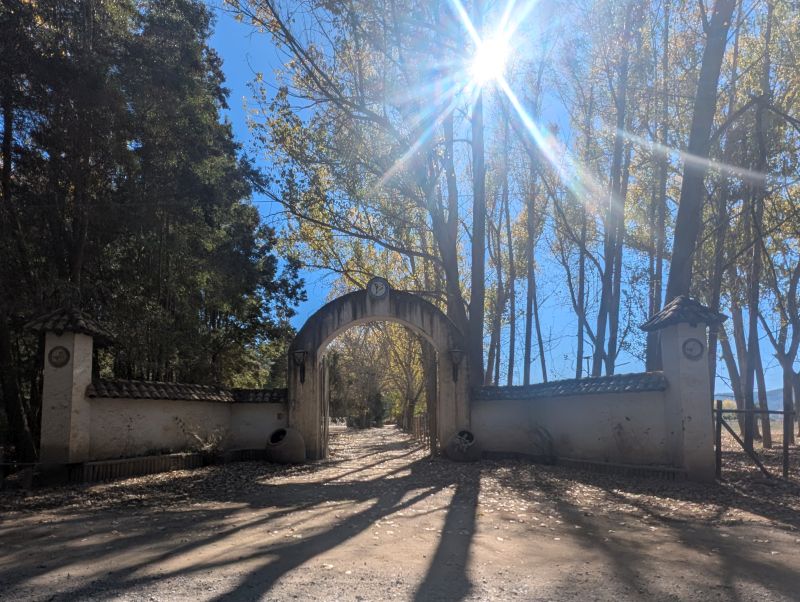
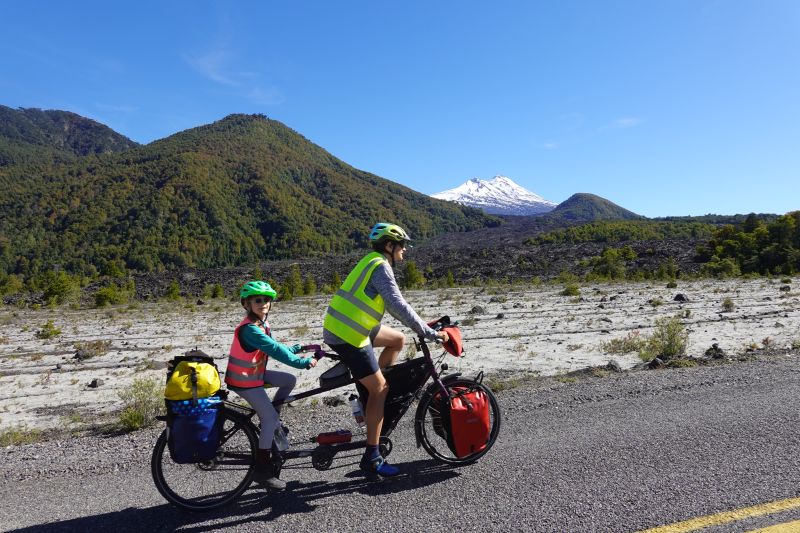
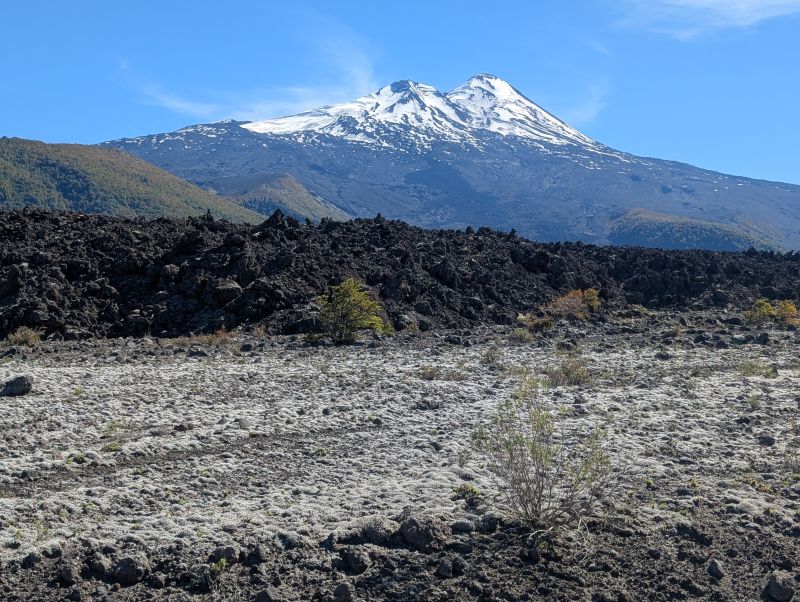
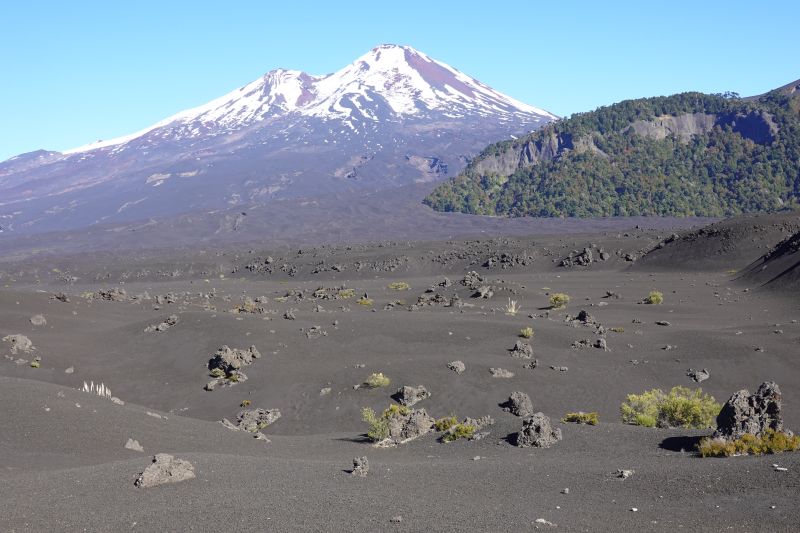
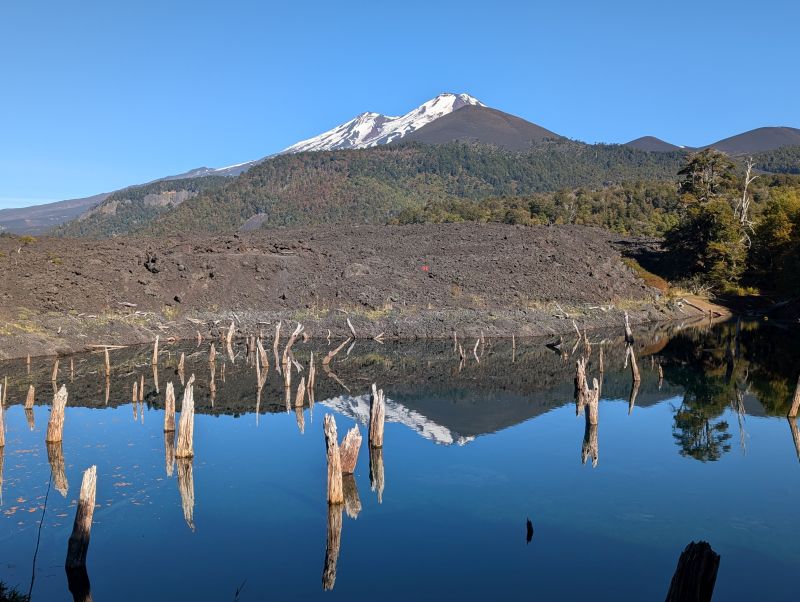
We left Junín with the blue sky above us and the fall colors blazing around us.  We turned off the main route and onto an almost traffic-free road that led back towards the Andes.  For lunch we ate leftover pizza and gazed across the big open landscape.  The volcano Lanín peaked over the hills, waiting for us.

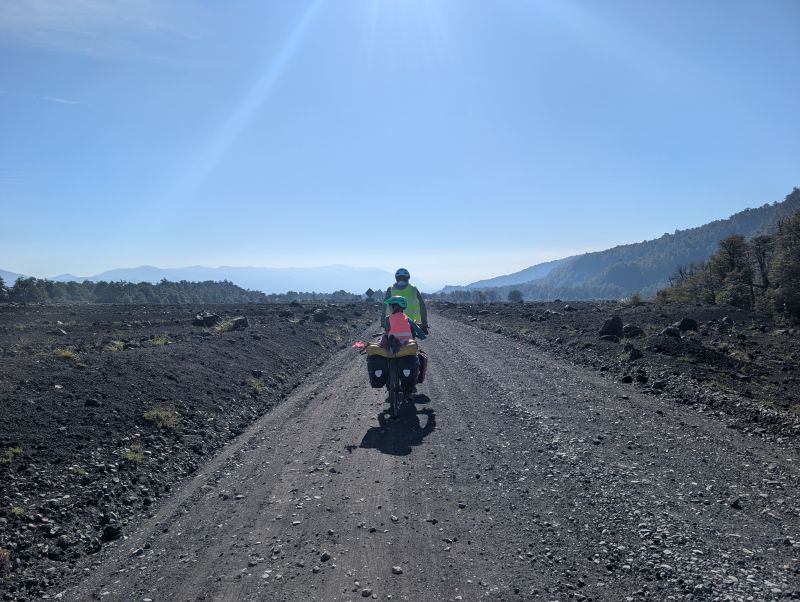
The ride from Junín to the Chilean border climbs up only about a thousand feet over 40 miles, so the ascent is gradual through a huge open landscape in the shadow of the looming volcano.  For visa reasons, we needed to dilly dally in this section for two nights.  The campground we had planned for was inexplicably closed, so we carried on through the beautiful valley looking for a free place to camp. 

Volcano peek-a-boo

We decided to camp near a small bridge about 2km off route.  It was down a gravel road past a quarry that was busy with dump trucks making trips up the pass to redo the road near the border.  Our intended campsite was in a stand of glowing yellow trees next to a river, and when we rolled up we found a group of fly fishermen drinking mate.  We asked if they were planning to spend the night, but they were just there to stage their fishing gear.  They were very friendly, on a ten-day family fly fishing trip.  We set up our tent and used their camping table for dinner while they went out to fish.  It was an incredibly picturesque spot to spend a (cold!) night.

Day 90: Wild camp to Camping Tromen (25km)

It was a perfectly peaceful night and a chilly morning.  When we walked away from the river to do our business we found ice curls in the volcanic sand.  I also found a yellow jacket nest about one foot away from where I had decided to pee. Yikes!

Today we’ll pass that volcano

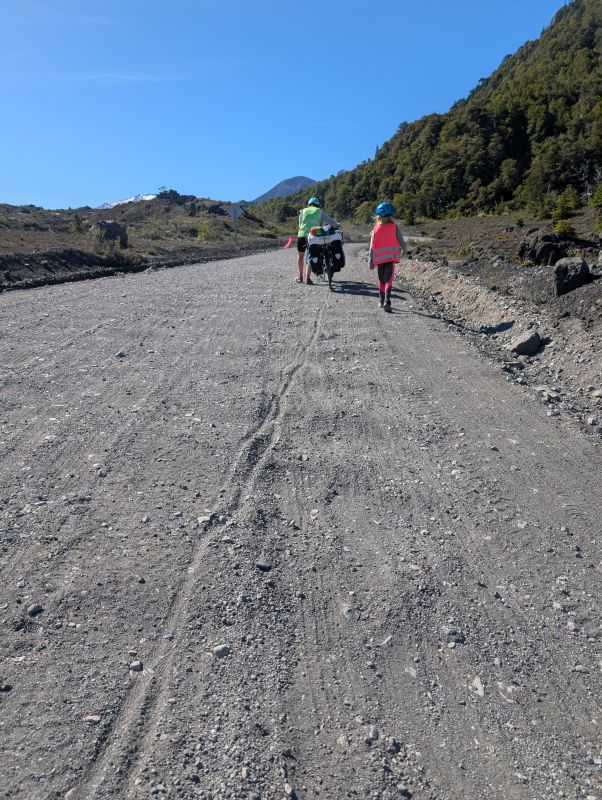
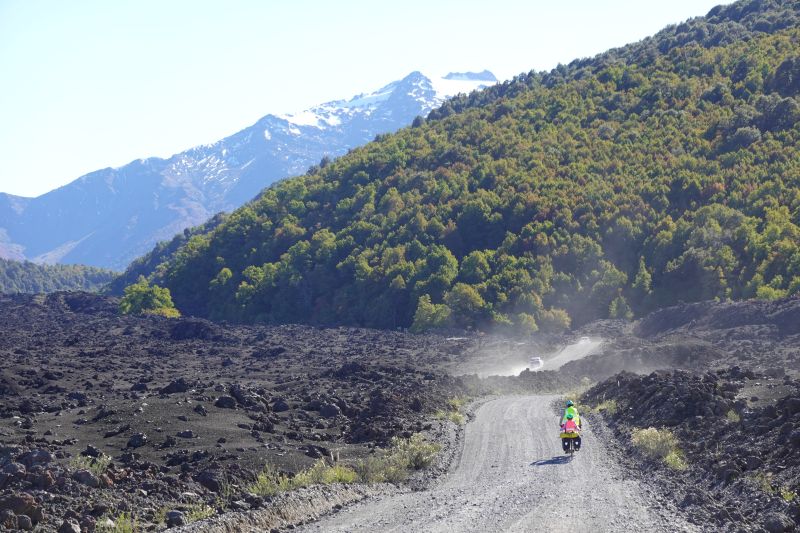
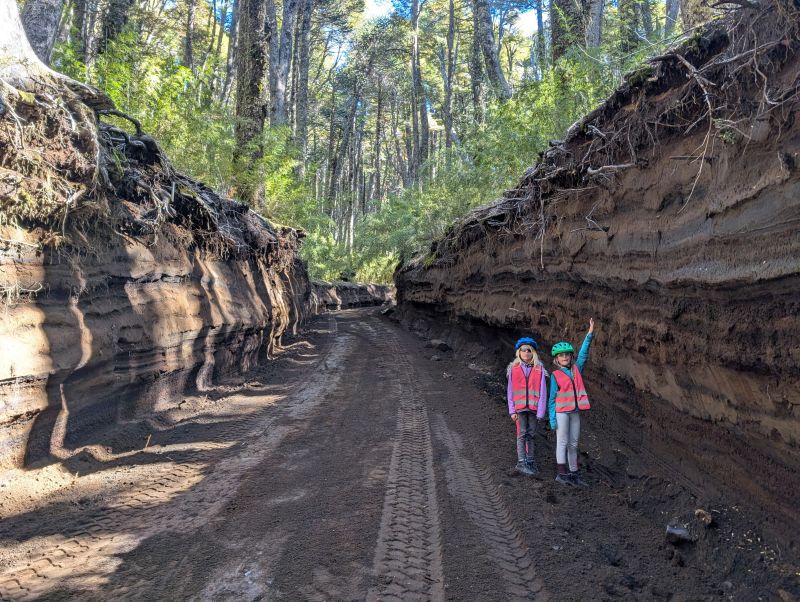
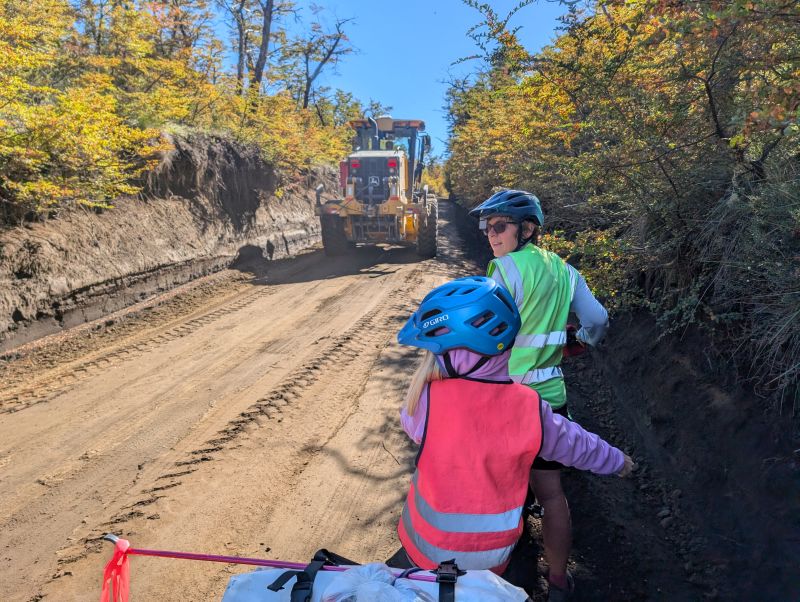
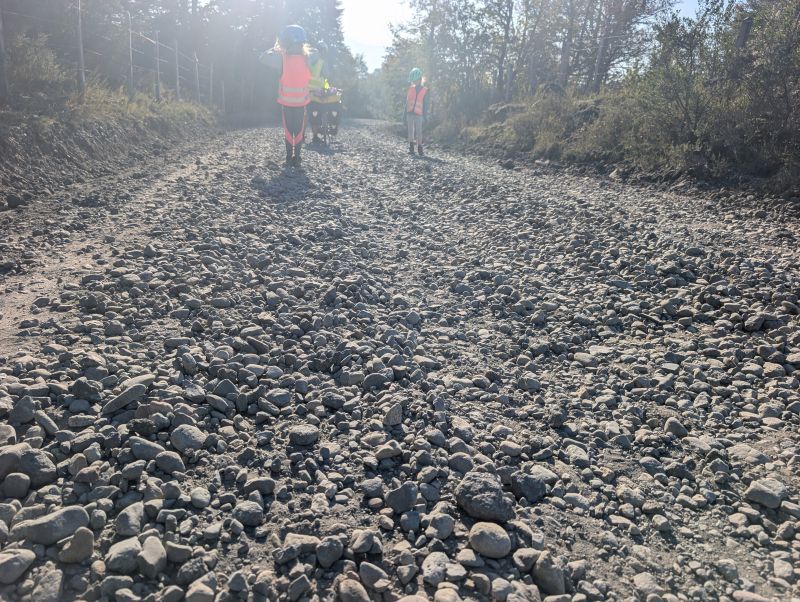
As we passed the quarry that morning on our way back to the main route we made a decision to try and befriend the dump truck drivers.  There were so many of them making trips up and down the next section of highway, it seemed like a good idea to wave and smile at them.  Sure enough, they gave us lots of space and honks and waves.  I think most of them passed us four or six times as we slowly made our way up the pass.  Our progress slowed quite a bit as the road turned to gravel. 

Road work and some locals running their horses

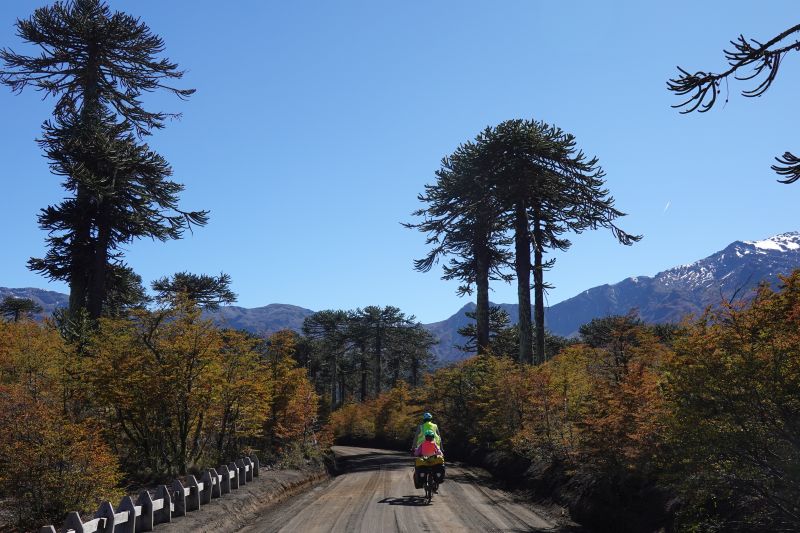
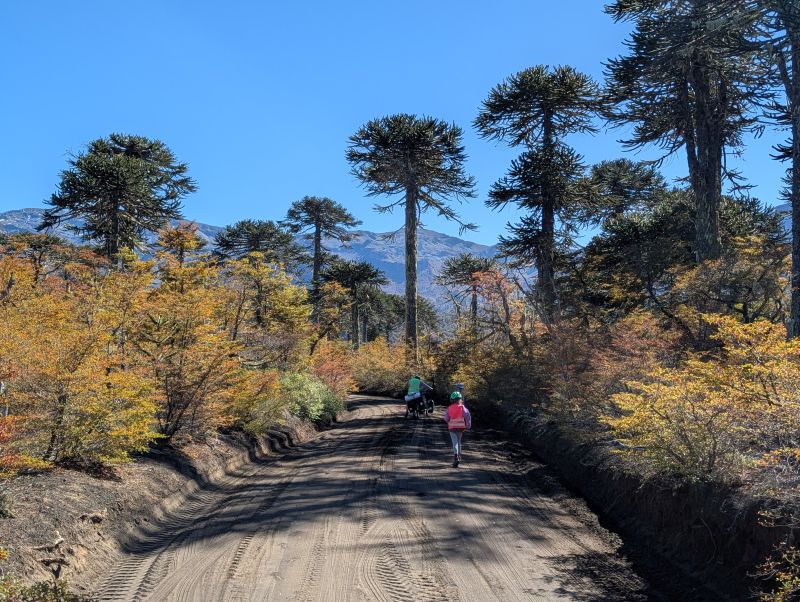
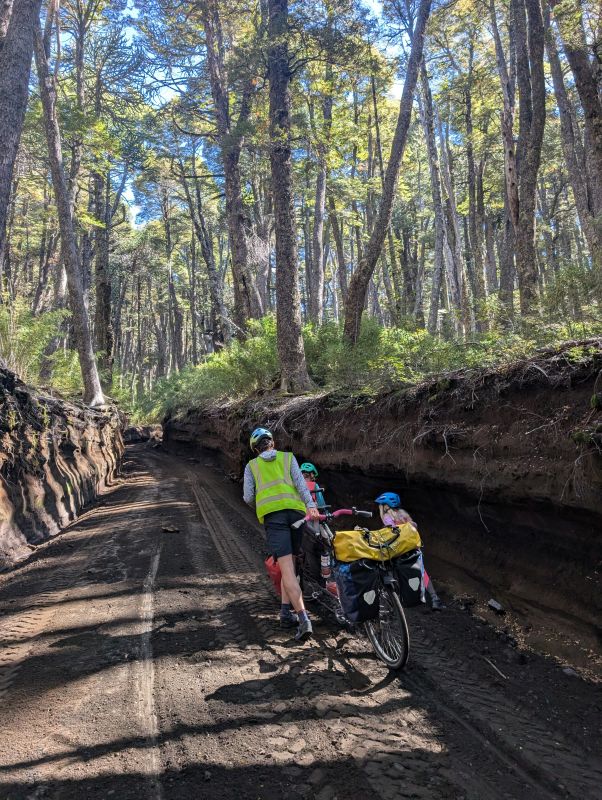
We entered a forest of Araucaria (monkey puzzle) trees.  These are the national trees of Chile and extremely distinctive.  It is a magical feeling to ride through them in the Andes.  As we slowly made our way through the forest a dump truck driver stopped and waved us over.  He gave us lunch!  It was incredibly generous and honestly we were extremely excited to eat some fresh food.  We immediately stopped and ate the entire thing, waving wildly in thanks as he drove off. 

When we finally reached the construction area all the workers and drivers stopped to take our picture.  This route is extremely popular with cyclists (for obvious reasons) but it sure seems like very few cycling families make it through! 

Throwing a frisbee in camp

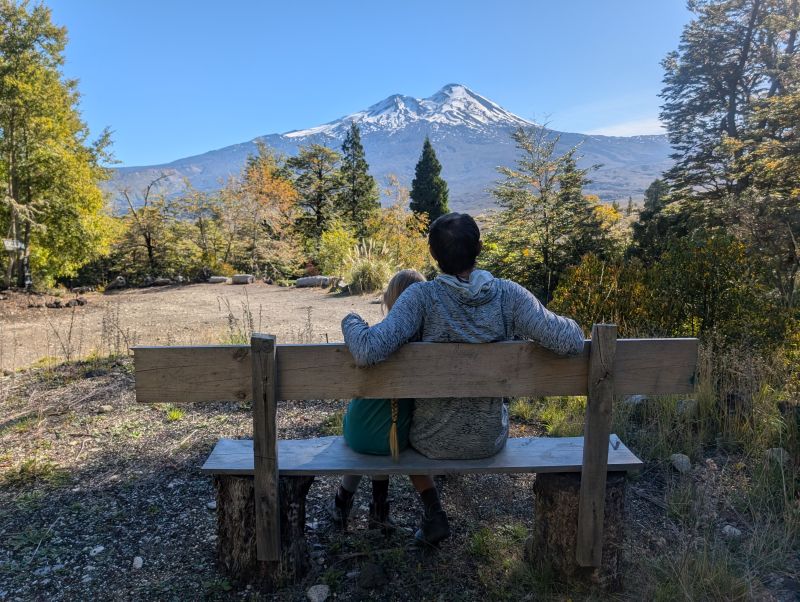
We stopped for the night at a campground right at the base of the volcano and extremely near the top of the pass.  It was unbelievably picturesque.  The clouds blew in overnight and were gorgeous in the light of the full moon, and in the early morning I saw a pink cloud resting atop the volcano.  The pictures just don’t do it justice.

Volcan Lanín at night

Day 91: Camping Tromen to Pucón (78km)

The morning dawned a bit cloudy, but there wasn’t any rain (yet) so we happily rode away from the campground to cross the border back into Chile.  Unlike our last border crossing, the two border stations were less than a kilometer apart.  Leaving Argentina was easy – they hand you a piece of paper when you enter the area, stamp it twice to prove you stopped and answered their questions, then they collect the stamped paper when you leave.  They don’t even stamp our passports!  Entering Chile is always a more complicated process.

Just like last time there were three steps.  1: Passport control.  We got our stamps and permission to be in the country for 90 more days. 2. Bicycle import.  We have to describe the bikes and get documentation to import them temporarily.  The process was different here than in Tierra del Fuego, but since we are leaving with the bikes in boxes on an airplane in 88 days time we didn’t worry about the details. 3. Food inspection.  No fresh products are allowed to enter Chile.  Many cyclists end up getting a thorough bag inspection, but we have been lucky.  We had a pile of food that clearly couldn’t enter (lentils and raw eggs), a pile of food that we weren’t sure about (powdered milk, cheese) and the clearly ok food was packed away.  The official took our sacrificial eggs and lentils, waved through the cheese, and made sure to take our photo with us on the bikes before we rode away.

Near the top. The road was gravel on the Argentine side, and paved on the Chilean
Back to Chile! Seems like a few too many stickers on the sign

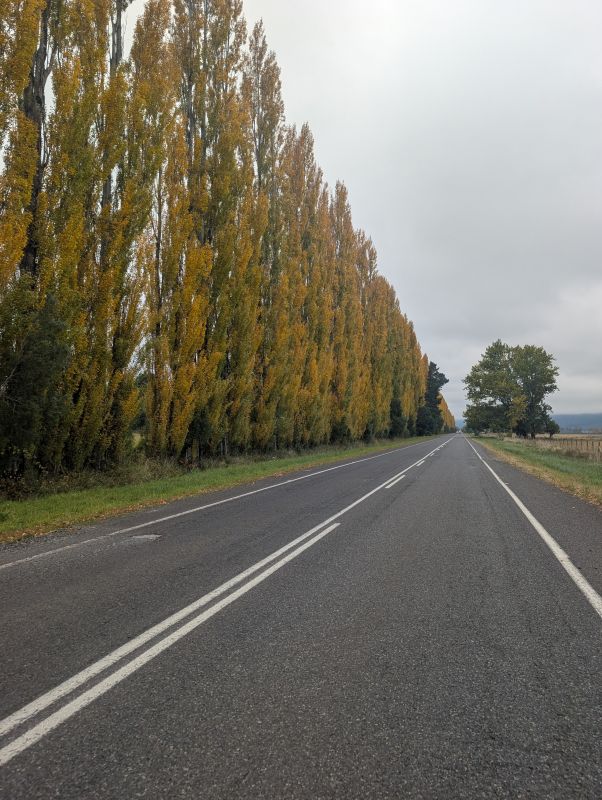
The fall colors up high at the pass level were truly lovely.  The clouds had really rolled in though, and it even started to sprinkle.  There was also a headwind.  We made a quick joke about how it rains on us in Chile, but we didn’t linger and pedaled to leave the high country behind.

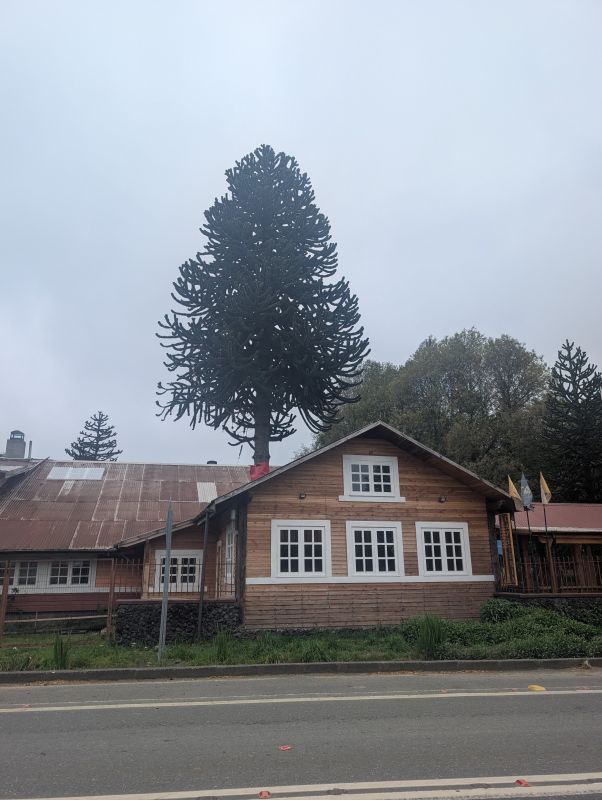
The Aracuaría trees received National Monument status in Chile in 1990, preventing their destruction. So, the road got built around this one!

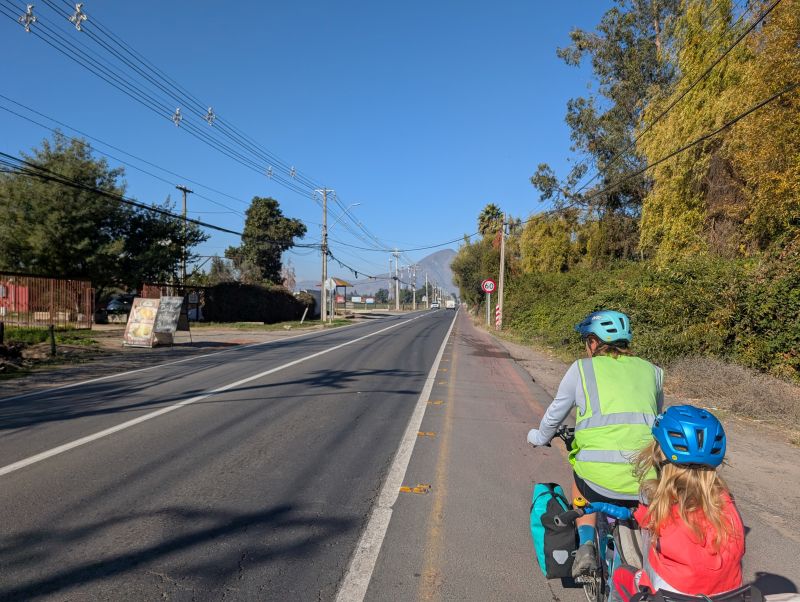
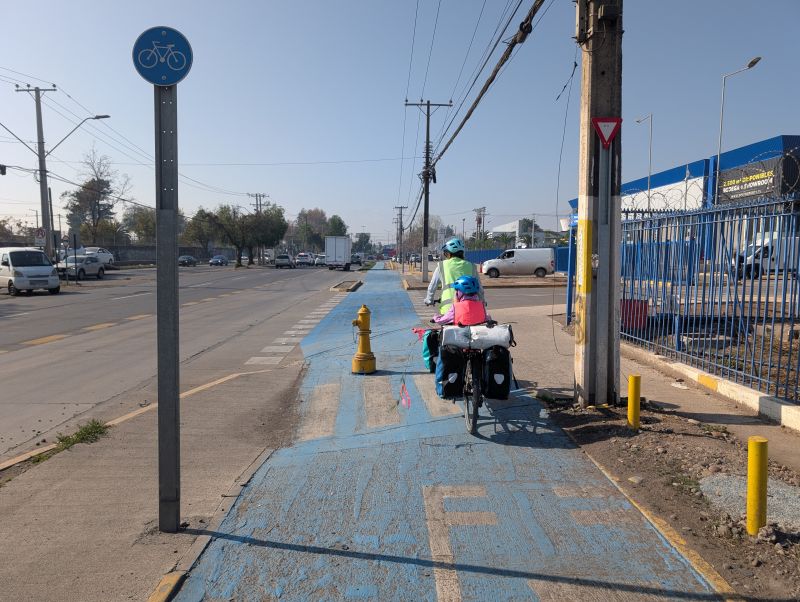
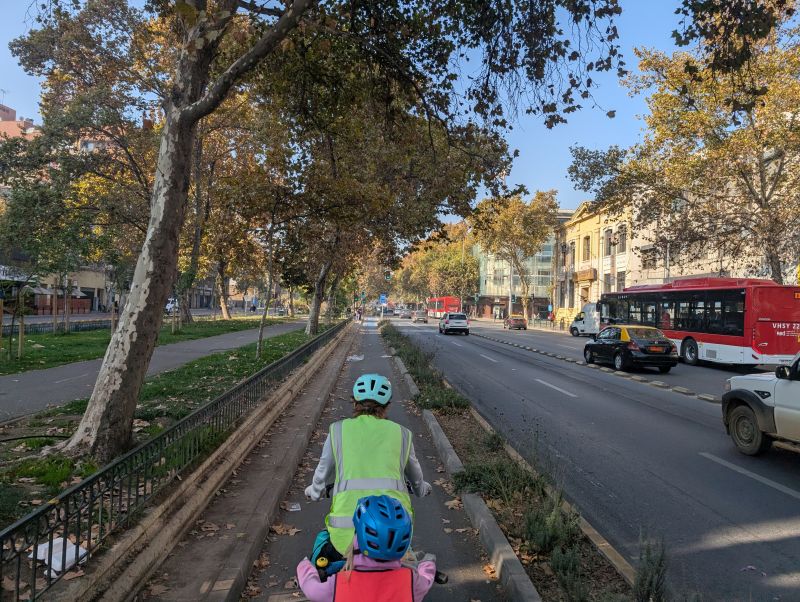
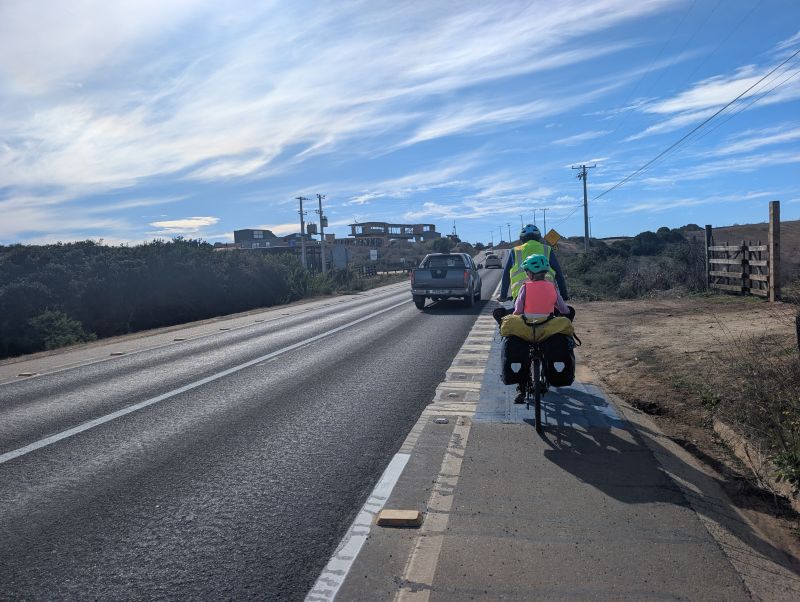
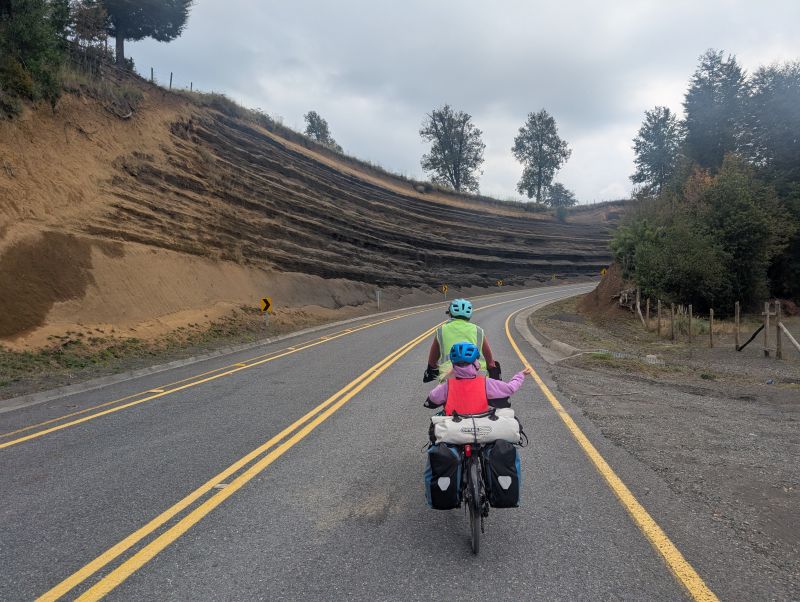
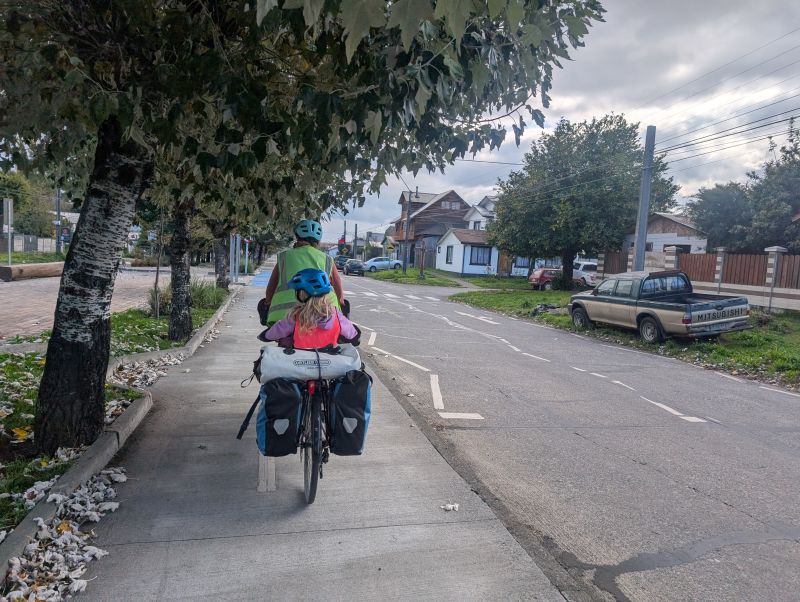
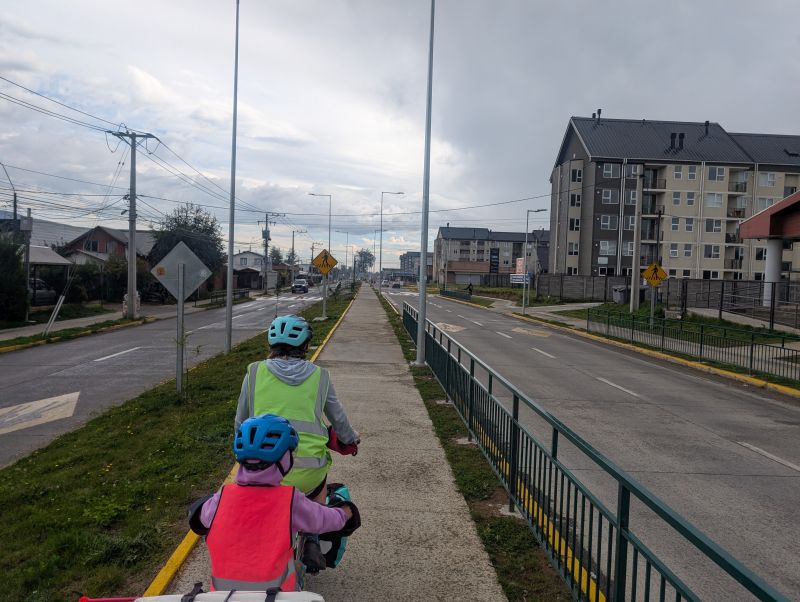
With over 3,000’ to descend we zipped down past the clouds and around a lot of tight curves.  We emerged from the clouds and mountains to find ourselves in a flat river valley.  We would spend the rest of the (long) day riding along the flat road towards the big fancy city of Pucón.  Happily, when we got close and traffic got busy a separated bicycle path appeared and whisked us all the way downtown to our lodging.  It was quite a shock for the whole family to pedal into a bustling town resembling Boulder, CO. 

Again, so happy for a bike path to lead us into the busy town of Pucón

We took a rest day here before getting back on our bikes. The girls have grown, and we found replacement fleece jackets with longer sleeves.

We found some sunshine!

… we just had to cross the Andes and enter Argentina.

Sunshine!

In this entry we struggle through the rain, ride over the Andes, and wake up in a sun-drenched Argentina.

Day 79: Rest (rain) day in Entre Lagos

We stayed an extra day in Entre Lagos because of weather conditions coming for the high pass we planned to right next.  Spoiler: despite our wait-it-out precautions we didn’t avoid wet and cold conditions…

During our extra day we discovered the flaw in our cabin here: a nest of yellow jackets underneath the primary bedroom.  This wouldn’t be a problem except that they were somehow entering the room!  Jason and I kept being confused and killing a couple at a time, then when there were ten we gave up and just kept the door closed.  Luckily this cabin had four single beds outside the main bedroom, so we were happy.  The owners would have happily moved us to another cabin, but at that point we were settled and halfway through our 1000-piece puzzle. 

We walked about town and went down to the lake.  Of course the volcano was shrouded in clouds, but we did find slides that were so high and so sketchy even H didn’t want to ride!

Day 80: Entre Lagos to Puyehue National Park (45 km / 28 mi)

We knew it was supposed to rain on the pass today, but conditions in town were forecast to be fine.  At this point we should know better than to trust the forecast – if the Philtrons are riding, a 10% chance of rain is actually 100%. 

The first part of the day along the lake was blissfully flat and fast.  We were in quite good spirits.  Then the rain got heavier.  Then the climbs started.  By the time we rolled up to our planned rest area we were soggy and feeling down.  The food truck had a covered outdoor seating area that was crowded with chickens.  We were there early, before the owners had even arrived, so we shooed away the chickens and tried to dry out.  It wasn’t working.  Once the owners arrived they actually invited us into their home, lit a fire, and served us a delicious lunch.  Their cats took over the chairs and our laps. 

Nearly two hours later we mustered the will to suit up in rain gear again and set out. 

The scenery was clearly lovely – lush forests, some farmlands, mist rising off the lake.  We passed some hot springs, or at least some advertisements for them.  Then it was a bit of a slog through dense forest towards Puyehue National Park.  The rain got harder again, and by the time we arrived it was downright pouring. 

The lovely young people running the reception tent were so kind to welcome us.  We had reserved a cabin in the park, grateful for anything with four walls and roof.  There was a wonderful surprise waiting for us though. They had already lit a fire in just about the cutest A-frame we’d ever seen.  It had a kitchen, a wood stove, four beds in the main room, a bedroom with a double bed, and a bathroom with a hot shower.  For four sopping wet cyclists it was a dream come true.

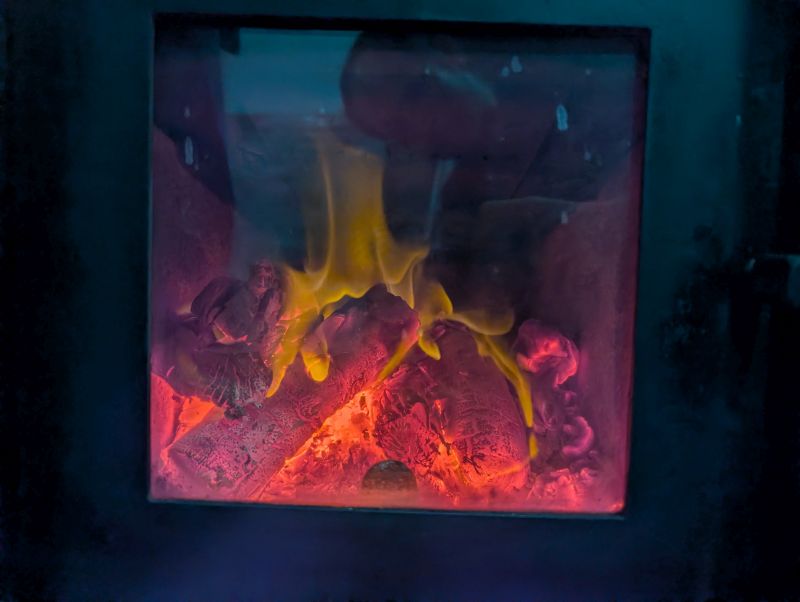
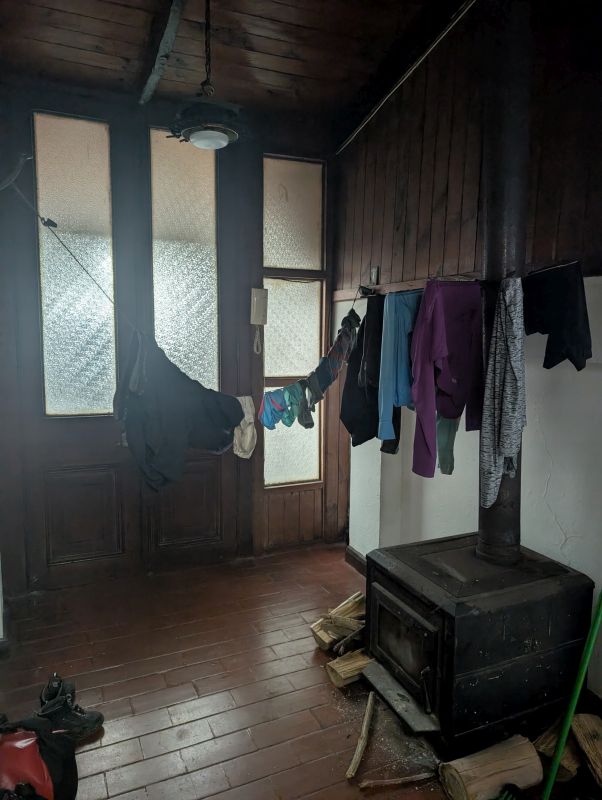
We took off everything wet and hung it about the wood stove while we cooked dinner and relaxed.  The rain was so intense that the raging river nearby overwhelmed the cabins water system, making our shower and toilet water brown with silt and river mud.  We didn’t care – the cooking water was clear and we used our filter.  The stove dried us all out.

Drying our wet gear

Day 81: Rest day in Puyehue National Park

After another close scrutiny of the weather models we decided to wait a day before attempting the pass. It was a toss-up weatherwise between today and tomorrow up high, but we can’t return to Chile until April 3 for visa reasons.  We decided that the opportunity to explore a national park and stay in a warm comfy cabin was just too special to miss. 

We spent the morning hiking all the trails on this side of the park.  We saw the raging river and three mighty waterfalls.  We even almost saw a nearby volcano.  The prevalence of invasive bamboo was disheartening, but we still really enjoyed ourselves.

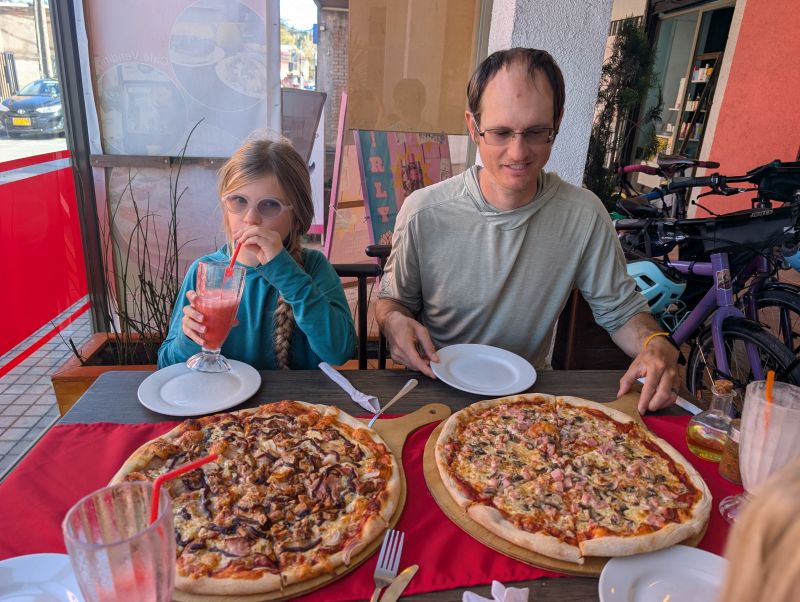
For lunch we went to the park restaurant and ordered two huge pizzas and a massive plate of fries.  It was such a yummy treat! When we had eaten all we could we retreated to the cabin to read and play games until bedtime.

Day 82: Puyehue National Park to Camping Brazo Rincon (47 km / 29 mi)

Today was a day to remember! It was the biggest pass we’ve ridden with the kids, it spanned two countries, and of course we did it in the cold rain.

It didn’t start out raining, at least.  We left the campground dry, and rode the 5km to the Chilean border post in good spirits.  It was simple to get our Chilean exit stamps, and the border official really seemed impressed to see that we had entered the country in Tierra del Fuego.

Chile and Argentina share a very, very, very, long border.  It is formed by the highest part of the Andes.  Because the border itself is at those high points, the two countries often choose to put their immigration stations very far away from the pass.  Cyclists (along with everyone else) need to get exit stamps from one country and then get through immigration of the other the same day, regardless of the distance between the two immigration facilities.  In this case, there were 40km and 3,500 feet of climbing between them.

After we got our exit stamps we skipped happily back to bikes to eat snacks.  Then we noticed a few sprinkles.  Then the sprinkles were enough to put on rain jackets.  When we got back on the road there was immediately a stop for road construction!  Luckily we were waved through and just told to ride on the newly-built non-traffic lane. 

We were slow.  It was cold.  The cloud cover was so low we could see none of the beautiful mountains and volcanoes that we knew were around us.  And yet… we kept riding.  We stopped for a fast, cold lunch about 2/3 of the way up.  By 2pm we were pushing the final few meters to the top of the pass.  Of course, by then it was really raining.

After we changed into dry clothes and full rain gear over down jackets we took a rushed photo at the summit sign.  Because of the pouring rain and risk of dangerous cold we couldn’t set up our good camera on a timer and instead relied on Jason’s phone with an ‘add-me’ feature.  It leaves something to be desired, but with the cold seeping into us we carried on.

Paso Cardenal Antonio Samore

The descent was fast and obviously beautiful, even with the low cloud cover.  Even in places that hadn’t received rain (dry pavement) we brought the rain with us.  We were relieved to roll into the Argentine customs building because it meant a roof!  We quickly got our new passport stamps and received some friendly encouragement from everyone working there.

Our destination was just a few kilometers up the road.  We had hoped a cabin would be available, but the campground only had campsites free.  Oh well – we found a flat spot and set up.  By then it wasn’t raining so we spread out all our wet gear on tree branches.  It proved to be an extremely cold night. I’m surprised we didn’t wake up to find our shirts frozen solid.

So strong

Day 83: Camping Brazo Rincon to Villa La Angostura (25 km / 16 mi)

It was cold when Jason and I poked our heads out of the tent, so cold that we told the girls to stay put until the sun appeared.  A thick fog had formed over the nearby lake.  I sat outside drinking a huge mug of coffee as I watched it burn off in patches.  I even saw some kind of a fog-rainbow form.

When the sun reached us it warmed up everything and we were treated to a perfectly blue sky.  The mountains we had crossed yesterday were behind us.  The girls walked out to the lake and found something wonderful: floating rocks!!  It’s true, the little ultra-light pebbles that formed the beach were actual volcanic pumice.  When the girls kicked them into the lake they floated.  Incredible.

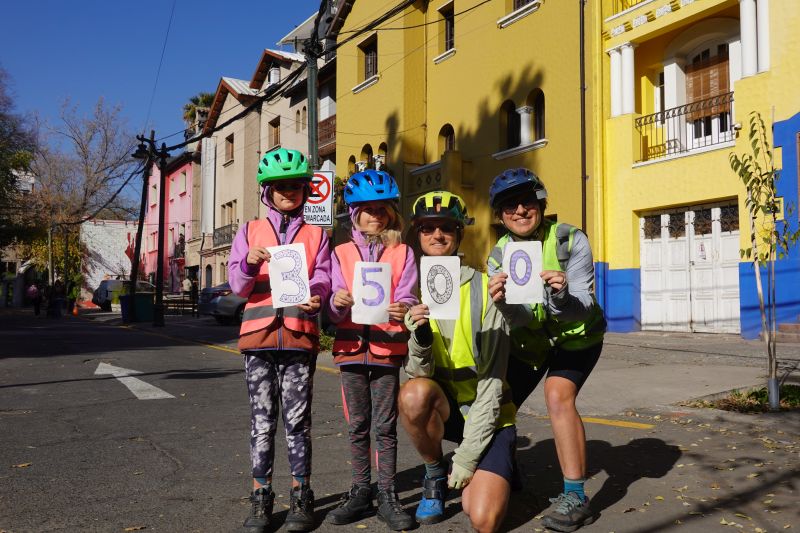
We didn’t leave camp early, but even when we left at 11 it was cold in the shadows.  We hit 2,000 km right around lunchtime, so we stopped to eat and also to take our photo. 

2000 km of riding from our start in Ushuaia

As we continued towards town we crossed several large overlooks of the famous lakes of this region.  Suddenly we were in the land of sunshine and tourism.  It felt festive. 

Town was bustling and very spread out along the highway.  A bike lane appeared just as traffic picked up, which we appreciated.  We nearly missed the turn off for our cabin because all the side roads were dirt.  Even in the clearly affluent areas, there were dirt roads with no sidewalks.  We also noticed there were no minimarkets like we had grown used to in Chile. 

Our cabin, however, felt like luxury!  We settled in to rest.

This “cabin” was huge

Exploring Chiloé Island

We started our tour of Chiloé from the southern end, in the port city of Quellón

In this entry we explore the big island of Chiloé.  This island is a continuation of the coast mountain range of central/southern Chile.  It is rich agricultural land, and also is well-known for extensive seafood.  We saw dozens of mussel farms, some salmon farms, and more fishing boats than we could count.  We enjoyed the differences from the Carretera Austral (especially the sunshine and pavement), but by the end we were ready to leave the wildly steep rollercoaster roads behind.

Day 64: Rest day in Quellón

After our 1am arrival off the ferry we needed a day to rest and recover our strength.  We did need to change cabins, since our landing place was only available one night.  Luckily we found a new place that was just a bit farther down the coast and so fun.  It was a house with one of the bedrooms lofted above the living room and also a little bit out above the yard! 

Half of the upstairs bedroom was outside the footprint of the building. “Impressive!”

After we dropped off our stuff at the new house we went in search of a place for a big seafood lunch. Our first try was a bust (the restaurant listed on Google was a daycare in real life), but at our second try we ended up eating a huge delicious lunch of fish, sushi, and other assorted seafood.  It really felt like a day on vacation! 

We had other things on our to-do list, like finding a post office, that we didn’t get done, but then again we were tired.  What we really needed was an early bedtime!

Day 65: Quellón to Cabañas Ranchita del Trauco (54 km / 34 mi)

This first day riding was a perfect introduction to Chiloe:  wildly steep hills, serene countryside, colorful houses, and plentiful services. 

Along the waterfront as we rode out of town
Houses were painted in so, so many different colors

We started the day off riding along the waterfront of Quellón.  We passed many small fishing boats, little houses, and a multitude of barking dogs.  The dogs don’t seem intent on harming us, just being as loud as possible.  Eventually we turned inland on a secondary (paved) road.  It was busy with traffic to seafood processing plants.  H in particular loved the smells of the mussels and clams cooking as we passed.

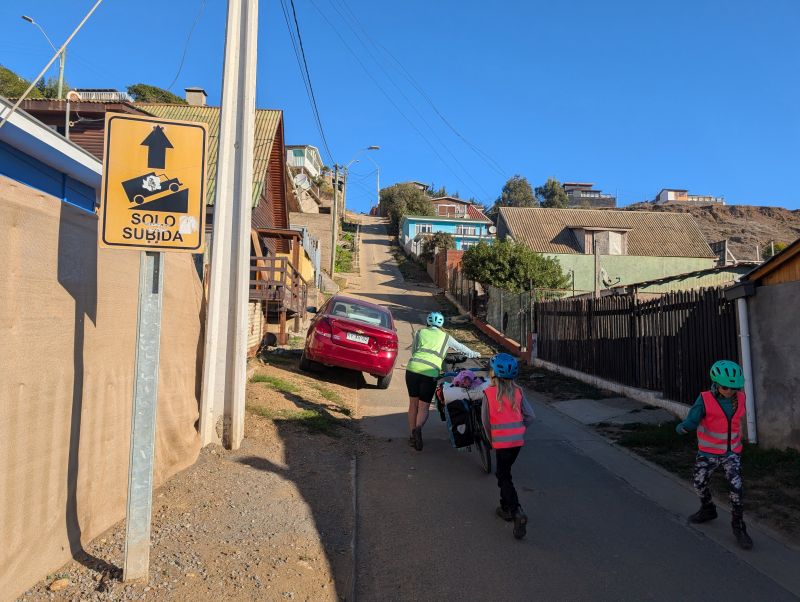
Before long it was just countryside and we were confronted with the steep hills Chiloé is known for.  We have gotten over many a steep hill on the Carretera Austral, but the grade of the secondary roads in Chiloé finally convinced us to start measuring.  It turns out we can ride grades up to 12%, but once we hit 14% it’s too much.  On this first steep hill we hit today we had trouble even *pushing* the bikes up.  I believe it was around 20%, although we were unable to measure it at the time.  We even saw a car struggling to get over the top.

CAUTION: Hill steeper than it appears!

Shockingly, the top of the hills don’t always throw us straight back down.  We emerged onto a flat plateau of perfect farms.  It was only after a bit more riding that we zipped down to another bayside town next to shimmering mussel farms. 

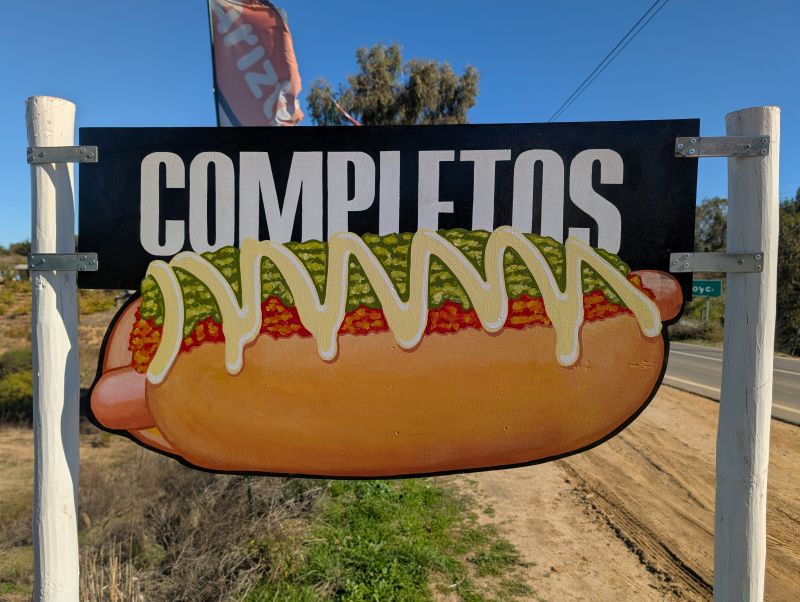
We rejoined the primary highway (actually a quiet two-lane road still) in time to get a lunch of hot dogs.  We were shocked at how frequently we passed stores and super markets.  It’s definitely time to stop carrying so much food! 

Jason was happy to see this “summit” sign. It couldn’t have been much higher than 150 m above sea level.

We stopped for the night at an absolutely delightful cabin on a medium-sized lake (Lago Natri).  The owners were so kind – they gave us fresh eggs, watermelon, and a special kind of regional liquor they made themselves.  The girls were thrilled because there was a trampoline to play on, of course. We tried the liquor (it was actually really yummy) and then carried it to the next stop, a hostel, to share with others. 

Day 66: Cabaña to Castro (43 km / 27 mi)

We were lucky that the morning rain passed by the time we started riding.  Under beautiful fluffy clouds we undertook the mornings task: climb and descend and climb and descend, repeatedly.  We climbed the same 100 meters four times.  We mainly listened to an audio book (Alcatraz and the Evil Librarians!), shifted down, and carried on. 

We stopped outside the town of Chonchi at a roadside restaurant where all the construction workers were getting lunch.  Wow was it delicious!  The girls shared a huge plate of salmon with fries, while Jason and I each got our own plates of fish.  The people working there were so nice too.  We left full of protein and energy, ready for more climbing.

There were roadworks underway for the rest of the day, which could mean an unpleasant ride, but in this case we were instructed to ride on the lane closed to traffic.  It was actually pretty nice!  The traffic in each direction was delayed back and forth so we had a nearly traffic-free ride into the edge of town.

Construction traffic left us with a lane to ourselves

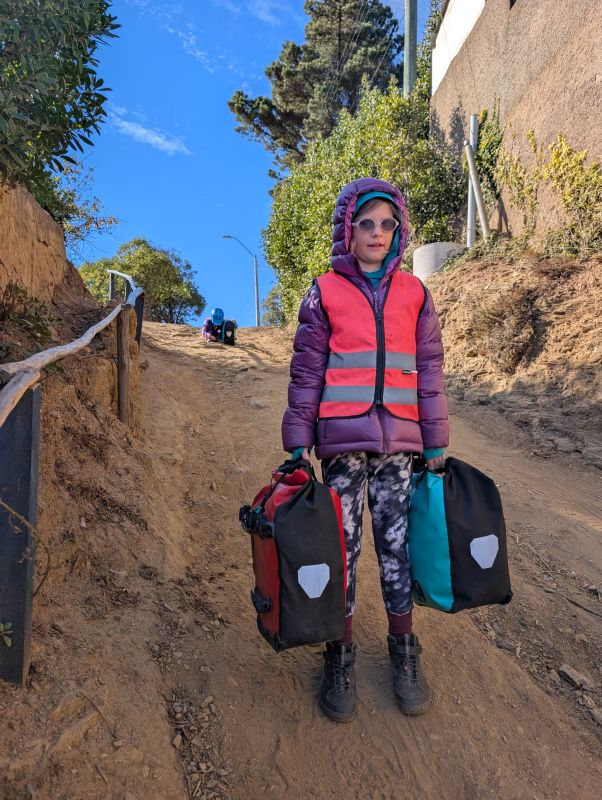
The city of Castro is mostly built on a big bluff above a quiet bay.  The lower part of town is famous for the buildings on stilts over the water.  To go from the lower part of town to the upper part… you guessed it.  Huge hill.  The road goes up, but we chose to take a pedestrian path that was even steeper.  I’m not sure why we make these choices!  In the end it took the help of BOTH girls to get each bicycle up the steep path.  While the girls helped one of us, the other would hold the bicycle steady on the slope using the brakes.  Even with both brakes on and the wheels fixed my bike tried to slide! 

As usual, we made it over the top.  Miraculously the town on top was flat!  We walked the rest of the way through the bustling streets to our hostel. It was such a busy city! 

Day 67: Castro to Dalcahue (20 km / 12 mi)

Most of this trip has been on roads with no viable alternatives roads.  Here on Chiloe we have had the option to try out little tiny alternate roads!  Leaving Castro we decided to avoid the major highway completely.  I’m so glad we did. Sure, there was a little bit of gravel/dirt (we started chanting “vote no to ripio”), but it was worth the excitement.  We saw some oddly terraced little hills at the edge of town, biked through some little towns with rainbow names (Llau Llau), and ended up at a dead end road with the only path forward as a narrow pedestrian-only (“closed”) bridge to a dead-end road on the other side. 

We cycled all the way to Dalcahue before we even ate lunch, then parked the bikes while we ate Sushi bowls and fresh juice.  We spent the afternoon relaxing in a cabin and decided to take a rest day.

Day 68: Rest (Rain) day in Dalcahue

The promised rain wasn’t as torrential as we had feared, but it was still good to have a slow day of tourism.  We bought magnets, fancy ice cream, and found a small shop that made delicious burritos.  We ate them for lunch AND for dinner!  It was good to feel like we were really on a vacation for a day.

Day 69: Dalcahue to Quemchi (38 km / 24 mi)

Have we mentioned the steep hills of Chiloe?  Well today we found more of them!  Right away we were hit with a big hill just to leave town.  We took the smaller, locals-only option (yup, more dirt/gravel) and it once again humbled us.  We pushed our ways up and over however, and on top was a smooth flat road!

The steep way out of town (spoiler alert: all ways were steep)

It was peaceful and pleasant before screaming back down to a river and up again.  And then again.  At this point we took a turn for a dirt/gravel “shortcut.” At the end of the day we told our host about this road and she said that our phones betrayed us with the directions, but we actually enjoyed it!  Yes it was steep but it was also completely free of traffic and through beautiful farmland.  There were parrots (yes parrots!) flying overhead as we creeped slowly up and down the steep hills.
We finally hit pavement (and more roller coaster up and down hills) shortly before our planned accommodations.  The cabin wasn’t quite ready yet so we took a walk down to the water and got a big plate of French fries from a roadside food stand.  We also picked up some groceries from a minimarket.  The owner was really happy to chat with us and tell us about all the very interesting specialty seafoods the people of Chiloe enjoy.  We liked learning about them, and can confirm no such foods exist in the US! 
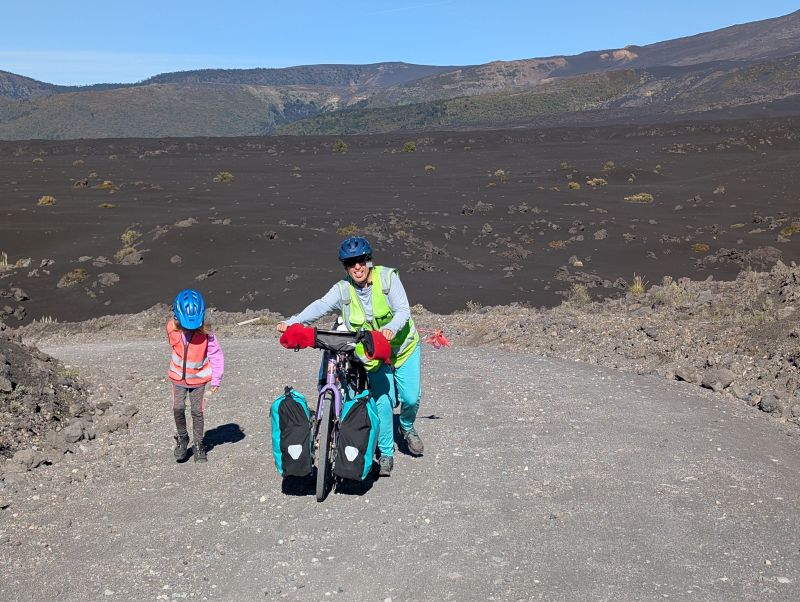
Deep, rich soil here
Photo magic (“add me”)

Our cabin was quite luxurious and on the second floor!  We could see the salmon farms in the bay below.  Most importantly, the internet was sufficient to watch the latest episode of Survivor 50!
Day 70: Quemchi to Pargua (51 km / 32 mi)

By the time this day dawned we were more than ready to see the steep hills of Chiloe disappear behind us.  In fact, the climbs were shorter today.  I’m not sure what got into us, but we just powered through the day.  We stopped only to eat lunch at a lovely overlook.  The road was rural and quiet; in short it was a nice day.

By 2pm we had reached the northern edge of the island.  The Chilean government is in the process of building a massive bridge to connect Chiloe to the mainland, but right now every single bit of traffic has to load onto a ferry.  Two companies run four boats each and it is a constant flow.  We rode directly onto a boat that left after mere moments.

H with the unfinished suspension bridge in the background

The crossing is only ten or fifteen minutes long but the ferry takes longer because of the wait for landing space.  There are multiple landing locations (three) and we are pretty sure each ferry just goes to whichever is available soonest.  Yet our ferry still had to wait in a ferry queue and then two boats landed at the same time on opposite sides of the dock!  If you’ve taken a ferry in the states (looking at all you Lopez folks!) you are accustomed to a dock that is part of a large complex.  The boats arrive guided in by piers and dolphins (that’s the term for the big guide posts that help a ferry dock properly).  Not here!  There’s just a concrete landing area (a ramp extending into the water, like a boat launch).  The ferry rolls in, lowers the car ramp, and holds steady while the cars drive on and off.  The ferry operators here are excellent.

By 3:30 we reached our home for the night.  Luckily it included an attached garage for the bikes because you guessed it – the torrential rains returned overnight!! The next day the downpour continued and we took another rest (rain!) day.

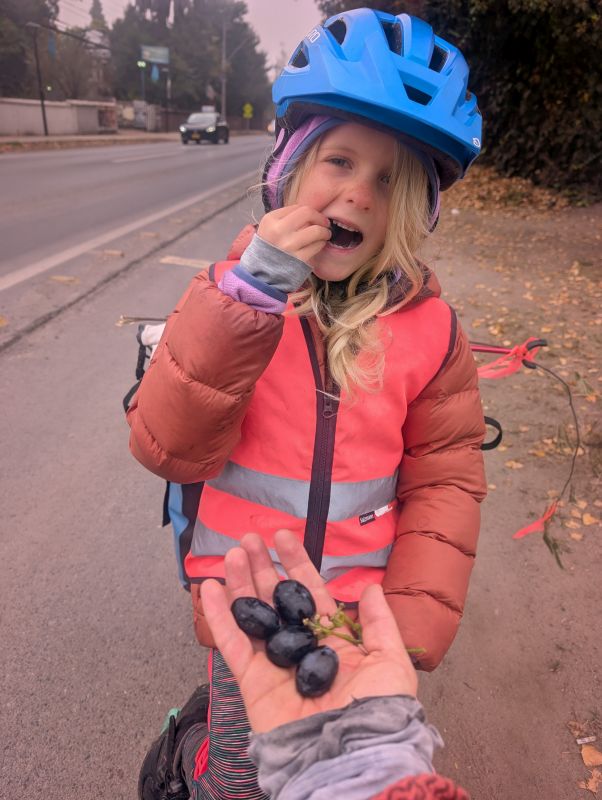
Yum!!! There is a different variety of grapes down here (we’ve never seen it in the US) and they are delicious.

Villa Mañihuales to Quellón

In this entry we brave the morning rain to ride through another round of beauty between villages before we shelter from more torrential rains in a simple cabin.  Then on the next sunny day (which is the kind of day cycletourists dream of) we flee the cold and rainy Carretera Austral and reach the coast.  Finally, we take a ferry to the big island of Chiloé.

Day 59: Villa Mañihuales to Villa Amengual (59 km / 37 mi)

After three days in one place, we woke up on the fourth day to see more rain coming down.  However, a close reading of the weather forecast (actually, a close reading of four different probabilistic weather models), showed that there would be a good riding window in the afternoon.  We rallied as a family and packed our bags, waving goodbye to the little apartment and the village of Mañihuales.

The road undulated through small farms in the shadow of huge, deeply forested mountains.  We were clearly in a temperate rainforest based on the flora, and also based on the cold drizzle that was all around us.  The riding wasn’t fast, since it was uphill most of the day, and into a stiff headwind.  At this point in our journey we generally don’t remark on headwinds except to say…  this is nothing compared to Tierra del Fuego!

By lunchtime 20km into the day we were wet and cold.  We stopped the moment was saw a sheltered bus stop.  As we ate our avocado-tuna sandwiches the rain poured down, but miraculously it stopped as we began riding again.  For the rest of the day we were under a pocket of sunny skies with rain clouds ahead and behind.  It was an amazing afternoon in spectacular mountain scenery.

At one point we were riding on a long steep uphill when I looked up and saw a huge, sheer rock face right next to the road.  I gasped and said “Look, there’s half dome!’, referencing the extremely famous landmark in Yosemite National Park.  Of course, here in Patagonia it was just a sentinel to passing soggy cyclists. 

We remembered seeing this house 11 years ago, and it looked abandoned then, too.

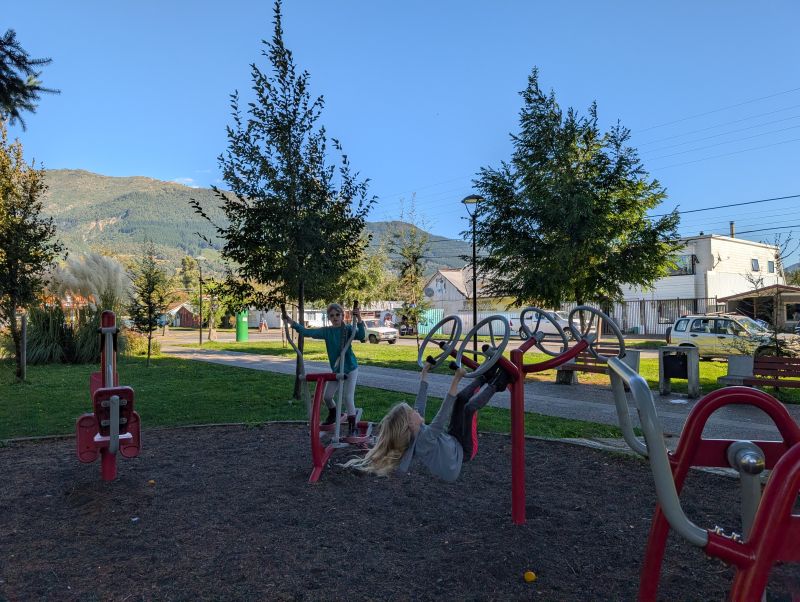
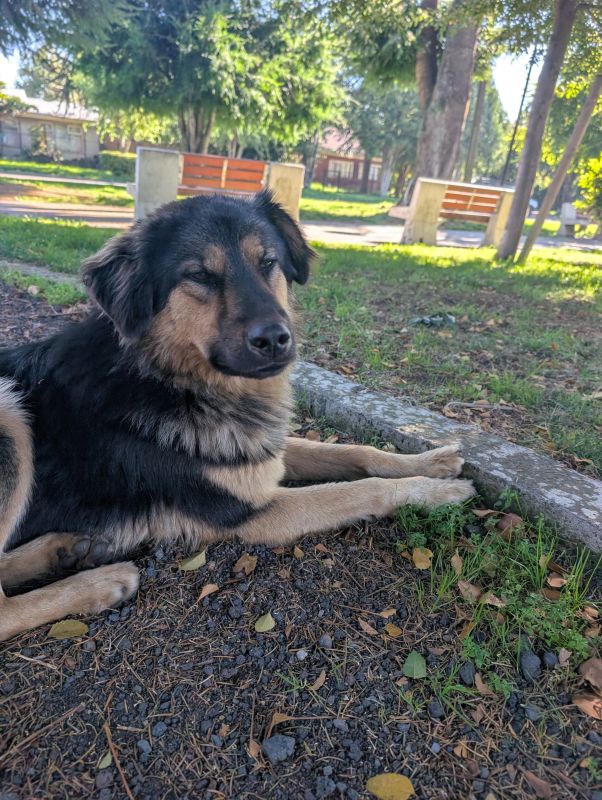
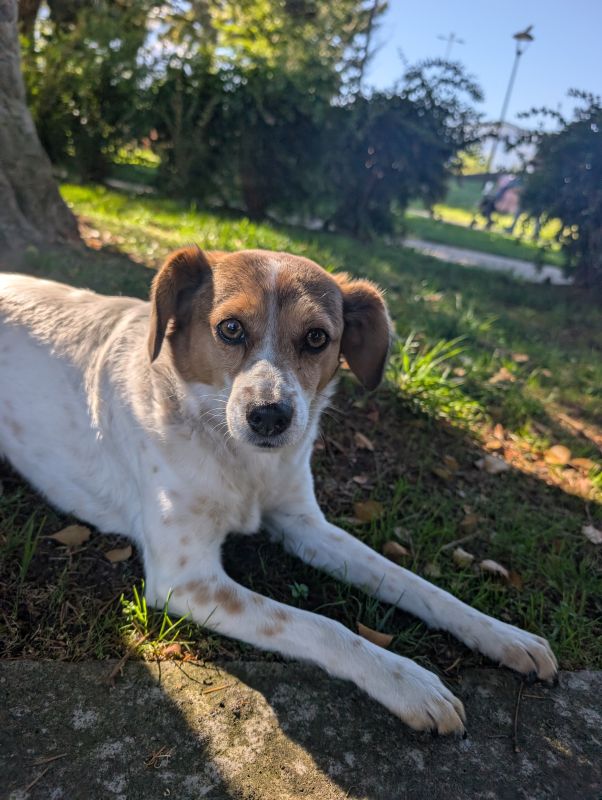
Our patch of sun followed us all the way to the very tiny hamlet of Villa Amengual.  This little village is perched on a hillside above a river, with towering mountains in every direction.  The girls stopped at the central square to test out the playground equipment and greet the local dogs.  As we rested there it started to rain (of course) and then the woman that runs the cabins in town came to find us.  We had been chatting with her to make sure a cabin would be waiting for us, but she revealed the other cyclists in town had decided not to vacate the cabin!  No worries, she had called around to find us another cabin up the road.  She said ‘Go knock on the door of the two-story white house.’ 

We found the two-story white house and someone quickly came out to welcome us. She took us to a very simple cabin down a soggy mud driveway, where a warm fire greeted us.  We were very happy to have a home out of the rain! The hosts were so friendly to us.  They brought lots of firewood (it was cold!) and shared many local history stories.  We learned about the priest that set up home in Patagonia in the 70s and 80s, connecting communities and facilitating trade (and many marriages).  We learned about the road construction, a mudslide disaster, and the giant satellite dish that made TV possible in the 90s–but only a Mexican TV station. 

Day 60: Rest day in Villa Amengual

Oh my gosh the rain would not stop!!  It must have rained 1.5 inches in a single day, just nonstop.  We only went out to track down food, which was actually difficult.  The village has three places to buy food, in theory, but one was closed and another was ‘open’ but no one was there.  The final store was on the other side of town along the highway.  It was actually open!  It was also the meat / butcher shop, so we were able to get what we needed for dinner.  It didn’t have vegetables, but we had inexplicably carried huge pieces of squash, cabbage, onion, and carrots from the previous town. Who would have guessed?

Day 61: Villa Amengualto Refugio Rio Cisnes (7 km / 4 mi)

We thought the rain had cleared up enough to make at least some forward progress, so we decided to ride a very short day to a nature preserve along the mighty Rio Cisnes.  We left town in a spot of sunshine.  It felt like an enormous privilege to be riding through the rainforest and past many rushing streams.  It was a bit of climb leaving town, and by the top of it… the rain returned!

As we crested the top and began the quick descent towards the river the beautiful sun spot became driving rain and dangerous gusts of wind.  We carefully descended, concentrating on keeping the bikes upright around the curves and through the gusts.  A couple of French travelers pulled over in front of us and lifted our spirits with balls of Lindt chocolate!  This was unexpected but delightful.

Shortly after the road straightened out we reached our destination.  It looked medium abandoned, but we stopped at the small building labeled ‘café’ to find a warm fire and a lovely spot to sit out of the rain.  Soon we were eating a delicious lunch of hot dogs and ham/cheese/egg sandwiches while our cabin was prepared.  When we finished eating we headed down to the cabin/lodge, which is set up to have rooms rented separately for up to 8 people.  We correctly had guessed that no one else would visit on this rainy day, and we got the entire picturesque cabin to ourselves.  It was lovely!  But also cold.

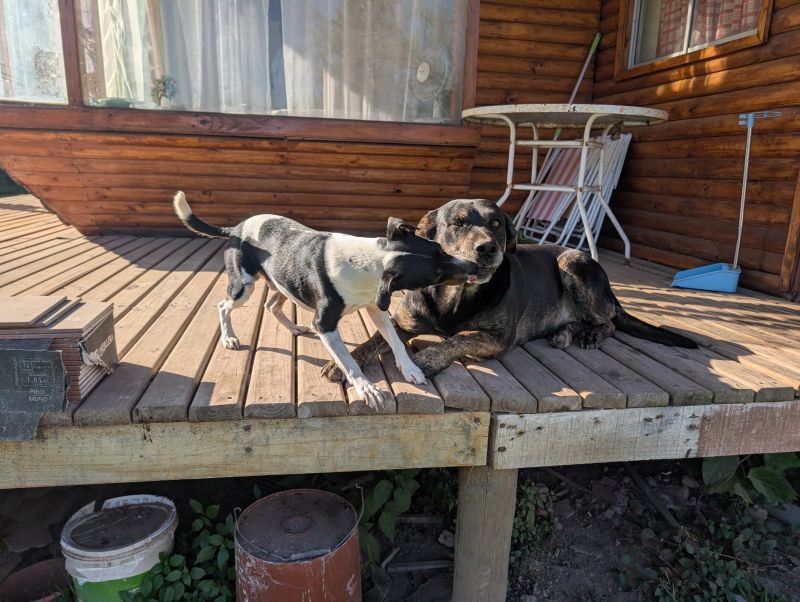
Our friendly “guard dog”

It took Jason four tries to get the wood fire started, since the wood provided was soggy and too green to really burn well.  Eventually he scavenged for better (older) wood under the cabin and soon we were in business!  We spent the afternoon reading, taking a little hike along the river, and preparing a surprisingly yummy chicken and green bean pilaf for dinner.  We all decided to sleep in the loft, occupying four single beds in the warmth above the stove.

Day 62: Refugio Rio Cisnes to Puerto Cisnes (55 km / 34 mi)

We awoke to perfect sun and blue sky. The mist was rising off the hillsides as we set out for a spectacular day of riding.  After so many cold and rainy days, we had made the decision to make a run for the coast and hop a ferry to the warmer island of Chiloe.  It was wonderful to have one perfect day of riding in this area before we left the rainy coast entirely. 

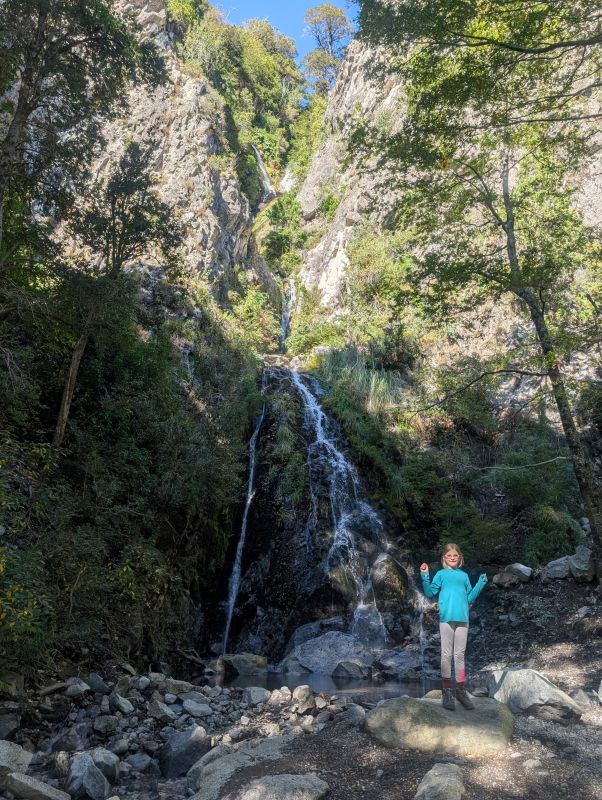
We rode in the shadow of the steep cliffs all morning along the beautiful Rio Cisnes.  It seemed that every hundred feet we passed another small stream/waterfall as it crossed the road.  We were in excellent spirits.

One noteworthy part of our route was passing the Piedra del Gato (cat rock) which is a sheer rock face above the river.  The road passes it in a raised section, and before the roadworks it took an entire day to get around this bottleneck.  I could see some of the ropes used by construction workers, still hanging abandoned on the rock face. 

In the early afternoon we turned off the Carretera Austral.  This was a big moment after nearly 800km on this one famous road.  It is one of the most famous cycling routes in the world, and for good reason.  Jason and I of course have already cycled it in its entirety, but we were delighted to turn off and pedal towards new routes.

Bye, bye, Carretera Austral! … See you in another 11 years?

The spur road to Puerto Cisnes was absolutely delightful as well.  There was almost no traffic and the grade was gentle as we zipped along the river valley.  We were delighted to reach the small port town at the mouth of the river.  We dropped our belongings (and the kids) off at our cabin and went to make sure everything was in order for the ferry to Chiloe. 

The ferry takes 12 hours and was scheduled to depart at 11am the next day.  We had already purchased tickets for the humans, but needed to buy tickets for the bicycles.  The bicycle tickets were surprisingly expensive, about $50 per bicycle.  Humans were $35 each, except H who was inexplicably free.  In any case, we got our tickets printed and paid for.

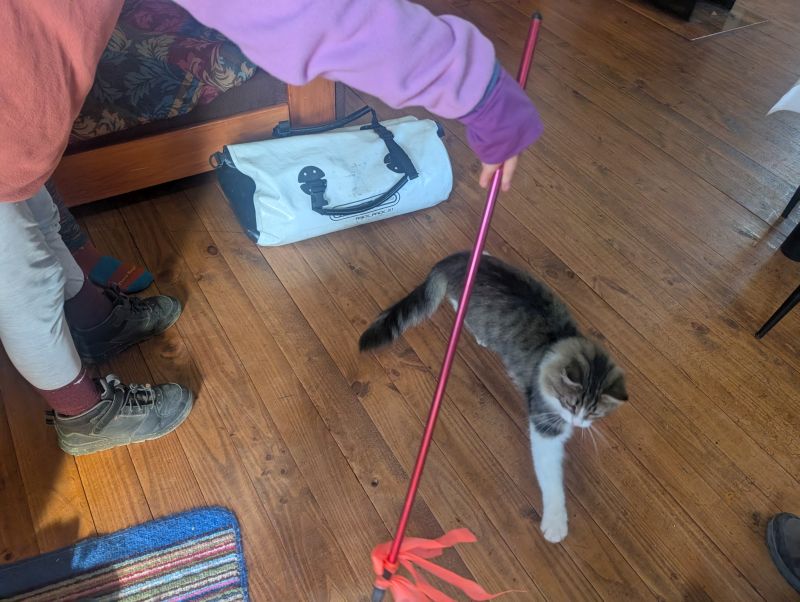
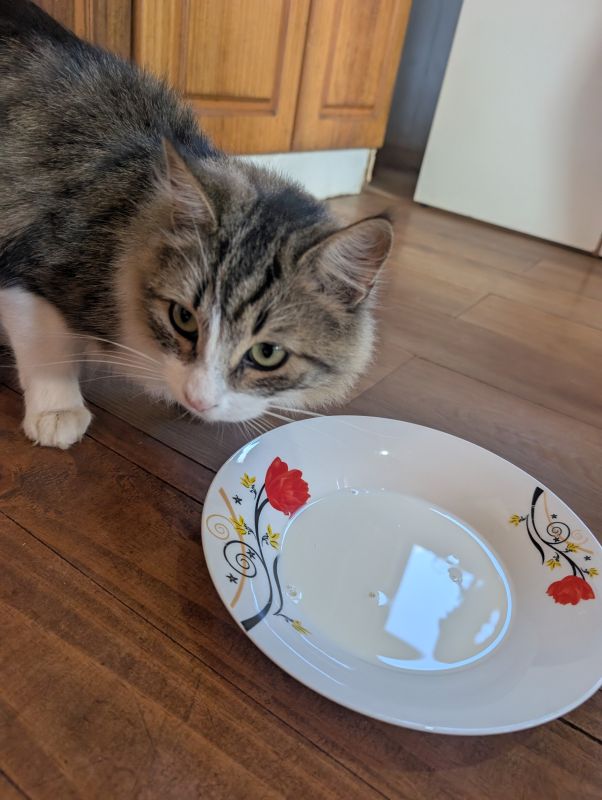
That evening we ordered pizzas and wandered town as they cooked.  It was such a nice town!  A lovely park straddled a stream in the middle of town, and there were all services you could need (including playgrounds).  We bought fruit at the fruit store, visited the ATM, and the pizzas were incredibly delicious when they were finally ready.  We took them back to our cabin where we ate and watched the second episode of Survivor season 50 (which is excellent as well!). Jason and A took a trip to a grocery store and were completely tickled to see a cat eating out of the sold-by-weight cat food bin inside the store! He asked the lady if cats eat free, and she said ‘Yes, this one does, it lives here!’

This is the kind of day that erases the previous 6 days of rain and cold.

Day 63: Ferry from Puerto Cisnes to Quellón (1 km)

The person that printed our tickets told us to arrive for the ferry two hours early, so around 9:15 we arrived at the dock… and there was no ferry.  Huh.  We asked around a bit and learned that the ferry wasn’t expected to arrive until 11:30!  We lamented a bit that we had arrived so early, but then we just settled in to wait.  The girls played Nintendo and Jason and I enjoyed chatting with the other passengers.  It was a mix of local people moving around the area for work or for family, and some tourists.

Waiting for the ferry. What else would they do?
It’s finally coming!

When the boat finally arrived the pedestrians and cyclists were allowed on first.  We settled the girls into our seats, then Jason and I set off to watch the cars load.  The boat has only one way on or off, so all the trucks and cars had to back onto the ferry.  It took a long time!  We finally pushed off from the dock at 1pm. 

The rest of the day was spent admiring the scenery, playing games, and just waiting. We were all reminded of Washington state and the waters around Lopez Island.  It was a perfectly calm and sunny day, so no one was sick.  The boat didn’t arrive at its destination until after midnight though, which was very late!  Luckily we had a small cabin reserved close to the dock.  It was an exciting and short ride in an unknown town in the middle of the night.  I bet the kids will remember this!  In any case we safely reached a small yellow house, parked the bikes and went straight to bed.

It is 1 AM and finally time to find our beds!