Category Archives: camping

Posts about where we stayed the night.

What to bring: Sleeping gear for camping

This is the first in a series of posts about specific gear that we plan to bring on our trip.

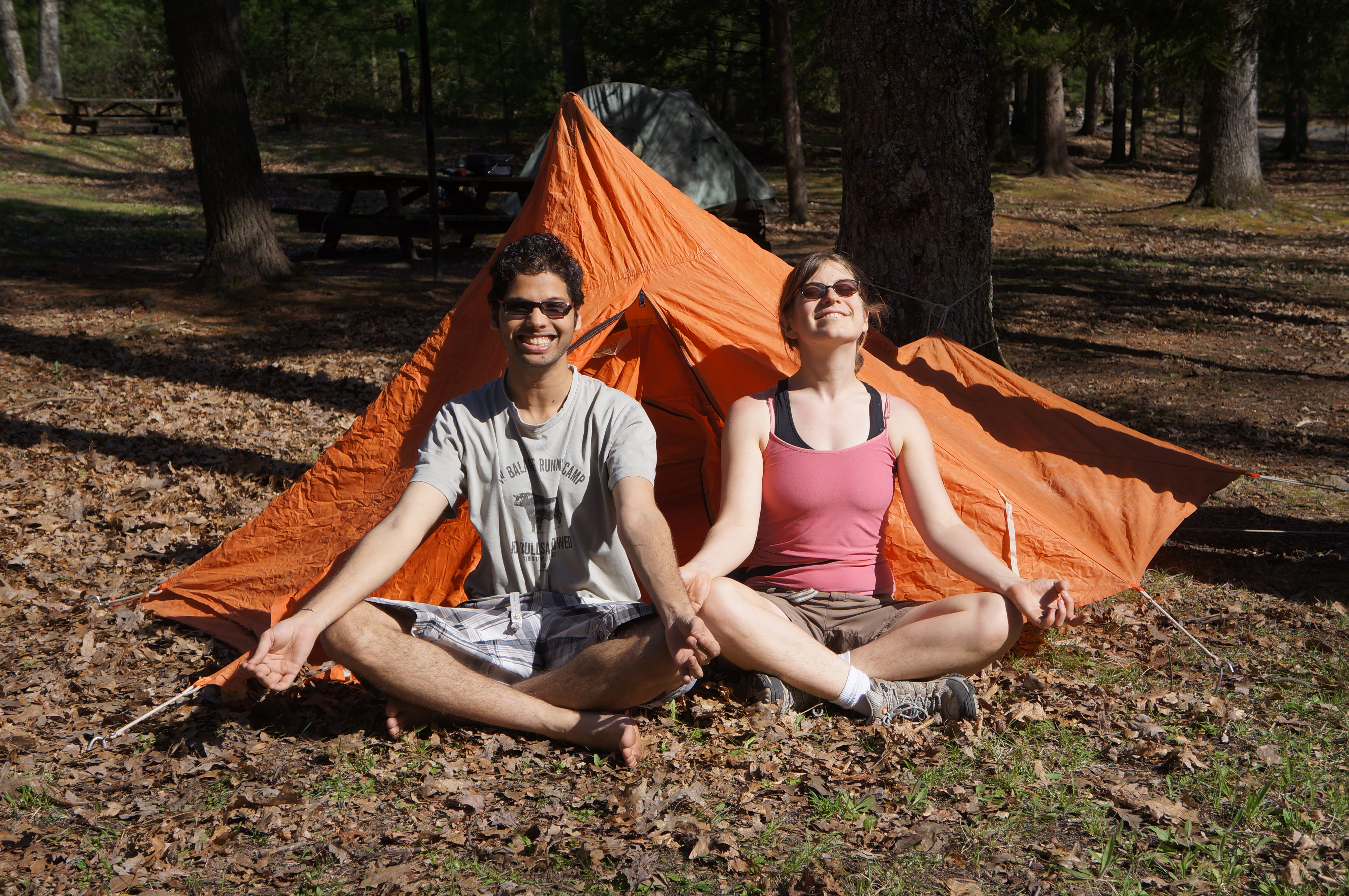
tent with meditators

A comfortable position for meditation, but a sad looking tent!

We’ll be camping many nights on our upcoming trip. For that reason, it is important to be comfortable while in our tent – whether the conditions are cold or hot, wet or dry. Once you’re on the road long enough, you will hit all conditions, including those most unpleasant. Let’s take a look at the gear we’ll bring.

Tent – Having a good quality tent is a must for comfort. It must have low, waterproof fly for those days when it is pouring rain. The fly can be removed to provide more circulation in hot weather. Also, it is best to have enough space to relax in the tent. When you are caught in a bad rain, it is nice to pass the time playing cards. Finally, we like to have enough space under the fly but outside the tent to store bags and dirty shoes. We got our tent from REI (Quarter Dome T2 Plus).

snow and wet tent

A night where we needed both warmth and waterproofing.

Sleeping bags – We’ll be hitting some cool nights in Alaska – likely down near freezing. Warm sleeping bags are a must for a good night’s sleep! We considered buying silk liners for extra warmth, but decided we wouldn’t need it. We have 20°F (-7°C) bags, and will switch to 40°F (4°C)  when we get to warmer climates. We got our warm bags from GoLite.

Sleeping pads – The big choice here is whether to go with foam or inflatable pads. (We did not consider for a second to not have a pad!) Foam pads are great because they can’t pop/deflate, but inflatable pads are great because they pack up into a smaller space. Both get you off the cold ground which is helpful. We’re planning to use our self-inflating open-cell foam pads (from Therm-a-Rest). We’ll probably pack a patch kit in case we puncture them. I have read about some folks taking both types of pads… maybe that is excessive?

Pillows – Are not necessary for short trips, but they are essential for long-term comfort. After weeks and months of sleeping in your tent, you don’t want to develop a neck or back ache from not having a pillow! I think pillows are are very personal, and a good fit will depend on your preferences. We decided to go with small inflatable ones, which have two different fabrics on the two sides – one better for hot conditions, and one for cold.

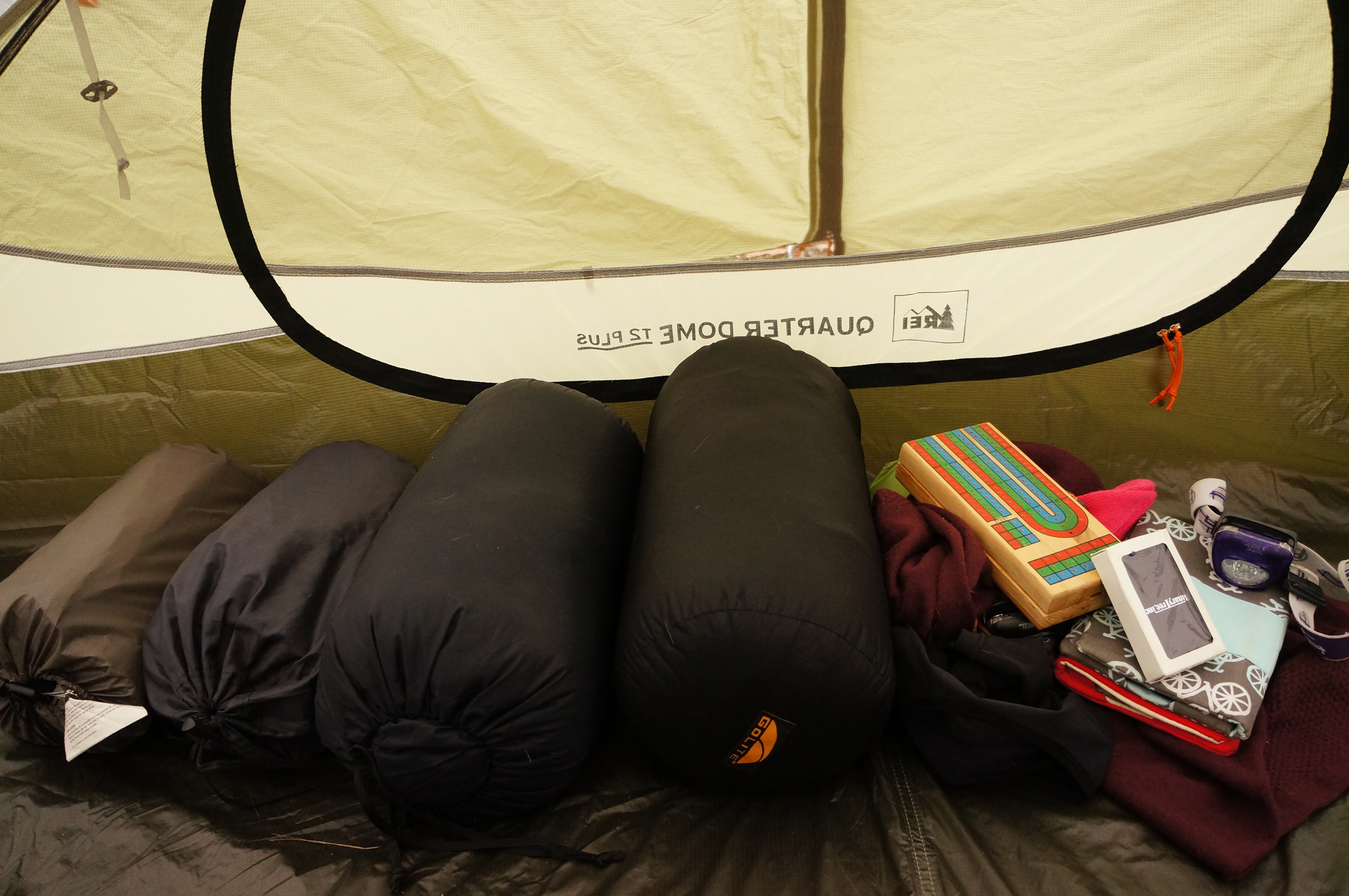
sleeping bag and pads

Sleeping bags and pads in their stuff sacks. Kindles, cards, and headlamps are often used in our tent, too!

Stuff sacks – Preferably waterproof, you’ll need bags to store each of these items in. Usually they come with each item you buy. Don’t lose them! Without the bags, your supplies will never pack down into small places. Compression bags are also great for clothing, but we’ll get into that in another post.

And last, but not least…

Bear spray – This isn’t necessary for physical comfort, but in bear-prone areas, think of it as your cuddle buddy for sweet, unworried dreams. This is best used when touring solo!

Staying the night: camping, hotels, and other options

Where we’ll be spending our nights will vary by locale and country. We expect to start the trip with a lot of camping, to help keep costs down in the US and Canada. Once we hit Central America we plan to stay in hotels more often. Throughout the trip we also hope to stay with local hosts.

wild camping

Our worst “wild camping” site ever – it got dark and the road went uphill, so we camped in a ditch.

In the US and Canada – Campgrounds are prevalent. The only trick is to try and get a reduced rate since we don’t want to pay $40 for an RV site! In OR and CA, many state parks

tent in the bathtub

After a rainy night of camping and a rainy day of cycling, a hotel room provides some important amenities.

have $5 per person hiker/biker sites. This is great because really all we need is a 8’x8’ area to pitch the tent, not an electric hookup and parking spot. When in remote areas, there is the opportunity to “wild camp” which essentially means making camp off the road out of sight. This is an excellent option because it is free and the location tends to be convenient. — Don’t worry, we won’t pass any fences or “No Trespassing” signs!

Points further south – Once entering Mexico and points further south, hotels/motels/hostels get much less expensive, and I read that campgrounds become less common. In some regions, camping is highly discouraged. In others, it is not as safe as we would like to be. We expect to find accommodation in buildings more often during this part of our trip. Once we get much further south, particularly to Chile and Argentina, we will again be camping a lot.

A third option: local hosts – This is by far the most interesting option, and provides the most benefit, since local folks will give you the scoop on all the local history, attractions, and any safety concerns. That includes advice on upcoming road conditions, which may be necessary once we venture further south!

We plan to visit with various friends and family along our route in the US, but in other locales, there are a variety of ways to meet local hosts. The main way is to use warmshowers.org, a website set up to help connect touring cyclists with potential hosts. Another service is couchsurfing.org, which is a site for general travelers. You may be more familiar with this site if you are not a cyclist. Daisy has a profile on Warmshowers and I have one on Couchsurfing so we are ready to go on this front!

Typically, the local hosts will offer accommodation (a bed, futon, or camping spot), and also possibly dinner and some form of entertainment. The only downside, though, is that after a long day of cycling you have to have enough energy saved up to make good conversation! ;) But we’ve noted through past visits and hosting that the cultural exchange is well worth the effort.

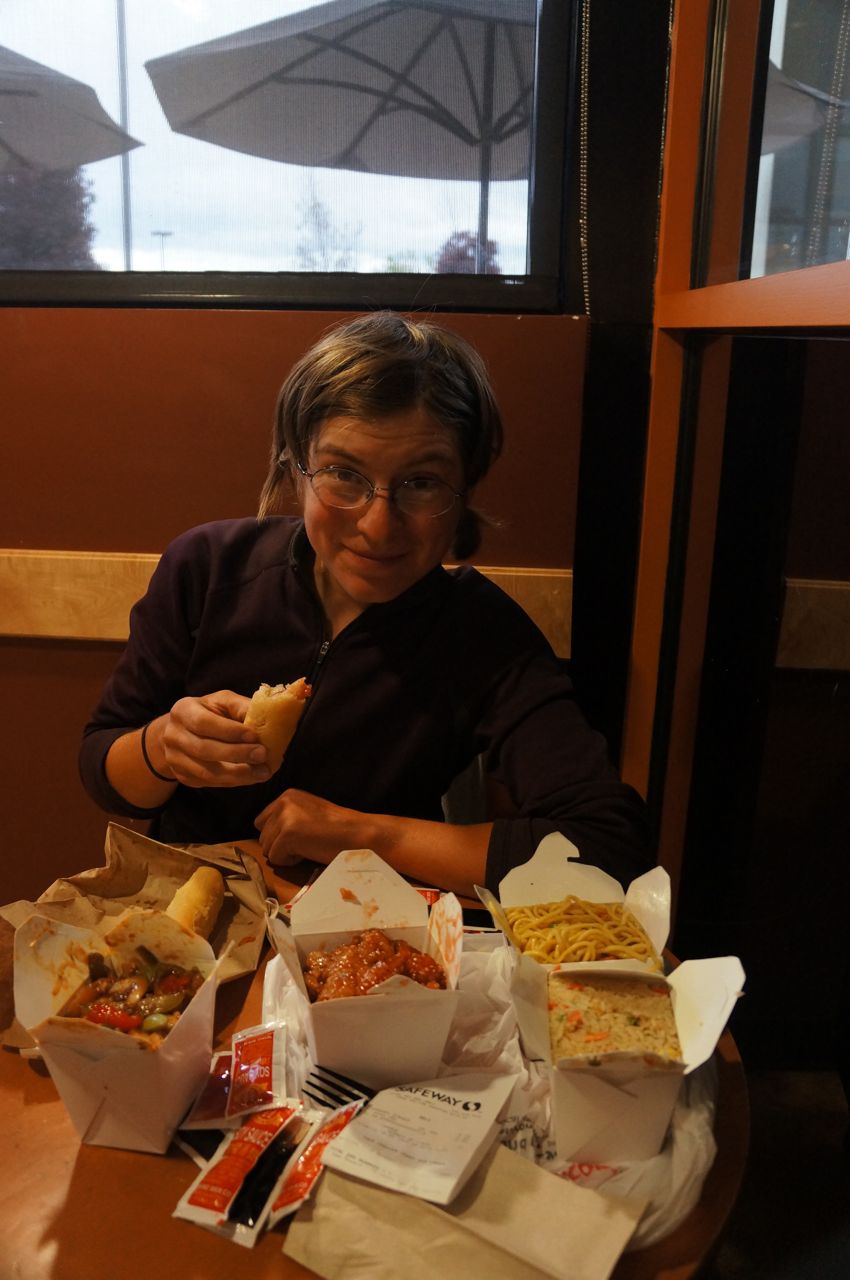
a large dinner

Eating a feast at Safeway, right before being offered a place to stay.

More often than you may imagine, random folks will approach and offer a place to stay. An example of when this might happen is when you’re sitting outside the grocery store eating a bag of chips AND a box of cookies, looking a bit dirty, but definitely happy and friendly. It is even better when the person offering to host tells you the story of how their child is on a long-distance cycle tour, and so they try to return the favor of hosting to balance some of the good fortune their child has received. 

Honeymoon – Day 5

Ocracoke, NC to Pettigrew State Park, NC; 62 miles

Route for day 5

Route for day 5

What a day!  It was supposed to be a nice, easy 36 miles to the state park.  We failed to notice, however, that a few of the roads that Google sent us on were unnamed.  The adventure started even earlier though, around 2 am.

The storm that blew in over the Outer Banks the night before caused the power in our motel to go off around 2 am.  Sometime later we got cold from the resulting lack of heat, and had to resort to using our sleeping bags to stay warm!  In the morning we had to be at the ferry before 7am, and so had to get prepared while it was still dark out. Without the lights we had to pack up using our headlamps in the motel!

The ferry had generator power, so it was still on schedule.  The woman selling tickets told us there were 7 inches of standing water in her lawn.  Yikes.  It took 2.5 hours to ferry back to the North Carolina mainland, and the rain continued.  It would continue all day.

We rode for about 2 hours into a strong headwind and rain.  Our directions sent us down a road with a sign: ‘road ends 1 mile’.  Uh oh.  Foolish us, we pushed into the wind anyway, hoping the sign was wrong.  It wasn’t – we reached the end of the road and found only a farmhouse and a large building with tractors.  We stepped in for directions and met Reed and Randy, two cotton farmers.  They invited us in out of the rain and peppered us with questions about life on bikes.  Reed even helped us plan a route to the state park we were aiming for, and gave us a new map.  Best of all, they gave us a big bag full of raw North Carolina peanuts.  I’m not sure how Jason fit the bag into his pannier, but he did.

As we left the rain started again, and we still had a long way to ride.  10 of the remaining miles were on a dirt/sand/gravel road through a wildlife refuge.  On another day it would have been beautiful, but on that day it seemed to go on forever, and we were exhausted when we finally reached the edge of the lake we were aiming for.

10 slow, difficult miles into the wind on this muddy road nearly finished us.

10 slow, difficult miles into the wind on this muddy road nearly finished us.

At the end of the mud road we met a gravel road, and luckily a park ranger who provided us with yet another map to find the campground.  We didn’t know it at the time, but there were still 20 miles left to ride.  We were already exhausted, but the promise of a picnic table, restroom, and spot for the tent kept us pushing as the temperature dropped.

We arrived at the park at dusk – just in time.  The ranger was very nice and helped us find a sheltered campsite.  I spent nearly half an hour in the restroom hitting the hand drier over and over to warm up and dry my shoes out.

Our campsite at Pettigrew State Park.

Our campsite at Pettigrew State Park.

We were so tired that we didn’t even have energy to read after climbing in the tent.  Honestly, we were asleep at 7:30.


Honeymoon Trip – Days 0 and 1.

Route for Day 1

Route for Day 1

After the wedding, we limped through a busy week at work trying to wrap up a few projects and prepare for our honeymoon.  The plan was to drive down to Virginia beach (a 7 hour drive), park the car at Jason’s grandparents’ house, and start riding south towards the outer banks. The route was to be a 7-day loop planned through a combination of Adventure Cycling maps and Google Maps.  Using Google got us into a little bit of trouble at times… more on that later.  First, an account of the trip’s beginnings.

Day 0 / 1: Drive to Virginia Beach, Day 1: Virginia Beach to False Cape State Park.

We put both beds in the motel room to good use.

We put both beds in the motel room to good use.


We left State College at 5:00 on Friday, and after an uneventful 4-hour drive we stayed in a motel in Fredericksburg, Virginia.  Daisy’s bike got to sleep on it’s own bed.

The next day we were out early and were setting off on bikes before noon.  It was a bit chilly, but nothing that good headwear and gloves couldn’t handle.

And we're off!  The trip begins.

And we’re off! The trip begins.

We rode south on busy, giant divided roads through Virginia Beach.  This place was designed for motor vehicles, not bicycles, which is a shame because it’s a fantastically flat locale and has perfect potential to be a bicycle commuter’s dream.  Oh well.

The traffic continued until we were well out of town and reached the seaside.  We started to see houses on stilts and sand.  As we headed down the dead-end road towards a wildlife refuge traffic was almost non-existent.

Empty road en route to Back Bay Wildlife Refuge.

Empty road en route to Back Bay Wildlife Refuge.

The plan was to ride through Back Bay Wildlife Refuge to get to False Cape State Park – a park that is only accessible on foot or bicycle.  During this time of the year, it is only possible to reach the park by riding along the sand for 3 miles during low tide.  We were very concerned that it would not support our fully-loaded bicycles, but it did!  It was incredible to ride away from tourist-congested beaches to untouched seashore.

We rode along the sand towards a hidden, untouched jewel of a park.

We rode along the sand towards a hidden, untouched jewel of a park.

We were so very pleased to learn we could ride and wouldn't have to push the bikes for miles!

We were so very pleased to learn we could ride and wouldn’t have to push the bikes for miles!

There was about 4 miles of beach riding before we found the entrance to the State park through the dunes.  We saw sandpipers, seagulls, and pelicans as we rode.

The campsite was just off the beach, in a protected grove of live oak trees.  We had to push the bikes through some loose sand to get there, but we made it.

We took a stroll around the park after we set up camp, and found the ranger station.  The ranger was very friendly, and when we told her of our plan to ride the beach south into North Carolina she warned us that there were 10.5 more miles of beach before we would find pavement.  Google had shown us a neighborhood right at the border only a few miles  away!  We decided to worry about it the next day, and headed off to watch the sunset.

Sunset over Back Bay

Sunset over Back Bay

We made dinner in the dark, and were ready for bed by 6:00.  In fact, the campsite was so spectacularly isolated that we saw the Milky Way at 6:15!  We crawled into our warm sleeping bags for a bit of reading, and were asleep by 8:00.  A great first day on our Honeymoon!